
Rummy is one of the most played card games in the world, and one of the fastest-growing segments in real-money online gaming. In India alone, the online rummy market generates over $1 billion annually. In North America and Europe, skill-based card game platforms are gaining licensing acceptance as a distinct category from casino gambling, opening regulated market access that traditional gambling products don’t enjoy.
For operators and entrepreneurs evaluating rummy game development, the first and most persistent question is cost. The honest answer is: it depends on more variables than most cost guides acknowledge. A basic rummy app and an enterprise-grade multi-variant rummy platform can differ in cost by a factor of ten or more, and both could legitimately be called “rummy game development.”
This guide breaks down what actually drives rummy development cost in 2026, what you should budget for each major component, and how to evaluate whether a quote reflects realistic production quality or dangerous underscoping.
What Is a Rummy Card Game App?
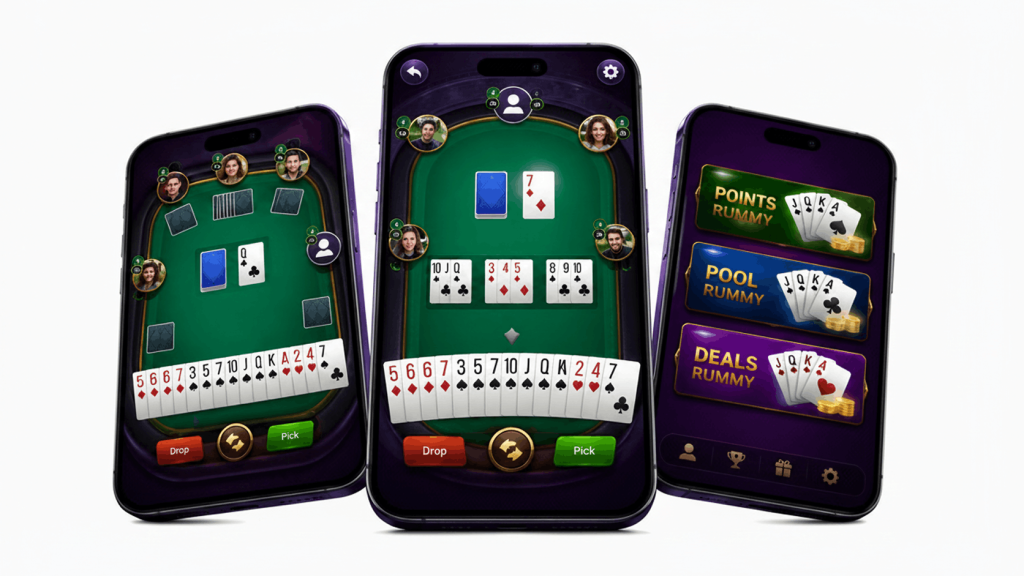
A rummy card game app is a digital platform delivering one or more variants of the rummy card game: Points Rummy, Pool Rummy, Deals Rummy, Gin Rummy, Canasta, and others, over an internet connection.
Players compete against other real players or AI opponents, with outcomes determined by card draw mechanics and player skill in hand management and discard strategy.
The digital rummy format covers a wide spectrum of implementations. At one end: simple single-player apps with AI opponents, basic graphics, and straightforward rules enforcement. At the other: full-stack real-money platforms with multiple game variants, real-time multiplayer, tournament infrastructure, payment processing, KYC/AML compliance, fraud detection, and enterprise-grade backend systems supporting hundreds of thousands of concurrent users.
The cost to develop a rummy game is determined by where on this spectrum your product sits, and by the quality level you’re targeting within each component of the stack.
Our casino game development expertise covers the full stack, from card games and slots to crash games and table titles.
Key Factors That Affect Rummy Game Development Cost
Before looking at specific numbers, understanding the variables that drive cost is more useful than any single figure. The same “rummy app” brief can produce wildly different cost estimates depending on how each of these factors is scoped.
Game Variants and Rule Complexity
Points Rummy, Pool Rummy (51-pool and 101-pool), and Deals Rummy are the three core variants that any serious rummy platform must support. Each has distinct rule sets, scoring systems, and gameplay flows. Supporting all three from launch multiplies development and QA scope versus a single-variant MVP.
Adding further variants (Gin Rummy, Oklahoma Gin, Rummy 500, Indian Marriage) adds further development scope. Each variant requires separate rule engine implementation, separate testing, and separate UI configuration for cards, scoring display, and game flow. A platform supporting eight rummy variants costs proportionally more than one supporting three.
Platform Targets
A web-only rummy app and a cross-platform product covering iOS, Android, and web are categorically different development projects. Native iOS and Android apps require separate codebase development (or a cross-platform framework like React Native or Flutter, which has its own tradeoffs), separate QA cycles, and ongoing maintenance across platform updates.
Web-based deployment using HTML5/JavaScript reaches all devices from a single codebase, reducing initial development cost and ongoing maintenance burden. The tradeoff is performance and native feature access. Push notifications, offline capability, and certain device integrations work better in native apps. Most rummy platforms deploy a web-first product initially and add native apps as a second phase.
Real-Money vs. Social/Practice Play
This is the single factor with the greatest impact on total project cost. A practice-play rummy app requires game logic, multiplayer infrastructure, and user experience design. A real-money rummy platform requires all of that plus: payment gateway integration, KYC/AML verification systems, wallet management, fraud detection, regulatory compliance documentation, licensing support, and often an entirely different infrastructure security posture.
Real-money development is not incrementally more expensive than social play, it is categorically more expensive. The compliance and financial infrastructure required for licensed real-money operation adds 40–80% to the base development cost, plus ongoing licensing fees, compliance staff, and audit costs that social play platforms don’t incur.
Multiplayer Architecture
Rummy is fundamentally a multiplayer game. The quality of the real-time multiplayer engine covers latency, synchronization, handling of disconnections, and fair card dealing under network variance.
A low-latency multiplayer engine capable of handling hundreds of simultaneous tables requires significant backend engineering investment. Handling player disconnections gracefully (resuming games, managing timeout rules fairly), dealing cards from server-side RNG in a way that’s verifiably fair, and maintaining game state consistency across all connected clients are engineering challenges that budget development shops often underestimate.
AI Opponent Quality
Practice modes and fill-players for incomplete tables require AI opponents. Basic AI that plays legal moves without strategic intelligence is relatively inexpensive to implement. AI that plays at a skill level appropriate for different player tiers (providing genuine practice value without being either unbeatable or exploitably bad) requires significantly more investment in game tree analysis and difficulty calibration.
For most rummy platforms, mid-tier AI quality is the right target: good enough to provide a useful practice experience, not so advanced that it discourages new players.
UI/UX Design Quality
The card table interface is what players see every session. Card animation quality, table design, avatar systems, chat and emote features, and the overall visual presentation of game state all contribute to the perceived quality of the product.
Rummy UI design has specific challenges: displaying hand cards clearly on mobile screens, communicating game state (whose turn, what’s in the discard pile, what sequences are forming) without information overload, and making card interactions (pick up, discard, declare) feel fluid on touchscreen interfaces. High-quality rummy UI requires specialized casino and card game design experience, as generic mobile app designers often underestimate the complexity.
Backend Infrastructure and Admin Tools
A production rummy platform requires backend systems that are rarely itemized in development quotes but represent substantial work: operator admin panel (game configuration, player management, financial reporting), customer support tools (game history review, dispute resolution), automated monitoring and alerting, analytics and reporting infrastructure, and bonus/promotion management systems.
These systems are invisible to players but essential to operation. Their absence or inadequacy creates operational problems that become apparent immediately after launch and are expensive to retrofit.
Types of Rummy Games and Their Development Cost
Different rummy game formats carry different development cost profiles. Here are the main types and their approximate cost implications.
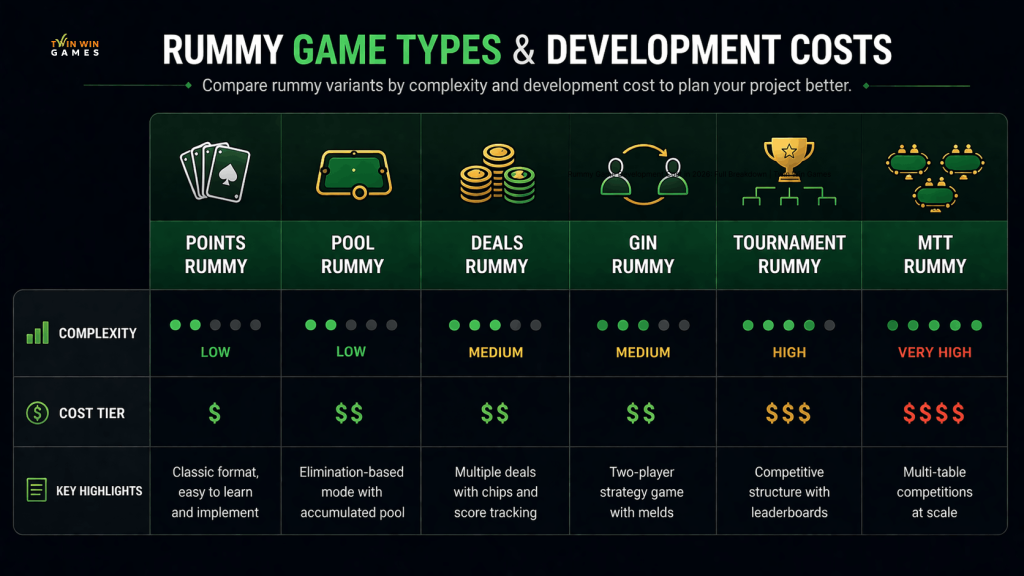
Points Rummy is the simplest and fastest variant. Each game plays to a single round with immediate scoring. As the most popular format in India and a gateway variant for new players globally, Points Rummy is typically the first implemented in any rummy platform. Development cost for a standalone Points Rummy product is at the lower end of the range.
Pool Rummy (51 and 101 Pool) extends gameplay across multiple rounds, with players eliminated when their cumulative score exceeds the pool limit. The extended session format requires more complex game state management, persistent scoring across rounds, and different UI states for ongoing vs. eliminated players.
Deals Rummy fixes the number of deals and distributes chips at the start. Players eliminate opponents by winning all chips over a set number of deals. The chip distribution and tracking mechanics add implementation scope versus Points variants.
Gin Rummy is distinct from Indian rummy variants in rules, hand size, and win conditions. It’s the dominant format in North American markets and required for operators targeting those geographies. Full Gin Rummy implementation alongside Indian variants represents meaningful additional scope.
Tournament Rummy structures competitive play across bracket, knockout, or leaderboard formats with prize pool distribution. Tournament infrastructure (bracket management, blind level escalation, late registration, prize calculation and distribution) is a substantial backend development project separate from the base game implementation.
Multi-Table Tournament (MTT) Rummy represents the most complex implementation: hundreds of simultaneous tables collapsing to a final table, with real-time leaderboard updates, dynamic table balancing, and prize pool management at scale. MTT infrastructure is a significant standalone engineering project.
Not sure which tier fits your project? Tell us your scope and we’ll give you a realistic estimate within 24 hours. Get a Free Estimate →
Rummy Game Development Cost Breakdown
The following ranges reflect development by a professional studio with genuine full-stack casino game development experience. Offshore shops offering significantly lower numbers are typically underscoping the project, using junior-heavy teams, or omitting backend infrastructure and compliance components from their estimates.
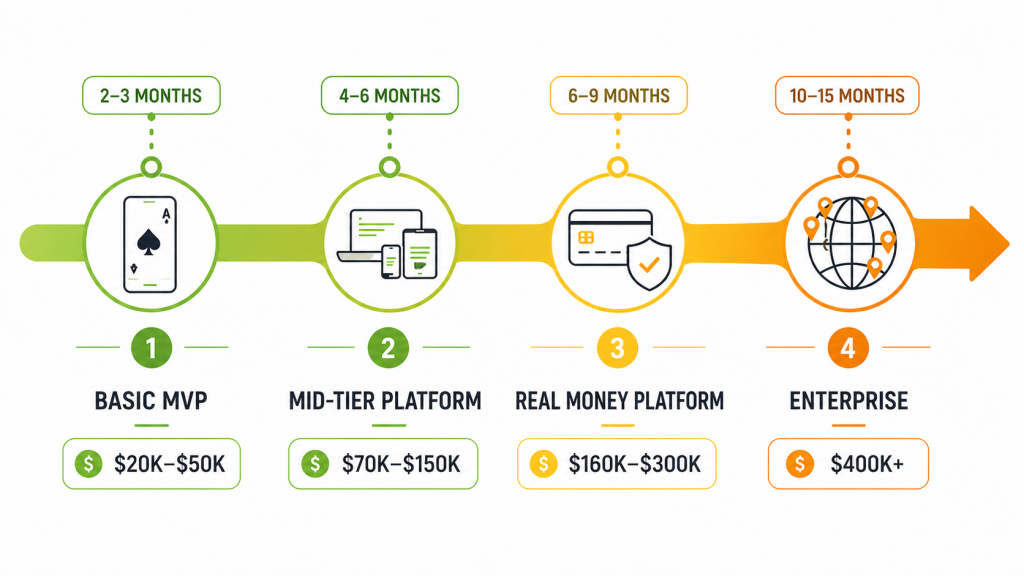
Basic Rummy App (MVP / Single Variant)
Scope: Single rummy variant (Points or Gin), practice play only, 2–4 player tables, basic AI opponent, web or single platform delivery, standard UI design.
Development cost: $20,000–$50,000
Timeline: 2–4 months
Suitable for: Market validation, practice-only platforms, social gaming apps, internal product prototypes.
Limitations: No real-money capability, limited scalability, single variant restricts addressable market.
Mid-Tier Rummy Platform (Multi-Variant, Social Play)
Scope: 3 rummy variants (Points, Pool, Deals), social play with virtual chips, real-time multiplayer for 2–6 players, mid-quality AI opponents, cross-platform delivery (web + mobile), lobby system, player profiles, chat, basic leaderboards.
Development cost: $60,000–$150,000
Timeline: 4–6 months
Suitable for: Social gaming operators, practice platforms with premium upgrade paths, B2C apps in markets where real-money card gaming isn’t yet licensed.
Real-Money Rummy Platform (Single Market)
Scope: 3+ rummy variants, real-money play with full payment stack (deposit, withdrawal, wallet management), KYC/AML verification integration, fraud detection, single jurisdiction compliance, tournament infrastructure (Sit & Go and scheduled tournaments), admin panel, bonus engine, customer support tools.
Development cost: $160,000–$300,000
Timeline: 6–10 months (including compliance and certification)
Suitable for: Licensed operators entering the real-money online rummy market in a single jurisdiction (India, UK, Ontario, etc.).
Enterprise Rummy Platform (Multi-Market, Full Feature Set)
Scope: Full variant library (5+ rummy types), real-money play with multi-currency and crypto payment support, multi-jurisdiction compliance (3+ markets), MTT tournament infrastructure, advanced AI at multiple difficulty tiers, live dealer rummy integration, affiliate management, CRM and player retention tools, analytics dashboard, white-label capability for sub-operators.
Development cost: $400,000–$900,000+
Timeline: 10–18 months
Suitable for: Established operators scaling into multiple regulated markets, platform providers building licensable rummy infrastructure, large-scale B2C product launches.
Rummy Game Development Team Structure
Understanding who builds a rummy platform helps you evaluate whether a vendor’s team is appropriately sized for your project scope.
A production-quality rummy platform requires the following roles, either in-house or in a structured partner studio:
Game Designer / Product Owner defines the rule implementations, variant configurations, UI flows, and feature prioritization. Rummy has significant rules variations between regional formats, and an experienced card game designer prevents expensive re-implementations of rule logic.
Backend Engineers (2–4) build the game server, real-time multiplayer engine, wallet and payment systems, and admin infrastructure. Backend quality is the primary determinant of platform stability at scale.
Frontend/Client Engineers (2–3) build the player-facing game client across target platforms. Card game UI development requires fluid animations, responsive touch interactions, and clear information hierarchy, which goes beyond standard web development.
Game Math / RNG Specialist implements and certifies the random number generation system for card dealing. For real-money platforms, RNG certification by an approved testing lab is mandatory.
UI/UX Designer (1–2) creates the visual language of the platform, covering card designs, table environments, UI components, and animation specifications.
QA Engineers (2–3) test functional correctness (rule enforcement across all variants), multiplayer edge cases (disconnection handling, timeout scenarios), financial transaction accuracy, and cross-device performance.
DevOps / Infrastructure Engineer (1) configures and manages the cloud infrastructure, deployment pipelines, monitoring, and scaling systems.
Compliance / Legal Support for real-money platforms, either in-house or as an engaged specialist, navigates licensing requirements, KYC/AML program design, and technical standards documentation.
A team of this composition, engaged full-time, costs between $40,000 and $120,000 per month depending on seniority levels and geography. This provides the sanity check for quoted project costs: a $40,000 quote for a 3-month project implies a team being paid $13,000 per month, which does not describe a senior-capable team in any market.
Hidden Costs in Rummy Game Development
Development cost is the largest single line item but not the only one. Budgeting that omits these categories produces financial surprises after contracts are signed.
Licensing fees for real-money operation vary by jurisdiction: India’s state-by-state skill game licensing landscape, UK Gambling Commission fees, Malta Gaming Authority application and annual fees, and Ontario AGCO licensing all carry different cost structures. Budget $20,000–$100,000 in first-year licensing costs depending on your jurisdiction mix.
Testing lab certification for RNG certification and technical standards compliance runs $15,000–$40,000 per market, with timeline implications (6–10 weeks per submission) that must be scoped into your launch plan.
Third-party service integration costs, including payment gateway setup fees, KYC/AML provider subscription costs, fraud detection service fees, push notification services, and analytics platforms, add $1,000–$5,000 per month in ongoing operational costs that aren’t always itemized in development quotes.
Content and game art licensing, if you’re using licensed card designs, avatar packs, or branded assets, adds per-unit or revenue-share costs that continue post-launch.
Ongoing maintenance and support, covering bug fixes, platform updates (iOS and Android OS updates require ongoing app maintenance), security patches, and feature additions, typically runs 15–25% of the original development cost annually.
Marketing and player acquisition is often the largest single cost in bringing a rummy platform to commercial scale. In the competitive Indian online rummy market, player acquisition costs range from $10–$50 per registered user. Build this into your financial model before committing to development investment.
Need something beyond a standard rummy format? Our custom game development service covers proprietary mechanics, unique variants, and fully branded experiences.
How to Choose a Rummy Game Development Company
The quality of your development partner determines your outcome more than any other single decision. These are the criteria that separate reliable studios from those who will deliver a product that disappoints at launch.
Full-stack casino game experience is non-negotiable. Rummy platforms are not standard mobile apps. They require expertise in real-time multiplayer engineering, casino mathematics, compliance infrastructure, and financial transaction systems. Studios without a demonstrated casino game portfolio are unlikely to have encountered the specific failure modes that experience teaches.
Verifiable delivery track record means documented case studies with real timelines, team sizes, and measurable outcomes, not marketing language about “100+ projects.” Ask for references you can contact directly. Ask specifically about on-time delivery rates, post-launch issue rates, and how the studio handled problems when they occurred.
In-house vs. outsourced team structure matters significantly. Studios that subcontract core development work (particularly backend engineering or compliance) introduce coordination overhead, accountability gaps, and quality variance that in-house teams don’t have. Ask directly: who on your team will build the multiplayer backend? Are they employees or contractors?
Math and compliance expertise for real-money development covers RNG certification, responsible gaming tool implementation, and jurisdiction-specific technical standards. These are not areas where general software developers possess sufficient knowledge. Ask how many regulated real-money products the studio has shipped and which testing labs have certified their work.
Post-launch support model defines your ongoing relationship. Understand exactly what’s included in the development contract versus what triggers additional cost after launch. A studio that disappears after delivery, or charges premium rates for every post-launch fix, is a poor long-term partner for a live platform that requires continuous maintenance.
Why Twin Win Games Is the Right Partner for Card Game Development
Twin Win Games builds full-cycle casino and card game products for operators, studios, and platform providers worldwide. Our 110+ in-house specialists cover every discipline required for a production-quality rummy platform: game design and math modeling, frontend and backend engineering, art and animation production, QA, and certification support across UKGC, MGA, and other regulated markets.
We’ve shipped 1,000+ casino game projects with a 95% on-time delivery rate and zero post-launch critical issues over three years. Our average delivery timeline is 3–6 months, which is 20–30% faster than the industry standard, enabled by proprietary engine infrastructure, reusable component libraries, and AI-assisted art production pipelines.
Our clients include Aristocrat, Relax Gaming, and William Hill. Our partnerships average 7+ years in duration, which reflects what happens when a development partner consistently delivers what they promise.
If you’re scoping a rummy game development project, from MVP validation to enterprise platform, talk to our team. We’ll give you a realistic cost estimate, a credible timeline, and honest guidance on where to invest and where to simplify.
Key takeaway
Rummy game development cost in 2026 ranges from $30,000 for a single-variant MVP to $900,000+ for an enterprise multi-market real-money platform. The right budget depends on your target market, product scope, real-money vs. social play model, and platform requirements.
The most expensive mistake in rummy development isn’t overspending. It’s underspending on a project scope that requires more capability than the chosen vendor can deliver. A $60,000 real-money rummy platform that fails compliance certification, can’t handle concurrent user load, or ships with exploitable game logic will cost far more to fix than building it correctly from the start.
Invest in understanding your scope clearly, evaluating vendors on verifiable track records rather than quoted prices, and budgeting for the full cost of launch, including licensing, certification, and first-year marketing, not just development.
FAQ
How much does it cost to develop a rummy game app in 2026?
A basic single-variant rummy app for practice play costs $20,000–$60,000. A mid-tier multi-variant social platform runs $70,000–$150,000. A real-money rummy platform for a single regulated market costs $160,000–$300,000 including compliance infrastructure. Enterprise platforms with multi-market licensing and full feature sets range from $400,000 to $900,000+. These ranges assume a professional full-service studio. Offshore quotes below these figures typically underscope the project or use junior-heavy teams that produce higher long-term costs through post-launch rework.
How long does it take to develop a rummy card game?
A basic rummy MVP takes 2–4 months. A production-quality multi-variant social platform takes 4–6 months. A real-money platform for a single regulated market takes 6–10 months, with certification timeline as a significant variable. Enterprise multi-market platforms require 10–18 months. Timeline is directly correlated with scope. Studios quoting 2-month timelines for enterprise real-money platforms are either underscoping or planning to cut corners on testing and compliance.
What technology stack is used for rummy game development?
Most production rummy platforms use a combination of: Node.js or Go for the real-time game server (high-concurrency performance), WebSockets for real-time client-server communication, React or Vue.js for the web client, React Native or Flutter for cross-platform mobile, PostgreSQL or MongoDB for game state and transaction storage, Redis for real-time session state, and cloud infrastructure (AWS, GCP, or Azure) with auto-scaling configuration. The specific technology choices should be driven by your performance requirements and your development team’s expertise. A stack your team knows well outperforms a theoretically superior stack they’re learning on your project.
Do I need a license to operate a real-money rummy platform?
Yes, in all major regulated markets. India operates under a patchwork of state-level skill game legislation. Some states permit real-money skill games (rummy is generally classified as a skill game in Indian courts), while others prohibit them entirely. UK operators require a UKGC license. Malta-based operators need MGA licensing. Ontario requires AGCO registration. Each jurisdiction has its own application process, technical requirements, and ongoing compliance obligations. Legal advice specific to your target jurisdiction is required before committing to development investment. Licensing requirements should shape your platform design from day one.
What features are essential in a rummy game app?
Core features every production rummy platform requires: multiple game variants (Points, Pool, and Deals Rummy minimum), real-time multiplayer with robust disconnection handling, a verified RNG for card dealing, practice mode with AI opponents, tournament infrastructure (Sit & Go at minimum), player wallet and transaction history, in-game chat and emotes, player profile and statistics, responsible gaming tools (session limits, deposit limits, self-exclusion for real-money), and an operator admin panel for game configuration and player management. Secondary features that drive retention and differentiation include leaderboards and achievements, referral programs, VIP tiers, live customer support integration, and multi-language localization for target markets.
Ready to Build Your Rummy Game? Twin Win Games delivers full-cycle card game development.