
At Twin Win Games, we don’t treat AI as a replacement for artists.
We use it as a production tool, one that helps experienced teams work faster without sacrificing creative control or quality.
AI doesn’t turn game art into “instant delivery.”
What it does is remove friction from specific stages of production.
The real outcome is not “a full game in days,” but casino-quality assets and art phases delivered faster, more predictably, and with clearer creative ownership.
As our Art Director, Andriy Pryslopskiy, puts it internally:
“AI isn’t dark magic. It doesn’t replace thinking or taste. It accelerates certain steps, but artists still define the result.”
Our Client-First Approach to AI
Core principle:
We integrate AI into production only after explicit client approval.
Some partners prefer fully traditional workflows, and we respect that.
For teams open to AI-assisted production, we clearly explain where AI is used, where it isn’t, and why.
We don’t sell a single “AI pipeline.”
Instead, we offer two production approaches, chosen based on project goals, asset type, and feedback expectations.
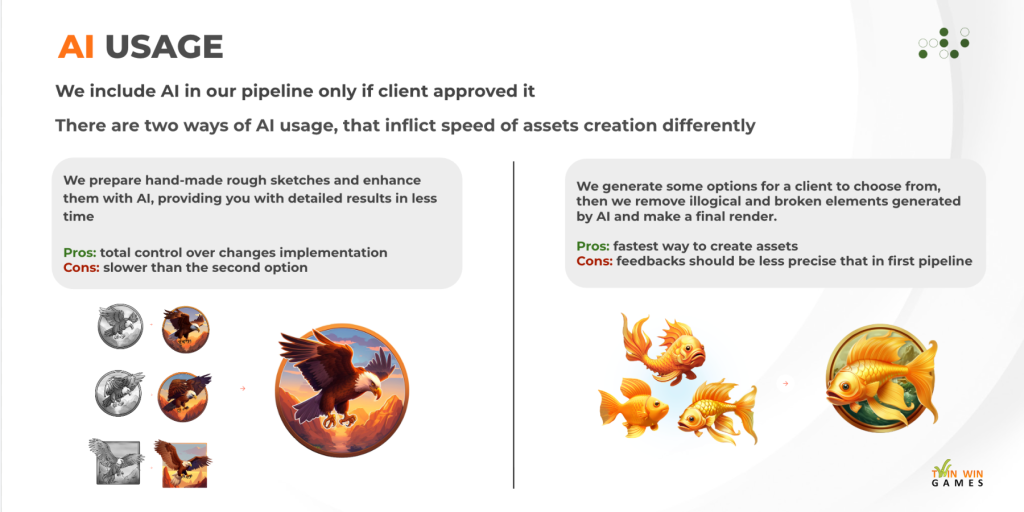
Pipeline Option 1: AI-Enhanced Manual Workflow
Best for:
Projects requiring high creative precision, emotional expression, and detailed feedback loops.
How it works
- Hand-crafted foundation
Artists create rough sketches and early concepts manually. - AI-assisted exploration (early stage)
AI is used at the rough / concept stage to explore variations in composition, lighting, or mood — before details are locked. - Artist-led refinement
Designers manually refine selected concepts, ensuring stylistic consistency and brand accuracy. - Client review & iteration
Feedback is implemented precisely, down to individual elements.
Variations make sense at the sketch stage.Once we move into detailed art, the focus shifts from exploration to refinement.
Timeline (realistic range)
Compared to fully manual workflows, this approach typically delivers a moderate acceleration.
- Traditional process: ~4–5 weeks (depending on feedback cycles)
- AI-enhanced manual: ~3–4 weeks
- Average efficiency gain: ~20–25%
Advantages
- Full creative control at every stage
- Precise feedback implementation
- Ideal for complex characters and branded content
- Artists retain ownership of creative decisions
Trade-offs
- Slower than AI-first approaches
- Requires more upfront artist involvement
- Speed depends on client feedback cadence
Pipeline Option 2: AI-First Generation Workflow
Best for:
Theme exploration, rapid prototyping, and supporting visual assets.
How it works
- AI-driven concept generation
AI produces a broad set of internal concept directions. - Human curation
Artists select the strongest options that fit the project’s visual goals. - AI cleanup + manual correction
Illogical elements are removed, details fixed, and consistency enforced. - Final render & optimization
Assets are polished and prepared for production pipelines.
AI can generate many options internally,but clients never get noise — only 2–3 strong, curated directions per asset.
Timeline (realistic range)
This workflow optimizes early ideation and supporting assets, not full game art.
- Traditional approach: ~3–4 weeks
- AI-first workflow: ~2–3 weeks
- Primary benefit: faster exploration, not instant delivery
Advantages
- Faster concept validation
- Efficient theme exploration
- Useful for A/B testing and early production phases
- Reduces bottlenecks for background and decorative assets
Trade-offs
- Feedback is directional, not pixel-level
- Not suitable for emotionally complex characters
- Requires trust in artist curation
Transparency: What AI Can’t Do (Yet)
We’re clear about AI limitations:
- ❌ Emotional nuance and character personality
- ❌ Licensed IP compliance without human oversight
- ❌ Final animation timing and “feel”
- ❌ Game-engine integration
- ❌ Cultural and contextual judgment
If you are planning to scale your asset output or launch a new slot theme, explore how professional slot game art production services can help your team move from early concepts to fully prepared game-ready assets without delays.
Choosing Your AI Pipeline
Not sure which approach fits your project? Here’s our decision framework:
| Project Characteristic | Recommended Pipeline |
| Complex main characters with emotions | Pipeline 1 (AI-Enhanced Manual) |
| Environmental/background elements | Pipeline 2 (AI-First Generation) |
| Licensed IP with strict guidelines | Pipeline 1 (AI-Enhanced Manual) |
| Rapid prototyping / theme testing | Pipeline 2 (AI-First Generation) |
| Detailed iterative feedback expected | Pipeline 1 (AI-Enhanced Manual) |
| Tight deadline, fast market entry | Pipeline 2 (AI-First Generation) |
| Symbol sets, UI elements, icons | Pipeline 2 (AI-First Generation) |
| Premium brand requiring nuance | Pipeline 1 (AI-Enhanced Manual) |
Most effective: Hybrid approach using both pipelines strategically
- Pipeline 1 for hero assets (characters, key visuals)
- Pipeline 2 for supporting elements (backgrounds, symbols, effects)
Start Your AI-Enhanced Slot Development
Curious how AI can accelerate your casino game art production?
Free 30-minute consultation:
- Review your current art workflow
- Identify AI opportunities specific to your projects
- See examples from our AI-enhanced portfolio
- Get timeline and cost estimates for your next slot game
Schedule AI workflow consultation →
Or explore our AI-enhanced work: