
| QUICK ANSWER Crash casino game development requires four core components: a provably fair RNG system, a real-time multiplayer backend, a responsive HTML5 frontend, and operator platform integration. Studios that build all four under one roof deliver faster and with fewer integration failures. Twin Win Games covers the complete crash game development scope. |
Crash casino games are the fastest-growing format in online gambling in 2026. The mechanic is simple: a multiplier rises from 1x, players cash out before it crashes, and the tension between greed and caution drives repeat sessions. That simplicity hides serious technical complexity. A crash game that fails under concurrent load, uses an unverifiable RNG, or lags on mobile loses players permanently on the first session.
This guide covers the core features, development steps, common failure points, and best practices for building a crash casino game that performs in production.
Crash Casino Games Explained
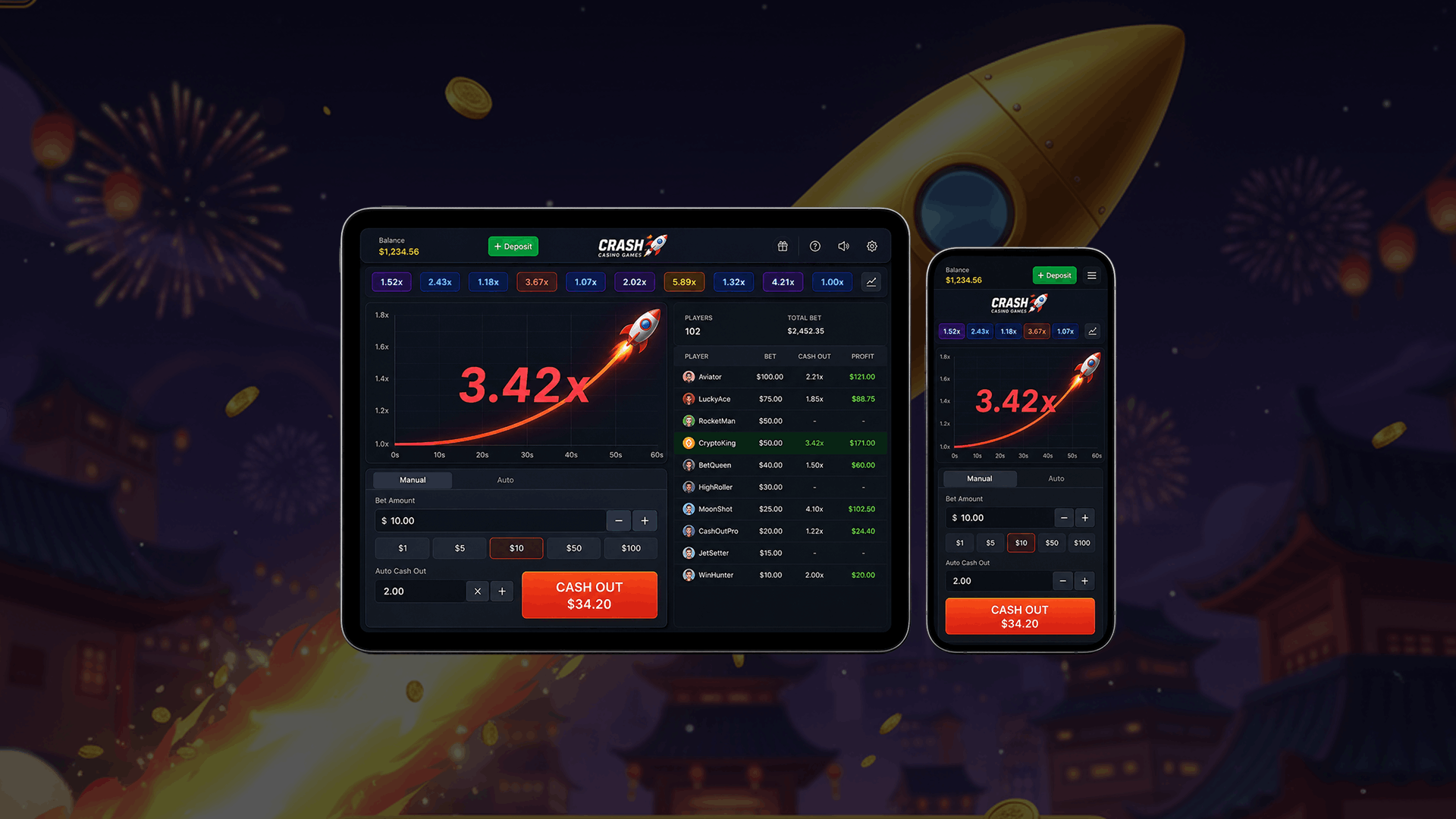
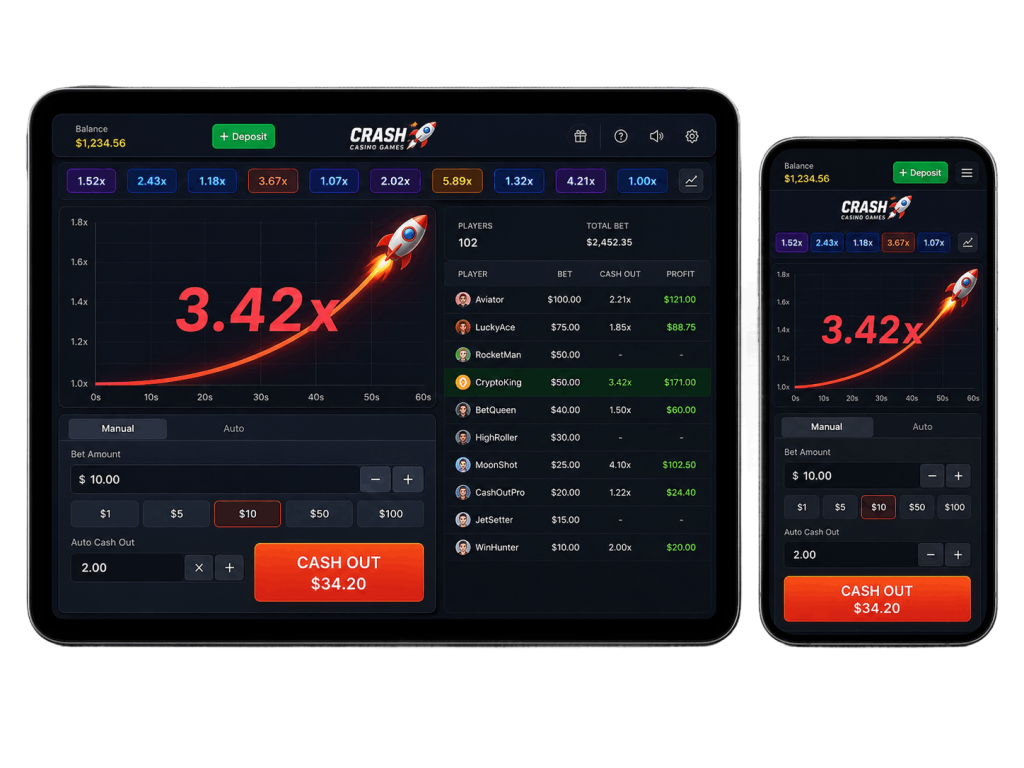
A crash casino game is a real-time multiplayer gambling format where a shared multiplier grows from 1x and can crash at any randomly determined point. Every active player places a bet before the round starts, watches the multiplier rise, and chooses when to cash out. Players who cash out before the crash collect their bet multiplied by the cashout coefficient. Players who fail to cash out in time lose their stake.
The format originates from provably fair crypto gambling platforms and entered mainstream online casino distribution around 2019. By 2025, crash games were standard inventory across all major aggregation platforms and a primary acquisition format for operator marketing campaigns targeting younger demographics.
Top Crash Casino Game Variations
The crash format has expanded into several distinct variants that operators use to differentiate their game libraries.
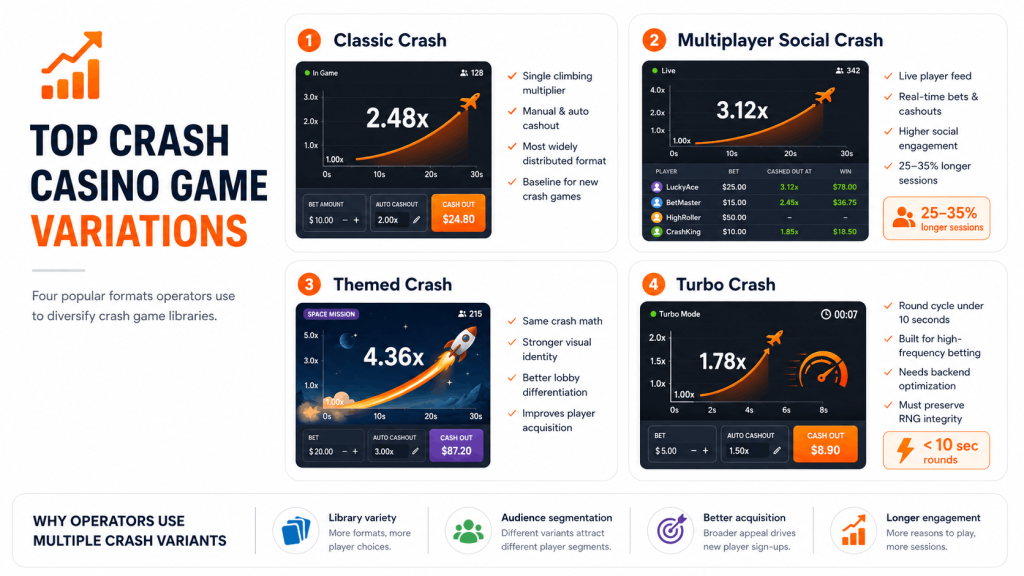
Classic crash uses a single climbing multiplier with manual and auto-cashout options. This is the most widely distributed variant and the baseline for all new crash game development.
Multiplayer social crash adds a live player feed showing other players’ bets, cashout points, and win amounts in real time. The social layer increases session length by 25 to 35% compared to solo crash formats, according to Twin Win Games production data.
Themed crash applies a narrative layer to the mechanic: a rocket launching, a plane taking off, a character climbing. Theme does not change the math but significantly improves player acquisition through visual differentiation in operator lobbies.
Turbo crash accelerates the round cycle to under ten seconds, targeting high-frequency betting behavior. This variant requires additional backend optimization to maintain RNG integrity at higher round volume.
The Evolution of Crash Casino Games
Crash games emerged from the Bitcoin gambling community around 2014, where provably fair verification was a competitive requirement because players had no regulatory authority to appeal to. The hash-chained seed architecture developed in that context became the technical standard the entire format now uses.
Mainstream online casino adoption accelerated after 2019 when aggregation platforms began accepting crash game submissions from independent studios. By 2023, crash games were generating more first-time deposits for operators than any other game format in several European markets. The introduction of live dealer hybrid formats in 2024 further expanded the addressable audience.
How Crash Casino Games Work
Every crash game round follows the same technical sequence. The server generates a crash point before the round begins using a cryptographic RNG. The result is hashed and committed to players before betting opens. The multiplier then grows according to a defined curve until it reaches the predetermined crash point. After the round, the server seed is revealed and players can independently verify that the crash point was not manipulated.
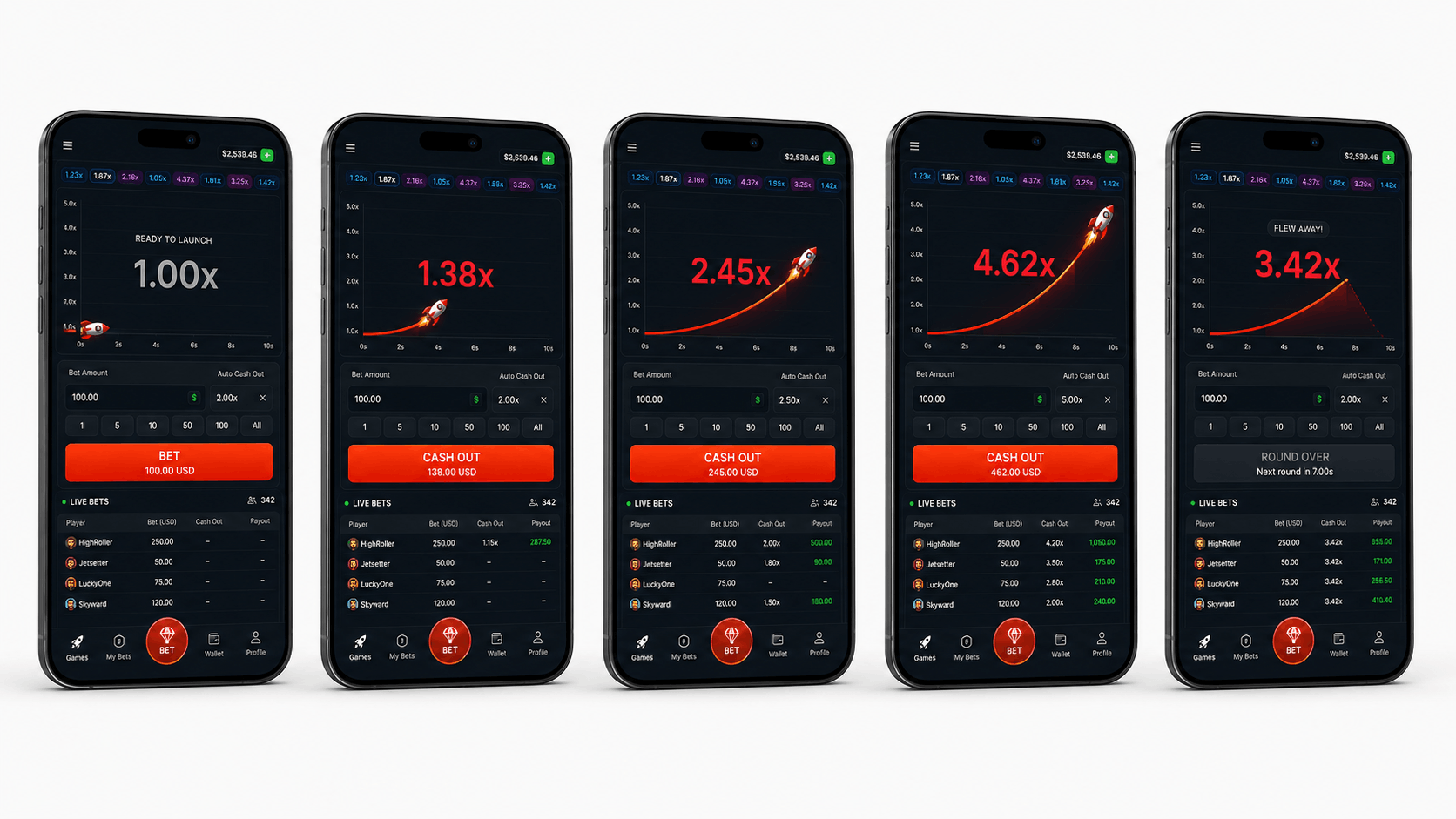
This sequence is the foundation of player trust in the format. Any deviation from it, including server-side crash point adjustment after betting opens, is both a technical failure and a regulatory violation in licensed markets.
Why Crash Casino Games Are Profitable for Operators
Crash games deliver three commercial advantages that traditional slot formats do not.
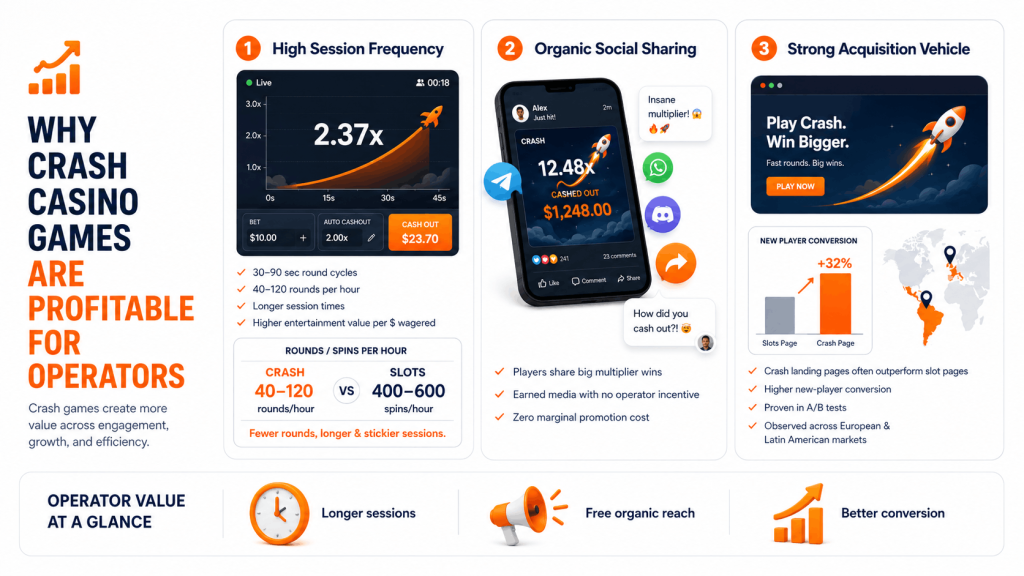
First, session frequency is high. Round cycles of 30 to 90 seconds mean players complete 40 to 120 rounds per hour, compared to 400 to 600 spins per hour on slots. Lower round volume at similar bet sizes produces longer session times and higher perceived entertainment value per dollar wagered.
Second, the social multiplayer format generates organic sharing. Players screenshot large multiplier wins and share them on social platforms without operator incentive. This produces earned media at zero marginal cost.
Third, crash games are effective acquisition vehicles. New player conversion rates on crash game landing pages consistently outperform slot landing pages in A/B tests across European and Latin American markets, based on operator data from the Twin Win Games client portfolio.
How to Build Your Own Crash Casino Game
Building a production-ready crash casino game requires sequential execution across six development areas. Skipping or compressing any phase produces technical debt that surfaces as failures after launch.
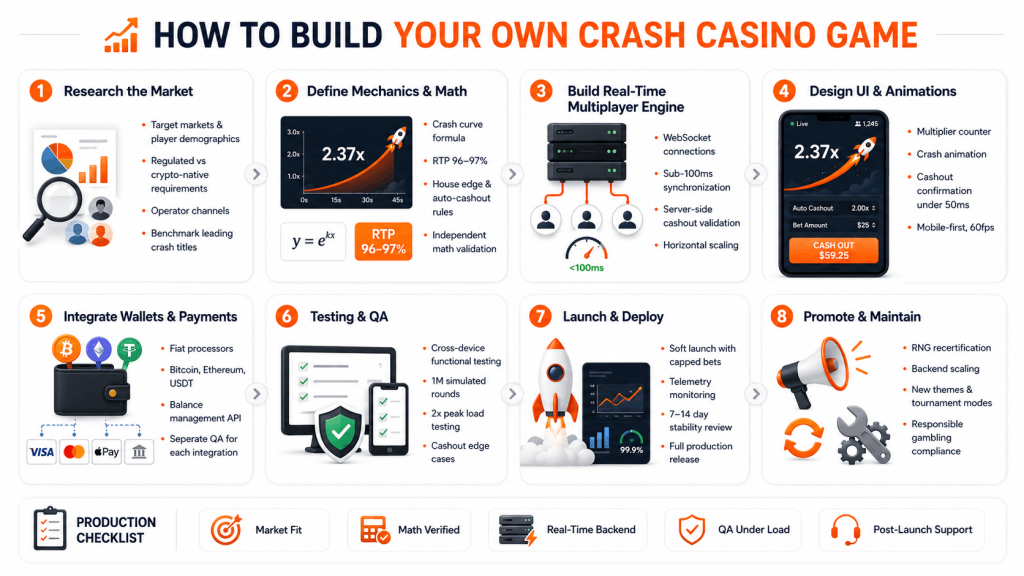
Step 1: Research the Crash Game Market
Identify the target markets, player demographics, and operator distribution channels before writing any code. The technical requirements for a UK-licensed crash game differ significantly from a crypto-native crash game targeting unregulated markets. Math model parameters, RTP requirements, and responsible gambling features all depend on the target regulatory environment.
The two dominant titles defining player expectations in 2026 are Aviator by Spribe and JetX by SmartSoft Gaming. Any new crash game entering the market is implicitly benchmarked against their UX, RTP, and round speed. Understanding what makes these titles the standard is the starting point for building something that competes with them.
Step 2: Define Game Mechanics and Algorithms
Specify the crash curve formula, house edge, RTP, and auto-cashout behavior before development begins. The crash point distribution must be modeled statistically to confirm that the long-run RTP matches the stated value across all bet sizes and cashout strategies. Twin Win Games recommends independent math validation by a certified testing laboratory before any code is written.
The market standard for crash game RTP in 2026 sits between 96% and 97%, with titles like Aviator (97%) and JetX (97%) setting player expectations. Operators targeting regulated markets should stay within this range to remain competitive. Deviating significantly below 96% produces player churn within the first week of launch.
Step 3: Develop a Real-Time Multiplayer Engine
The multiplayer backend is the highest-risk technical component. It must handle concurrent WebSocket connections, synchronize game state across all connected players with sub-100ms latency, validate cashout requests server-side in real time, and scale horizontally under peak load. Studios without prior real-time multiplayer infrastructure experience consistently underestimate this component and deliver backends that degrade above 200 concurrent sessions.
Step 4: Design Engaging UI and Animations
The multiplier counter, crash animation, cashout confirmation, and win display are the entire player experience. All of these must respond in under 50ms to player actions. A 200ms delay in cashout confirmation breaks the tension mechanic the format depends on. Design mobile-first at 390px portrait width. Build all animations at 60fps with graceful degradation to 30fps on lower-end devices.
Step 5: Integrate Crypto Wallets and Payment Systems
Crash games originated in crypto gambling and a significant portion of the player base expects crypto payment options alongside fiat. Wallet integration covers fiat payment processors, crypto wallet connectors (Bitcoin, Ethereum, USDT at minimum), and the operator’s internal balance management API. Each integration requires separate QA cycles.
Step 6: Testing and Quality Assurance
QA for a crash game covers functional testing across devices and browsers, RNG statistical validation (minimum one million simulated rounds), concurrent session load testing at 2x expected peak, latency measurement under load, and cashout validation edge cases. Skipping load testing is the single most common cause of post-launch failures in crash game deployments.
Step 7: Launch and Deploy the Game
Production deployment requires a staged rollout: soft launch with real money at capped bet limits, monitoring phase with active backend telemetry review, and full launch after seven to fourteen days of stable performance data.
Step 8: Promote and Maintain the Game
Post-launch, crash games require ongoing maintenance: RNG recertification when the math model is updated, backend scaling as player volume grows, feature updates (new themes, bonus mechanics, tournament modes), and responsible gambling tool compliance as regulations evolve.
Core Features of Successful Crash Casino Games
Every production crash game needs six features at launch. Missing any of them creates either a compliance problem or a player experience failure.
| Feature | Why It Matters |
| Provably fair RNG | Player trust and regulatory compliance |
| Auto-cashout | Accessibility and session control |
| Live player feed | Social engagement, session length |
| Bet history panel | Player transparency, responsible gambling |
| Mobile-first UI | 60%+ of sessions are on mobile |
| Multi-currency support | Operator distribution requirements |
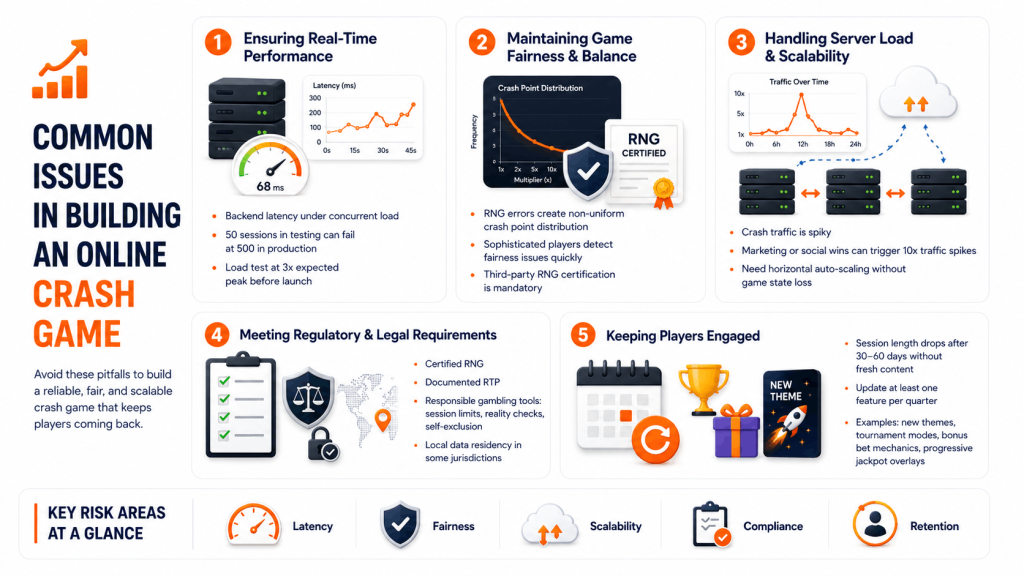
Common Issues in Building an Online Crash Game
Crash game development fails in predictable places. The real-time multiplayer architecture, mathematical precision requirements, and regulatory complexity of the format create failure points that general casino game experience does not prepare studios for.
The five issues below account for the majority of crash game launches that underperform or fail to reach sustained commercial operation.
Ensuring Real-Time Performance
The most common failure point is backend latency under concurrent load. Studios that build backends capable of handling 50 concurrent sessions in testing discover they cannot handle 500 in production. The solution is load testing at 3x expected peak before launch, not after.
Maintaining Game Fairness and Balance
RNG implementation errors that produce non-uniform crash point distributions are discovered by statistically sophisticated players within days of launch. Third-party RNG certification before launch is not optional for any game targeting regulated or reputationally sensitive markets.
Handling Server Load and Scalability
Crash game traffic is spiky. A marketing campaign or large-win social share can produce a 10x traffic spike within minutes. Backend architecture must support horizontal auto-scaling without game state loss during scale events.
Meeting Regulatory and Legal Requirements
Regulated markets require certified RNG, documented RTP, responsible gambling features (session limits, reality checks, self-exclusion), and in some jurisdictions local data residency. Non-compliance discovered post-launch results in delisting by operators and potential license suspension.
Keeping Players Engaged
Session length drops sharply after 30 to 60 days without new content. Successful crash game operators update at minimum one feature per quarter: new themes, tournament modes, bonus bet mechanics, or progressive jackpot overlays.
The Future of Crash Casino Game Development
AI Integration
AI is entering crash games in two forms. Adaptive difficulty systems adjust the game’s visual intensity and pace to individual player behavior patterns. AI-powered fraud detection identifies bot activity and coordinated cashout manipulation in real time.
Crypto and Blockchain Adoption
On-chain provably fair verification, where crash outcomes are recorded to a public blockchain, is moving from niche crypto platforms to mainstream operator offerings. This produces stronger player trust than server-side hash verification alone.
Worldwide Market Growth
Latin America, Southeast Asia, and Africa represent the highest-growth crash game markets in 2026. Localization requirements in these markets include local currency support, local language UI, and in some cases local payment method integration (PIX in Brazil, GCash in the Philippines).
Why Leading Operators Choose Twin Win Games for Crash Casino Games
Twin Win Games delivers crash casino game development as a complete engagement: math modeling, provably fair RNG implementation, real-time multiplayer backend, HTML5 frontend, operator integration, and compliance documentation. The team includes 110 in-house specialists, 70% senior level, with 12+ years of casino game development experience and 1,000+ released titles across regulated markets worldwide.
Operators working with Twin Win Games do not manage separate vendors for math, engineering, art, and compliance. Every component is delivered by one team under one project timeline.
For operators evaluating crash game development or expanding an existing casino game portfolio, the full service overview is at twinwingames.com/casino-game-development/
In-House Build vs. External Development Partner
| Factor | In-House Build | Twin Win Games |
| Timeline | 18 to 24 months | 12 to 20 weeks |
| Upfront cost | High, requires team build | Scoped per project |
| Compliance experience | Requires ramp-up | Existing multi-market |
| Platform integrations | Built from scratch | Pre-existing |
| Risk on first project | High | Low, proven pipeline |
| Math expertise | Requires specialist hire | Included in scope |
FAQ
What platforms can crash casino games be developed for?
Crash casino games built in HTML5 run on all modern browsers across desktop, tablet, and mobile without native app installation. They integrate with online casino platforms via standard aggregator SDKs. Twin Win Games delivers crash games compatible with all major aggregation platforms and direct operator integrations.
How long does it take to develop a crash casino game?
A standard crash game with custom theme, provably fair RNG, multiplayer backend, and single-market compliance takes 12 to 20 weeks with Twin Win Games. A fully custom build with proprietary math model and multi-market certification runs 20 to 36 weeks.
How much does it cost to create a crash casino game?
A white-label crash game with custom branding typically ranges from $25,000 to $60,000. A fully custom crash game with proprietary architecture and compliance documentation for regulated markets typically ranges from $80,000 to $200,000. Twin Win Games provides detailed scope-based estimates at twinwingames.com/casino-game-development/
How do you choose a reliable crash casino game developer?
Evaluate four things: a live crash game in production you can play, a clear explanation of their provably fair RNG architecture, load test results at production scale, and prior compliance certification experience in your target markets. Twin Win Games meets all four criteria with a verifiable track record of 1,000+ shipped casino titles.
Ready to Build Your Crash Game?
Twin Win Games delivers crash casino games from math model through live deployment, with full provably fair implementation, real-time multiplayer backend, and regulated market compliance support.