

Every certified slot comes with a document most players never see. It sets out exactly how the game is designed to pay: every combination, every probability, and the return each part of the game contributes. Testing laboratories use it to verify the game, regulators keep it on file, and operators use it to check that the game performs as designed.
That document is the PAR sheet. This guide explains what it contains, who relies on it, and why a slot cannot be certified without one.
What Is a PAR Sheet?
PAR stands for Probability Accounting Report, and the name is sometimes also read as “paytable and reel strips”. It is the formal record of a slot’s math: how the game is programmed, and how it is expected to perform over a very large number of rounds.
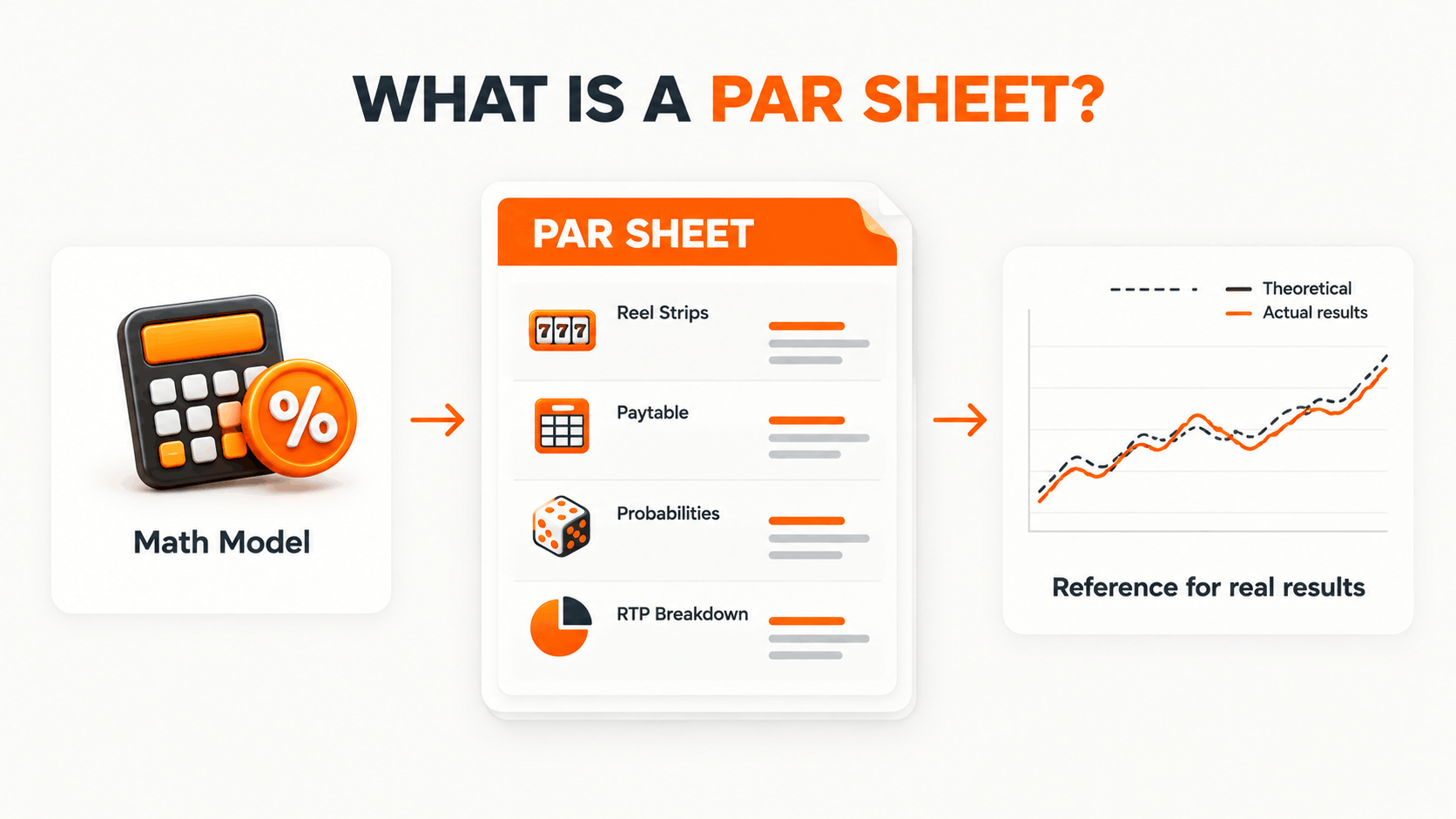
A PAR sheet describes theoretical performance. It states what the game will return over the long run, which is why it is the reference against which real results are later measured.
It is the final output of the slot math model. Once the model is designed and validated, the PAR sheet is how it is documented, shared, and checked.
What a PAR Sheet Contains
The exact format varies between studios, laboratories, and markets, but a PAR sheet for a modern video slot typically covers:
| Section | What it shows |
|---|---|
| Game identification | Game name, version, and the ID of the RTP version it describes |
| Reel strips or symbol weights | The position of every symbol on every reel, or the weights the game uses to select them, and, where the game has several sets of reel strips, how often each set is selected |
| Paytable | Every winning combination and what it pays |
| Combination probabilities | How many ways each combination can occur, and how likely it is |
| RTP breakdown | The total RTP, and how much of it comes from the base game, each feature, and each type of win |
| Hit frequency | How often a round produces any win |
| Feature statistics | How often each feature triggers, and what it awards on average |
| Volatility | A measure of how widely results vary, such as the standard deviation or a volatility index |
| Maximum win | The largest possible win, and how rarely it occurs |
For simple reel games, most of these figures can be calculated exactly. For modern slots with free spins, multipliers, sticky symbols, and retriggers, many feature figures come from simulation. Our math team runs a minimum of one billion simulated rounds for every RTP version of every game, and those results are part of what the documentation reports.
Who Uses a PAR Sheet
The studio. For the mathematician, the PAR sheet is the specification of the game’s math. For developers and QA, it is the reference the finished build has to match.
The testing laboratory. The lab uses it as the statement of what the game claims to do, and tests the game against it.
The regulator. The PAR sheet forms part of the record of what was approved for the market.
The operator. Operators compare a game’s actual results with its theoretical return to confirm it is performing as designed. Casino accounting even has a name for the expected figure: theoretical net win, the revenue a game should earn based on its programmed payback percentage and the amount wagered.
Because a PAR sheet sets out the full design of a game, it is commercially sensitive. Studios share it with laboratories, regulators, and operators, and it is usually kept confidential.
Why Certification Needs a PAR Sheet
A testing laboratory’s job is to confirm that a game behaves exactly as described. The PAR sheet is that description. Without it, the lab has nothing to verify the game against.
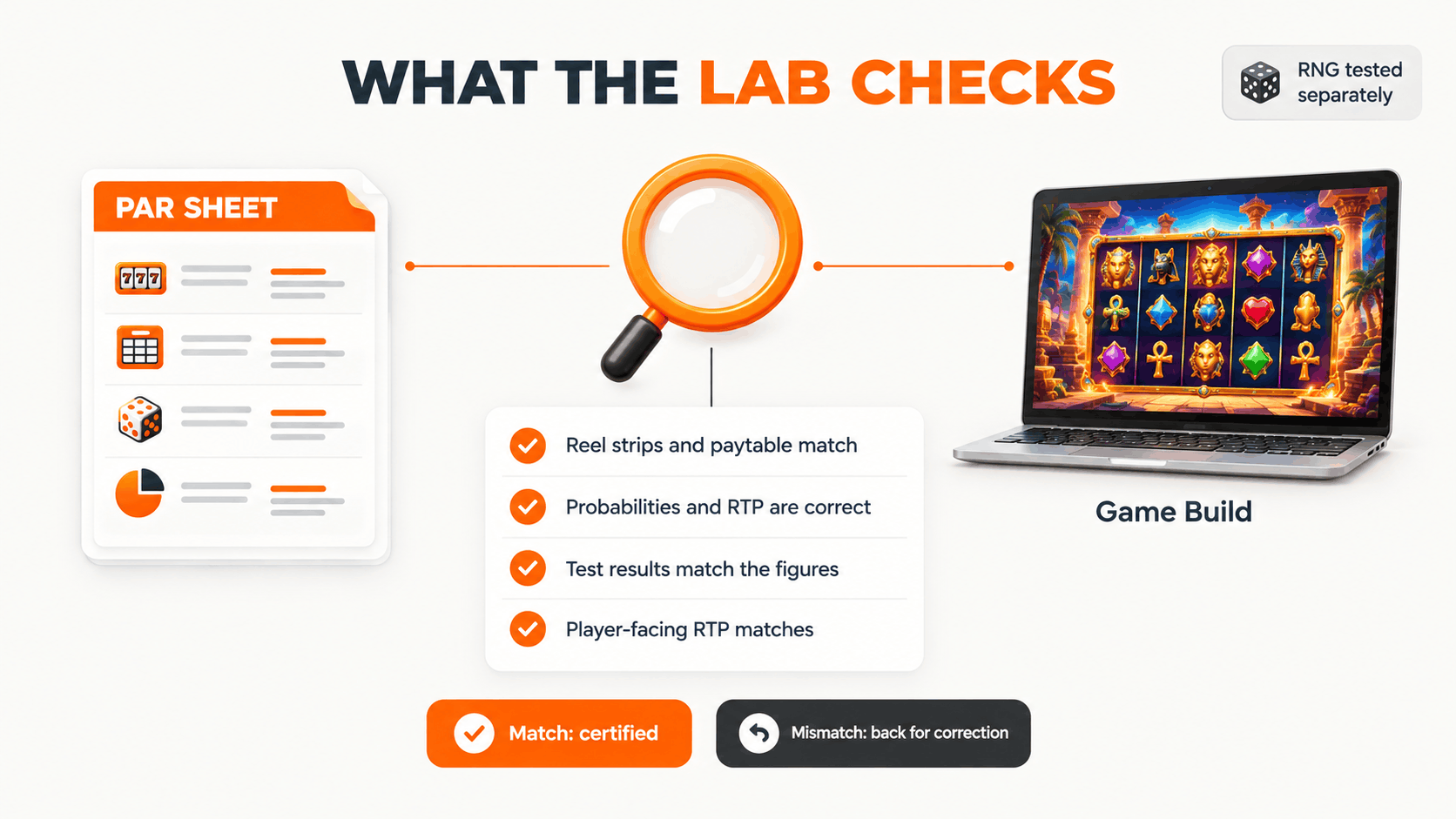
The RNG is tested separately, as its own part of certification. Against the PAR sheet, the lab checks that:
- the reel strips and paytable in the game build match the documentation
- the probabilities and RTP in the documentation are correct
- the game’s behavior in testing matches the documented figures
- the RTP shown to players matches the documented RTP
If any of these disagree, the submission fails and the game goes back for correction. That is why the documentation is as important as the math itself. Our slot certification guide covers the full certification process.
Special Cases
Several RTP versions
When a slot ships in more than one RTP version, the versions most often share the same paytable. What changes is how often the game selects each of its sets of reel strips, and that changes the probabilities the PAR sheet reports. Ruby Robbery, for example, ships at 96.11% and 87.99%, under the IDs RubyRobbery-96 and RubyRobbery-88.
Games where players make decisions
In most slots the RNG decides everything. In a game where players make choices, the RTP depends on those choices, so the documentation has to state the strategy behind each figure. In Yellow Slotmarine, players choose when to collect their winnings, and the game rules name the optimal collect strategy for each of its two RTP versions.
Bonus buy
When a game lets players buy a feature, the bought feature needs its own documentation as well. In Pirate Coins, for example, the game rules state that a bought Bonus Game runs with every feature at the same probabilities as one triggered naturally.
How We Prepare Math Documentation
At Twin Win Games, the math model, the simulation, and the documentation are produced by the same in-house team. Every RTP version is simulated across a minimum of one billion rounds before it is documented, and the documentation is prepared in the form laboratories expect.
Our own titles, built and documented this way, are certified for the UK, Malta, Latvia, and Portugal.
Frequently Asked Questions
What does PAR stand for in slots?
PAR stands for Probability Accounting Report. The term is sometimes also expanded as “paytable and reel strips”. Both describe the same document: the formal record of a slot’s math.
Is a PAR sheet the same as the game rules?
No. The game rules are written for players and explain how to play, what features do, and the game’s RTP. The PAR sheet is a technical document for laboratories, regulators, and operators, with the complete probabilities and math behind the game.
Does every RTP version need its own PAR sheet?
Yes. Each RTP version has its own probabilities, most often because the game selects its sets of reel strips with different frequencies, so each version is documented on its own.
Can players see a slot’s PAR sheet?
Generally not. PAR sheets are commercially sensitive and are shared with laboratories, regulators, and operators. Players see the RTP and the feature descriptions in the game rules.
Does a reskinned slot need a new PAR sheet?
A reskin keeps the original math, so the model behind it does not change. The reskin is still released as a new game, so it is documented and submitted for certification under its own identity. Our comparison of new slots, reskins, and ready-made games explains how the routes differ.
Need Certification-Ready Slot Math?
Our in-house mathematicians design slot math models, validate them across a billion or more simulated rounds per RTP version, and prepare the documentation testing laboratories expect.