
Before a slot has art, sound, or a single line of code, it has a math model. The model decides how often the game pays, how much it pays, and how the return is shared between the base game and the features. Every other part of production is built on top of it.
That is also why the math has to be right first. A model that changes late in production can unbalance the game and send it back through testing.
This guide walks through how a slot math model is built in practice, step by step, with examples from slots we designed and certified ourselves. For the wider theory of probability and house edge, see our guide to casino math.
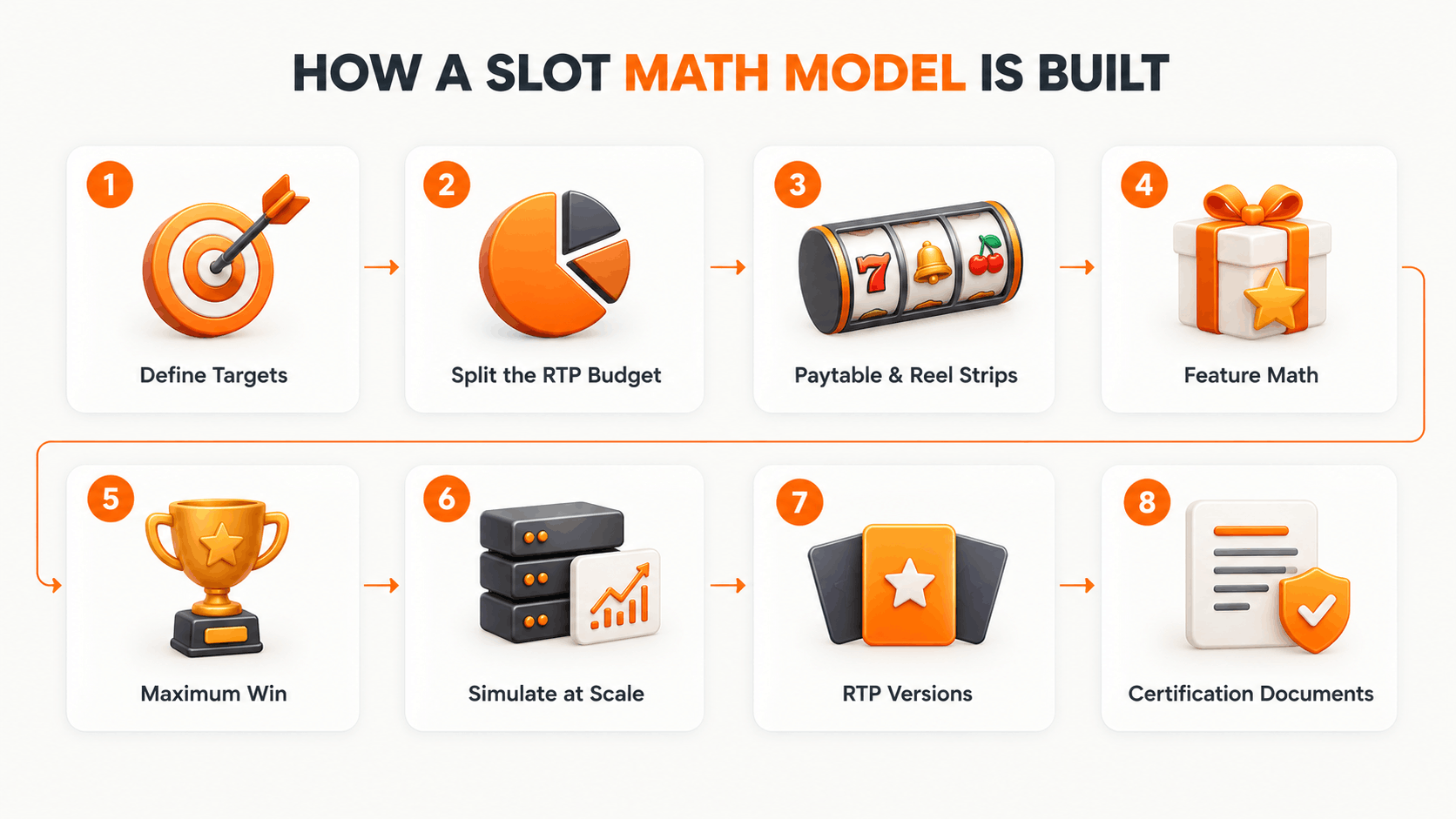
Step 1: Define the Targets
A math model starts from a brief, and the brief starts from the market.
The team sets the core targets before anything is designed:
- RTP: the share of all money wagered that the game returns to players over the long run.
- Volatility: how that return is distributed, through frequent small wins or rarer large ones.
- Hit frequency: how often a spin produces any win at all.
- Maximum win: the largest amount a single round can pay.
These targets depend on who the game is for and where it will run. Many regulated markets set minimum RTP levels or restrict features such as bonus buy, and an operator’s player base shapes how much volatility the game can carry. If the game will ship in more than one RTP version, that is decided here too, because every version needs its own model.
Step 2: Split the RTP Budget
RTP is a budget, and every part of the game takes a share of it. The base game’s line wins take one part. Free spins, bonus games, multipliers, fixed-win features, and jackpots each take another.
How the budget is split shapes how the game feels. A game that keeps most of its return in the base game pays steadily from spin to spin. A game that puts a large share into its features pays less often in the base game and saves its biggest moments for the bonus.
Hook the Fortune shows how many places the budget can go. Its return is spread across base game line wins, the Catch Time feature, which pays fixed wins from 1x up to 2,500x the bet when three or more golden Marlins land, and Free Spins with an All Wins Multiplier of x1 to x3.
Step 3: Design the Paytable and Reel Strips
With the budget set, the team designs the structures that deliver it: the paytable, the symbol values, the reel strips or symbol weights, and the payline or ways structure.
This is where many of a game’s defining decisions are made, including where each symbol is allowed to land. In Bank Wagon Heist, Wilds land only on reels 2, 3, and 4, and the Bonus symbols that trigger the feature land only on reels 1, 3, and 5. Placement rules like these give the mathematician precise control over how often key combinations can appear.
The outcome of every spin is decided by a certified random number generator. The math model defines the probabilities that the RNG draws from. Our guide to how slot machine algorithms work covers the RNG side in more detail.
Step 4: Build the Feature Math
Features are where modern slots become complex, because each one has its own internal math that has to fit the overall budget.
A feature model covers how often the feature triggers, what it can award, and how its parts interact. In Bank Wagon Heist, the Shooting Range bonus awards 9 to 27 Free Spins, Wilds carry a random x2 or x3 multiplier, and during Free Spins every Wild stays on the reels until the round ends. Each of these interacts with the others, and the model has to account for every combination.
Rules about retriggers matter too. In Hook the Fortune, three Bonus symbols during Free Spins retrigger the round with no limit on retriggers, so the model has to account for that chain as well.
Bonus buy adds one more layer. Its price is set from the expected value of the feature it buys. Pirate Coins, for example, sells its Bonus Game for 33x the total bet, with every feature at the same probabilities as when the bonus is triggered naturally.
Step 5: Set the Maximum Win
The maximum win is the largest amount one round can pay, and it matters to operators as much as to players, because it defines the game’s exposure.
It is rarely a single prize. In Pirate Coins, filling the whole grid awards the Grand Jackpot of 500x the bet, the game’s top fixed prize. The maximum win is 2,676x, because coin values and Chest multipliers can combine in the same round. The model has to calculate how these combine, and how rarely the very largest outcomes occur.
Step 6: Simulate at Scale
A math model is calculated first, then proven by simulation. The model runs through a very large number of game rounds to confirm that it behaves the way the calculations say it should.
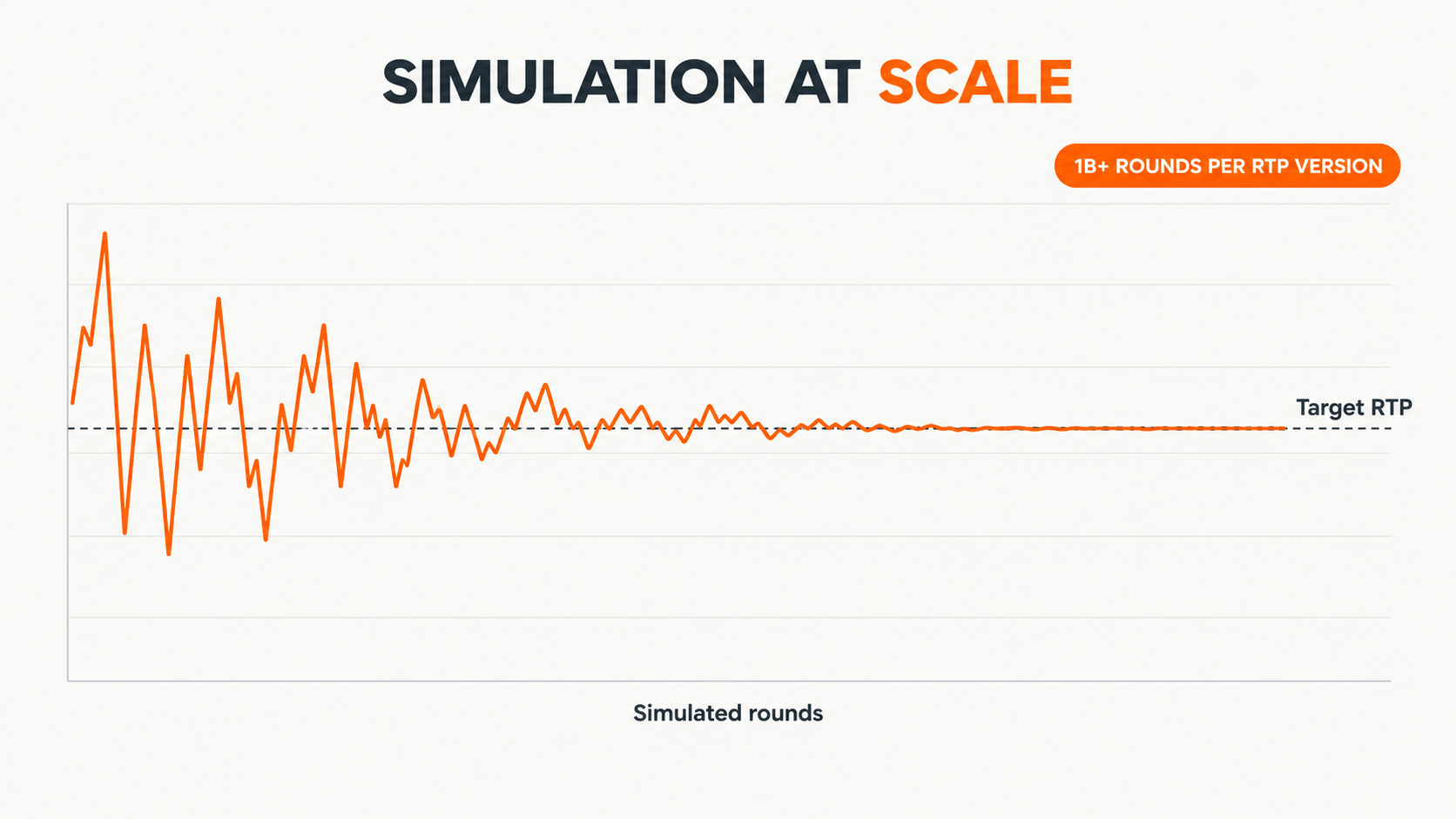
Simulation checks that:
- the RTP converges on its target
- volatility lands in the intended range
- hit frequency and feature trigger rates match the design
- the win distribution behaves as expected, including the rare top outcomes
Our math team runs a minimum of one billion simulated rounds for every RTP version of every game. At that scale, even outcomes that occur very rarely appear often enough to be measured.
Step 7: Build Each RTP Version
Many slots ship in more than one RTP version, so operators can choose the one that suits their market and business. Each version is its own model, with its own paytable, its own simulation, and its own documentation.
Ruby Robbery ships in two versions, at 96.11% and 87.99%, each with its own paytable ID. Yellow Slotmarine also ships in two, at 95.00% to 95.99% and at 87.00% to 88.00%.
Step 8: Document for Certification
The finished model is packaged for an independent testing laboratory: probability tables, simulation results, and the documentation the lab requires to verify the game. A central part of this package is the PAR sheet, which sets out the probabilities and returns behind the game.
The exact requirements depend on the laboratory and the market. Our slot certification guide explains what labs test and how to prepare.
A Special Case: When Players Make Decisions
In most slots, every outcome is decided by the RNG alone. Some games add a decision, and that changes the math.
In Yellow Slotmarine, players fill three Cash Meters and choose when to collect their winnings. Keep spinning, and the wins can grow, but three Bomb symbols reset everything. Because players decide when to collect, the RTP depends on their choices. The game rules state the optimal collect strategy for each RTP version, and the math team tested the RTP across multiple player strategies to deliver both versions.
Same RTP, Different Game
RTP alone does not define how a slot plays. Two of our games show this clearly.
Bank Wagon Heist and Catch the Luck both run at 94.01% RTP, and their features are built the same way: Wilds on reels 2, 3, and 4 with random x2 or x3 multipliers, a pick bonus that awards 9 to 27 Free Spins, and Sticky Wilds during Free Spins.
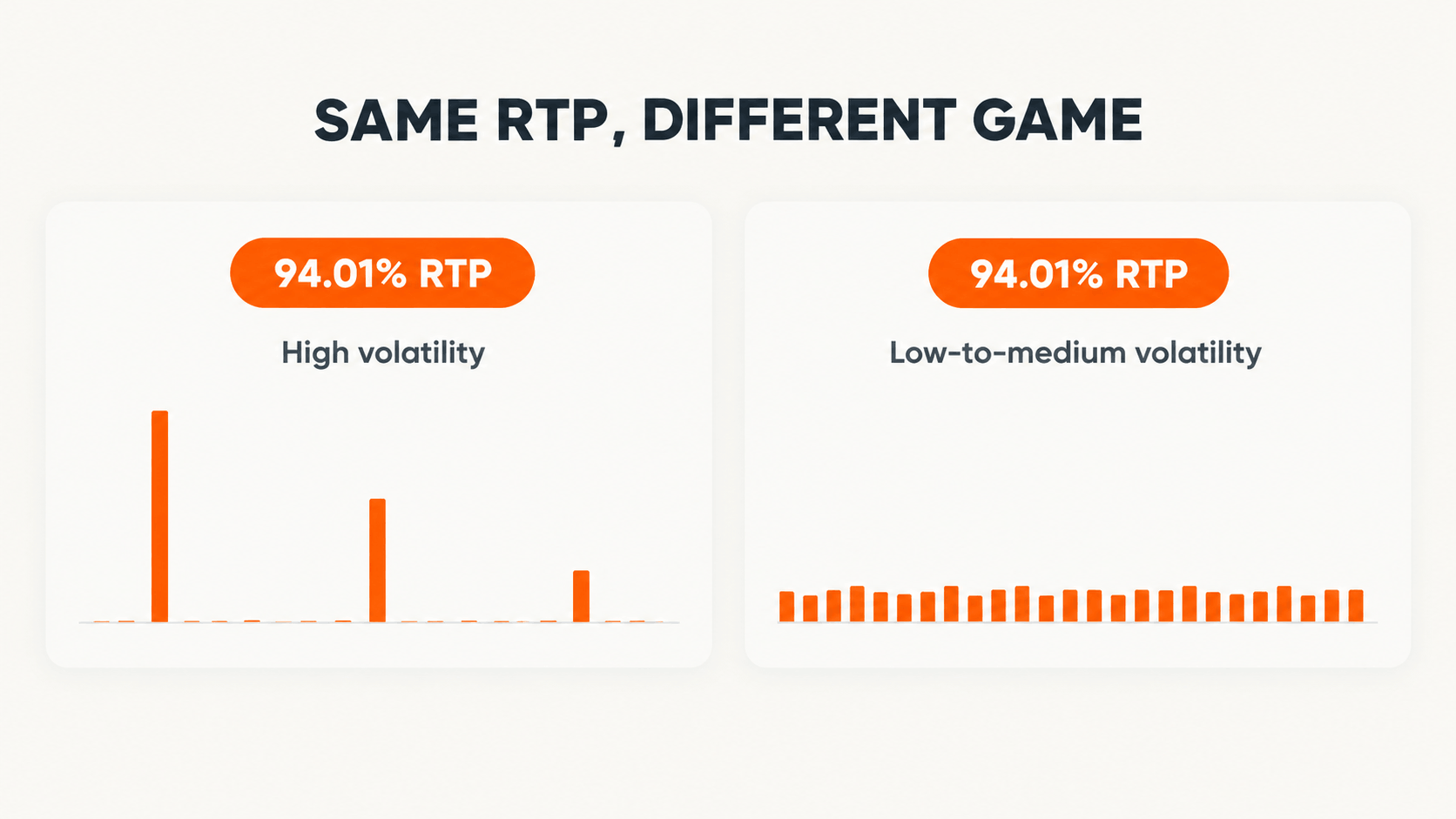
They still play very differently. Bank Wagon Heist is high volatility, with a maximum exposure of 4,821x the bet. Catch the Luck is low-to-medium volatility, with a maximum win of 1,784x. The difference lives in the math underneath: paytables, symbol distributions, and how the return is weighted between frequent wins and rare large ones. Our guide to what volatility means in slots explains the distinction in depth.
For an operator, that difference is a commercial choice. A high-volatility game suits players who want the chance of a large win. A lower-volatility game suits players who prefer longer sessions with steadier returns.
Frequently Asked Questions
What is a slot math model?
A slot math model is the set of calculations that defines how a slot pays: its RTP, volatility, hit frequency, paytable, reel strips or symbol weights, feature probabilities, and maximum win. The game’s RNG draws outcomes from the probabilities the model defines.
Who builds a slot’s math model?
A game mathematician builds it, working with the game designers before art and development begin. The mathematician designs the model, validates it through simulation, and prepares the documentation used in certification.
How many simulations does a slot math model need?
Enough for the results to be statistically reliable, including the rarest outcomes. We run a minimum of one billion simulated rounds for every RTP version of every game.
Can one slot have more than one RTP?
Yes. Many slots ship in several RTP versions, so operators can choose the one that fits their market. Each version has its own paytable, simulation, and documentation. Ruby Robbery, for example, ships at 96.11% and 87.99%.
Can the math change after a game is built?
It can, but late changes are expensive. A new model can unbalance features that were tuned to the old one, and it needs new simulation and documentation before the game can be certified again. That is why the math comes first. A reskin, by contrast, gives a game a new theme and art and keeps its math unchanged.
Need a Math Model for Your Game?
Our in-house mathematicians design and validate math models for slots and casino games, from RTP and volatility targets to feature math, simulation across a billion or more rounds per RTP version, and certification-ready documentation.