
Most slot projects face delays at the same point.
Not during art. Not during math.
They stall during certification.
Studios underestimate the compliance stage. Operators expect fast delivery. Labs demand strict requirements. If your game is not designed for certification from day one, you lose weeks or even months of roadmap time, and every month of delay translates directly into lost operator revenue and missed market opportunities.
At Twin Win Games, we build slot games designed to pass certification smoothly.
That comes from 1,000+ released games for 198+ clients worldwide, plus our own titles such as Bank Wagon Heist, certified for the UK, Malta, Latvia, and Portugal. This experience gives our clients a shortcut through the most common development and compliance pitfalls.
Below is a clear breakdown of how certification works, and the questions every serious studio or operator should ask before development starts.
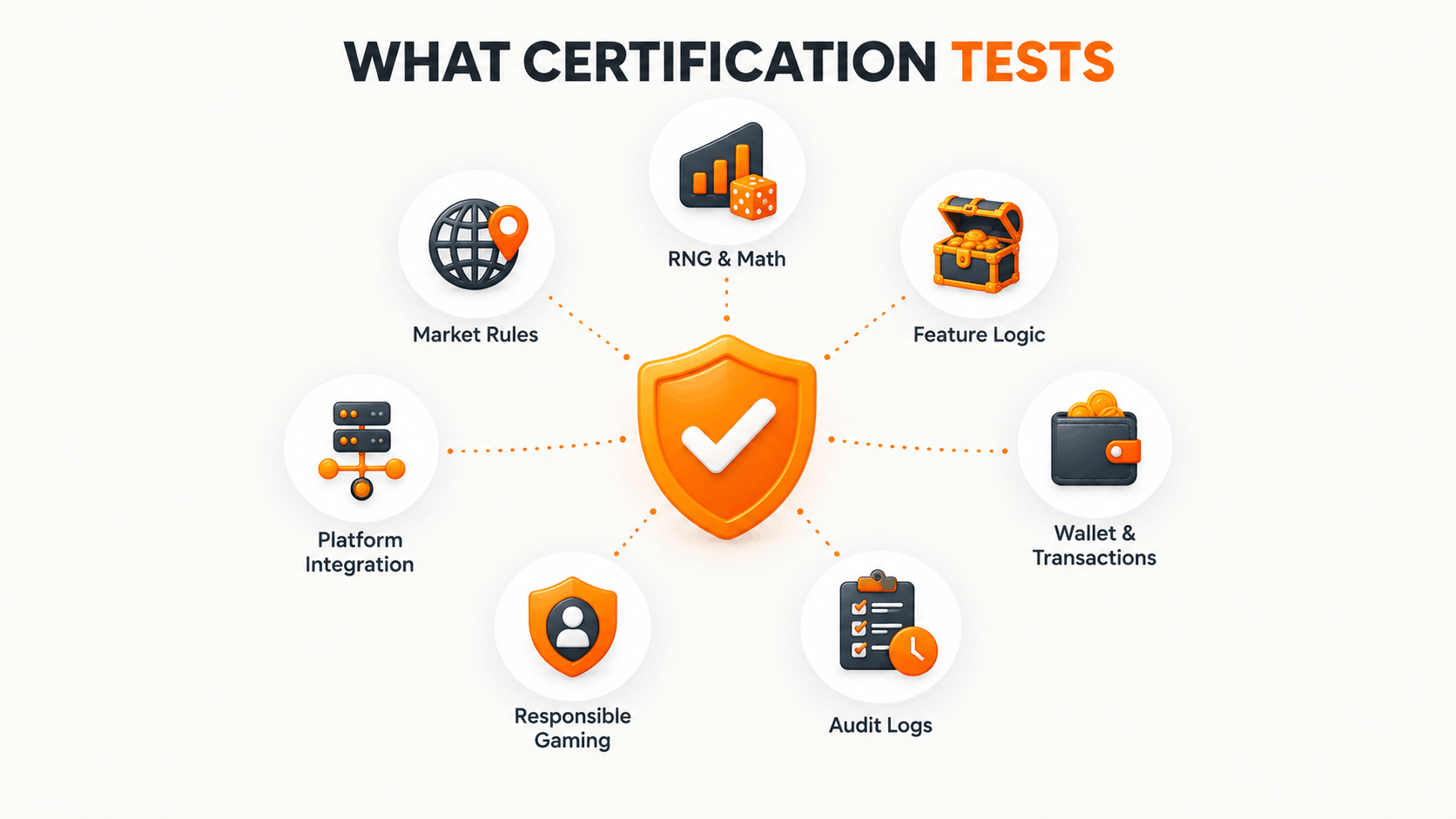
What Certification Actually Tests
Certification is far more than a quick technical check. Testing labs verify whether your slot game is stable, fair, compliant, and safe for regulated markets.
A failed certification can delay launch timelines, force feature rewrites, and create additional QA and integration costs. Modern certification processes test far more than the RNG alone.
RNG & Math Validation
Labs simulate millions of game rounds to verify:
- randomness
- RTP accuracy
- volatility behavior
- payout distribution
- statistical consistency
Even small math inconsistencies can trigger failed submissions. That is why we validate every model before it reaches a lab: our slot game math team runs a minimum of one billion simulated rounds for every RTP version of every game.
Feature Logic & Edge Cases
Testing includes:
- bonus rounds
- free spins
- jackpots
- gamble features
- recovery flows
- interrupted sessions
Labs specifically check how the game behaves in unusual or unstable scenarios.
Wallet & Transaction Stability
Certification also validates:
- wallet synchronization
- transaction consistency
- rollback handling
- duplicate request prevention
- reconnect behavior
This is critical in regulated online casino environments, where every bet and every win has to be settled exactly once. Our guide to iGaming server infrastructure explains how the remote game server and the operator’s wallet work together.
Audit Logs & Recovery Systems
Regulated markets require reliable audit trails. Labs verify:
- event logging
- session tracking
- balance history
- feature records
- recovery after crashes or disconnects
Missing or inconsistent logs are common certification failure points.
Responsible Gaming UX
Many jurisdictions require:
- responsible gaming messaging
- autoplay restrictions
- accessible game rules
- RTP visibility
- player protection features
Compliance applies to UX design as much as to backend systems.
RGS & Platform Integration
Labs also test compatibility with:
- remote gaming servers (RGS)
- operator platforms
- APIs
- external wallet systems
- promotional tools
Stable integration behavior is essential before launch approval.
Jurisdiction-Specific Compliance
Every regulated market has different requirements. Some jurisdictions restrict:
- autoplay
- bonus buy features
- spin speeds
- jackpot mechanics
- UI behavior
A slot approved in one market may still fail certification in another.
Why Experienced Architecture Matters
Many certification problems are created long before submission starts.
Weak backend architecture, inconsistent RTP systems, poor logging, or late compliance integration often lead to:
- failed submissions
- expensive fixes
- launch delays
- duplicated QA cycles
At Twin Win Games, we build slot games with certification requirements considered from the earliest production stages, helping studios reduce compliance risks before they become expensive problems.
Market-Specific Requirements
A game that passes in Malta will not automatically pass in Ontario or Italy.
Each market has its own rules:
- Malta requires RNG certification for Type 1 games, with testing carried out by an MGA-approved laboratory such as eCOGRA.
- Ontario requires certification by AGCO-registered Independent Testing Laboratories (ITLs), with all games certified before deployment.
- Italy requires certification from ADM-approved testing houses, with different tax regimes per game type.
Development must reflect these differences from the start, well before the final sprint.
Why Certification Impacts Your Roadmap
Certification errors are expensive, and lab fees are only part of it.
A missing UX element or a minor math inconsistency creates:
- Additional QA cycles, typically 2 to 6 weeks per iteration
- Lab resubmissions, typically $5,000 to $50,000 depending on complexity
- Feature rewrites that cascade through your codebase
- Delayed operator launches, with typical certification cycles of 2 to 4 months for standard slots and 4 to 6 months for complex games
- Lost revenue during delays
- Potential regulatory penalties
Real stakes:
- In Malta, compliance violations carry penalties from €10,000 to €500,000, with possible imprisonment of up to 5 years (source). One operator paid €2.34 million for violations (source).
- In Ontario, the AGCO approved over 5,000 certified games in its first year (source), all from suppliers who met strict technical standards.
Most delays trace back to one cause: the development team was not building with certification in mind from day one.
This is where Twin Win Games adds value. We run our own remote game server, with titles certified in regulated markets, and build on our proprietary PixiJS-based game engine. Together they let us build with certification in mind from the first sprint, so every build is structured, logged, parameterized, and documented the way labs expect.
The Questions Your Team Must Ask Before Development
These are the questions we hear from experienced studios and operators. If they are not asked early, launch risk increases.
1. Which markets will the slot support?
Each jurisdiction has different rules for RTP, bet limits, features, and UX.
Cost impact: Ontario operators pay a $100,000 annual regulatory fee per gaming site. Technical system evaluations typically range from $5,000 to $50,000 depending on complexity. Multiply these costs across every jurisdiction you target.
2. How many variants do we need?
Multiple RTP versions, feature toggles, or localization requirements affect both cost and structure.
Example: a single slot might need 3 RTP variants (94%, 96%, 98%), 2 feature configurations (with and without bonus buy), and 5 language versions. That makes 30 potential combinations to test and document.
3. Are the development standards aligned with major labs?
Labs such as GLI, BMM, eCOGRA, and SIQ follow strict documentation and testing flows.
Timeline reality: initial certification typically involves analysis of millions of game rounds. Expect a minimum of 90 to 120 days for first-time submissions in regulated markets such as Ontario.
4. What is the expected certification timeline?
A development team must know typical lab cycles to avoid last-minute redesigns. Lab testing itself is only one part of the cycle. The full process, including preparing documentation, responding to lab feedback, and any resubmissions, is what drives the total.
Typical full certification timelines:
- Standard video slot: 2 to 4 months
- Complex multi-feature slot: 4 to 6 months
- Re-certification after changes: 4 to 8 weeks
- Multi-jurisdiction rollout: add 6 to 12 weeks per additional market
5. Which features or UX elements may fail certification?
Common failure points:
- Autoplay restrictions. Many jurisdictions limit or ban autoplay features.
- Win-cap rules. Maximum win limits vary by market.
- Bonus-buy limitations. Some regions prohibit or restrict feature purchases.
- Mandatory responsible gaming banners. Required display frequency and content vary.
- Timing limits on animations. Markets set requirements for spin duration and animation speed.
- Session time limits. Mandatory breaks or warnings after extended play.
6. Are logs, errors, and recovery flows implemented correctly?
Certification often fails because of inconsistent logging, wallet calls, or error handling.
Lab expectations:
- A complete audit trail of all game events
- Proper handling of disconnections mid-spin
- Accurate balance reconciliation
- Clear error messaging for every failure scenario
- Timestamped logs with millisecond precision
7. Does the game architecture support easy localization?
Regions may require:
- Different volatility settings
- Different RTP configurations, since some markets set a minimum RTP
- Translated UI text with right-to-left language support
- Compliance icons and messages
- Currency and number formatting
- Cultural adaptations for symbols and themes
8. What are the total compliance-related costs?
More variants mean more testing, more QA, and more documentation.
Typical budget ranges per title:
- Initial lab certification: $15,000 to $50,000
- Math model verification: $5,000 to $15,000
- RNG testing: $3,000 to $10,000
- Documentation and compliance review: $5,000 to $20,000
- Re-certification for updates: $2,000 to $15,000 per submission
- Ongoing monitoring and audits: $5,000 to $20,000 annually
- Total for a single-jurisdiction launch: $35,000 to $140,000
- Each additional jurisdiction: an extra $20,000 to $60,000
If your vendor ignores these questions, delays become far more likely.
Where Twin Win Games Helps
We do not certify your game. We develop your game to be certification-ready.
Our experience spans 1,000+ released games for 198+ clients worldwide, including our own certified titles such as Bank Wagon Heist, so we understand how labs evaluate slot products.
Our slot game development services are built around certification readiness from day one.
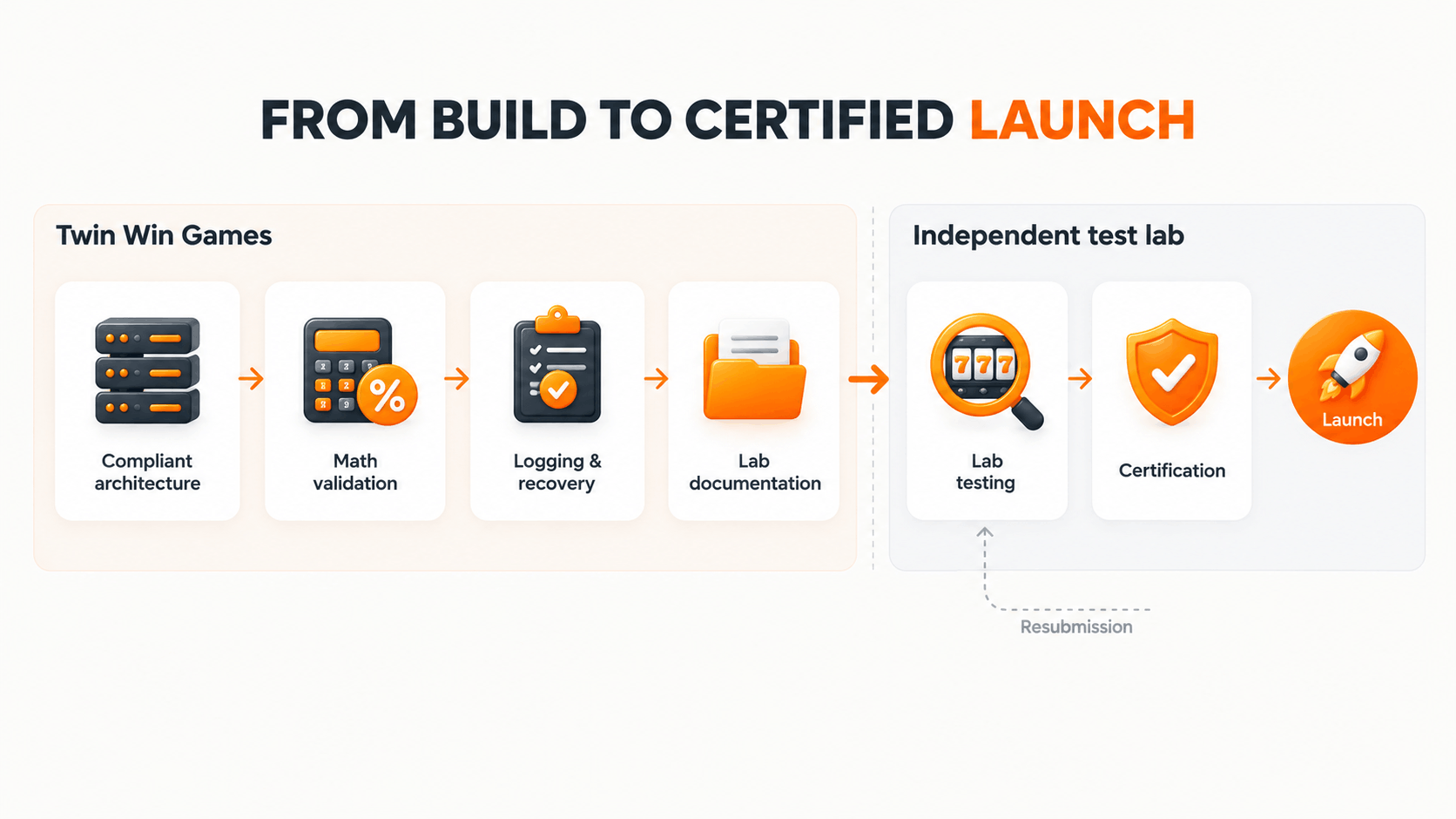
Our Certification-Ready Development Approach
Compliant architecture from the first sprint. Our own RGS, with titles certified in regulated markets.
Clean, predictable math structure. Built for verification as well as function, and validated across a billion or more simulated rounds per RTP version.
Correct handling of game states and errors. Every edge case documented and tested.
Audit-friendly logging. Complete traceability from day one.
Configurable RTP, volatility, and feature parameters. Easy variant management without code changes.
UX flows aligned with jurisdiction rules. Responsible gaming features designed in from the start.
Documentation and build discipline expected by labs. Technical documentation prepared to pass review.
The Result
A slot game that reaches the market sooner and avoids the expensive rework that failed submissions create.
Our Track Record
We build on our own proprietary PixiJS-based game engine and run our own remote game server, with a team of 110+ specialists, 90% of them mid and senior level. Our own titles are certified for the UK, Malta, Latvia, and Portugal.
Key Takeaways
Stop treating certification as a final step. Start integrating certification requirements into development from day one.
Focus on:
- Compliant math and RNG logic. Built for lab verification, and validated before submission.
- Simplified, testable feature flows. Fewer edge cases and fewer certification failures.
- Configurable RTP and volatility. Support for multiple jurisdictions without code rewrites.
- Responsible gaming UX standards. Mandatory features integrated from the start.
- Correct error and log handling. Complete audit trails that satisfy regulators.
- Scalable architecture for multiple jurisdictions. One codebase, many markets.
The Bottom Line
Studios that prepare for certification early hit their launch dates far more consistently. Those that leave it until the end face unexpected delays and additional costs that are avoidable with the right architecture.
Frequently Asked Questions
What is slot certification?
Slot certification is independent testing of a slot game by an accredited laboratory, which verifies that the RNG, the math, the feature logic, and the game’s behavior meet the requirements of a regulated market before it can launch there.
How long does slot certification take?
A full certification cycle typically takes 2 to 4 months for a standard video slot and 4 to 6 months for a complex multi-feature slot, including documentation, lab feedback, and resubmissions. Re-certification after changes typically takes 4 to 8 weeks.
How much does slot certification cost?
A single-jurisdiction launch typically costs $35,000 to $140,000 in certification-related costs, covering lab certification, math and RNG testing, and documentation. Each additional jurisdiction typically adds $20,000 to $60,000.
Which labs certify slot games?
Widely recognized testing laboratories include GLI, BMM, eCOGRA, iTech Labs, and SIQ. Each regulated market specifies which laboratories it accepts.
Can a slot certified in one market launch in another?
Not automatically. Each market has its own rules on RTP, features, autoplay, and UX, so a game certified in Malta may still need changes and a separate certification before it can launch in Ontario or Italy.
Does Twin Win Games certify slot games?
No. Certification is carried out by independent testing laboratories. We develop slot games to be certification-ready, with the architecture, math, logging, and documentation labs expect.
Ready to Build a Slot That Passes Certification Without Surprises?
We help studios and operators develop casino games engineered for regulated markets worldwide.
Schedule a 30-minute consultation to review your project’s compliance strategy.
Twin Win Games is a game development studio with 13+ years of experience and 1,000+ released games. Our own remote game server and proprietary game engine help clients build slot games ready for certification in regulated markets.