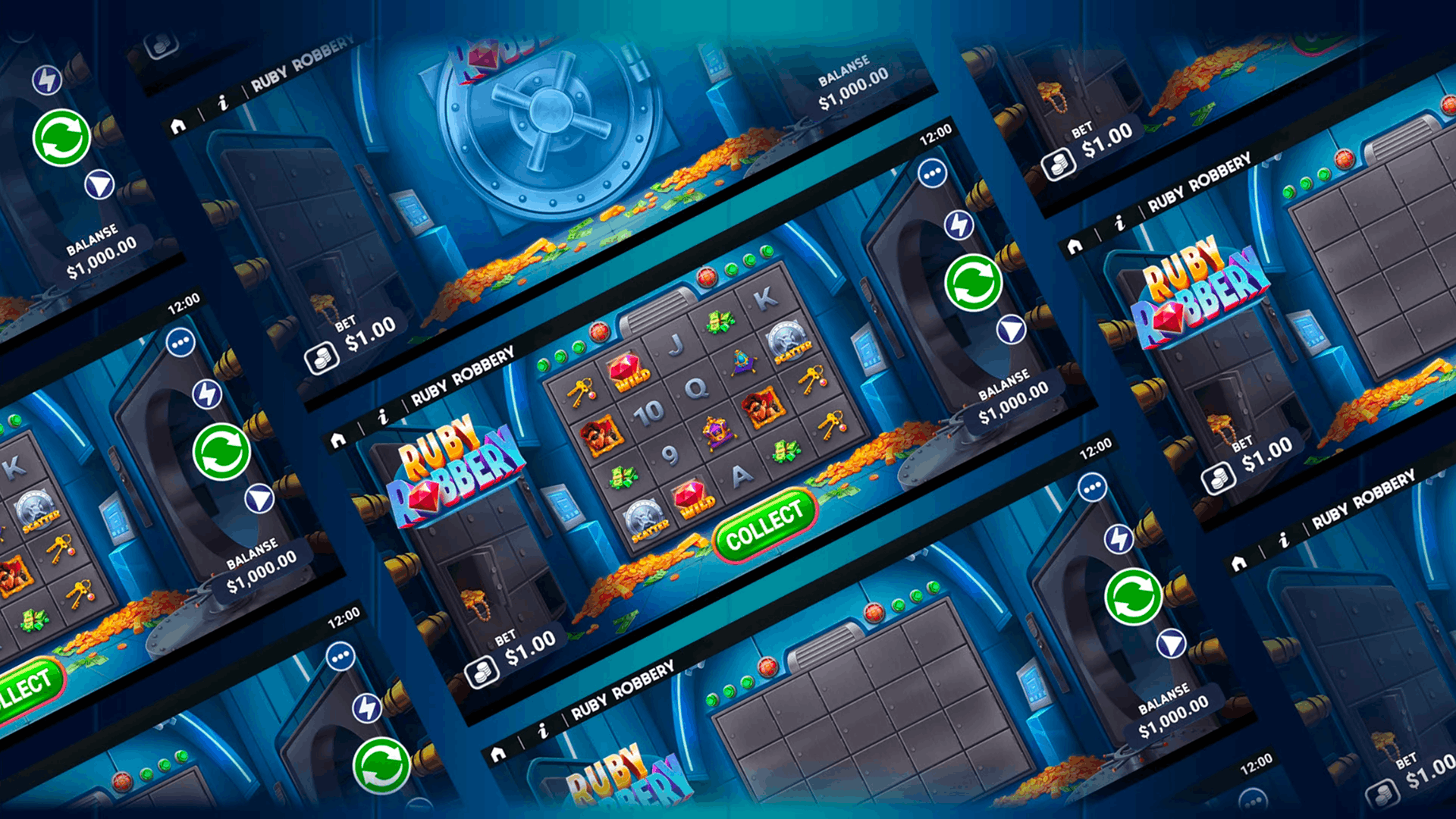
Behind every online slot sits more than one server. An iGaming platform is a stack of separate systems, each run by a different party, and knowing who runs which layer is the first step to building, buying, or integrating casino games well.
This guide breaks down how iGaming server infrastructure is structured, what the remote game server does during a single spin, and what scalability, performance, and security look like at each layer.
It matters more as the market grows. Grand View Research projects the online casino market to grow from $23.9 billion in 2026 to $38.0 billion by 2030, driven mainly by smartphone access, and every one of those sessions runs across this stack.
The Layers of iGaming Infrastructure
An online casino is built from five layers. Some are run by the operator, some by the game studio, and one sits between them.
| Layer | Who runs it | What it does |
|---|---|---|
| Player account platform (PAM) | Operator | Registration, login, KYC, responsible gambling tools, player history |
| Wallet and payments | Operator and payment providers | Player balances, deposits, withdrawals, payment compliance |
| Aggregator | Aggregator | Connects many game providers to many operators through one integration |
| Remote game server (RGS) | Game studio | Game logic, certified RNG, round results, game history |
| Game client | Game studio | The front end the player sees, served from a CDN into the browser |
The player account platform is the operator’s core system. It holds player identities and accounts, runs verification checks, and provides responsible gambling tools such as deposit limits and self-exclusion.
The wallet and payments layer holds the player’s balance and processes money in and out. Payment card handling, and the compliance obligations that come with it, sit here with the operator and its payment providers.
The aggregator lets an operator reach hundreds of games through a single integration, and lets a studio reach many operators the same way. Some studios also integrate with operators directly.
The remote game server is where the game actually runs. It holds the game logic and the certified RNG, decides the result of every round, and records it.
The game client is the part the player sees. For most real-money slots it is an HTML5 front end that loads from a content delivery network and runs in the browser.
What a Remote Game Server Does
The RGS is the part of the stack a casino game studio is responsible for, and it is the part that determines whether a game is fair, certifiable, and reliable in live operation.
Here is what happens during a single spin, in the most common setup, known as seamless wallet integration.
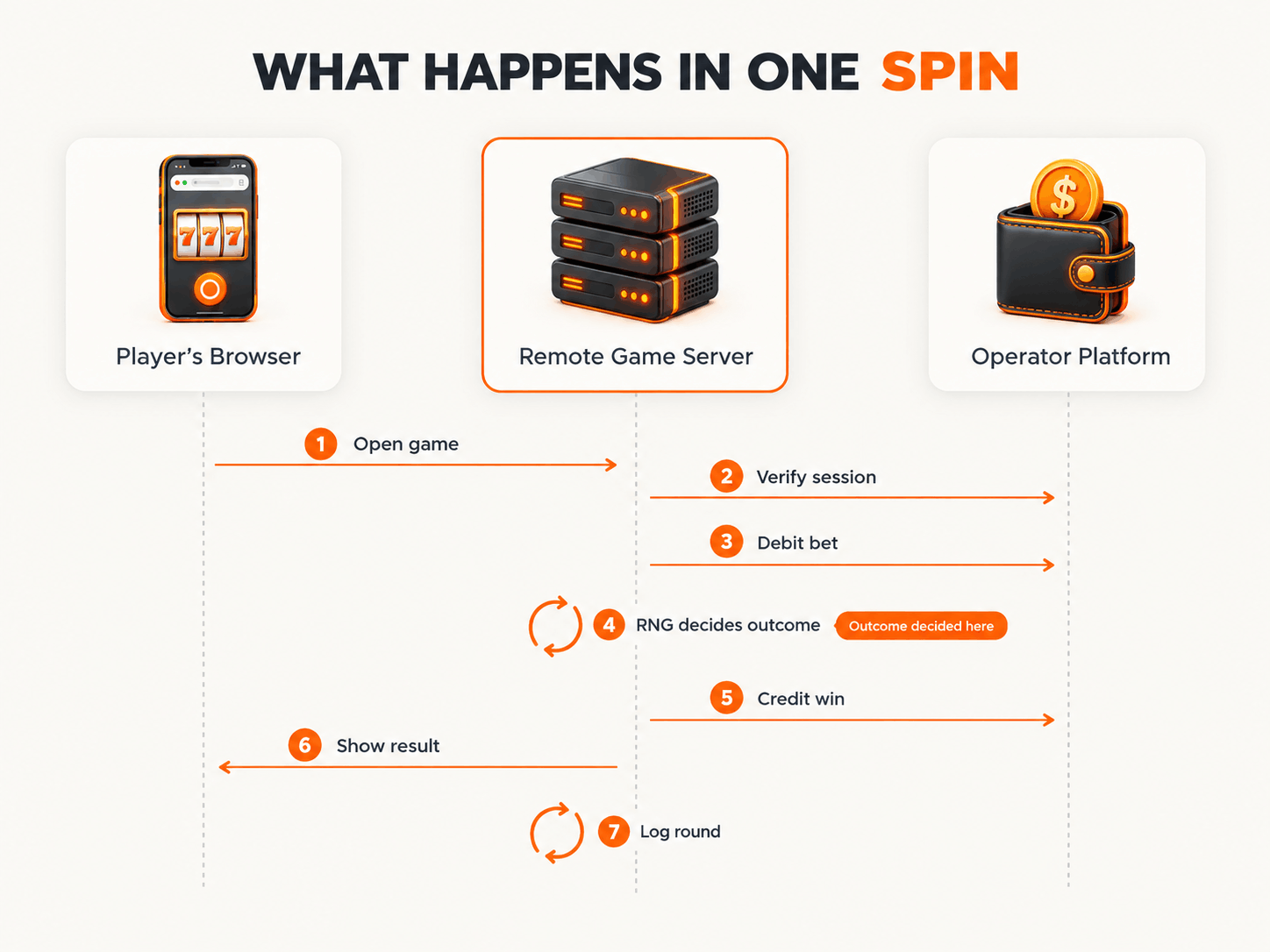
- The player opens the game. They tap it in the operator’s lobby, and the game client loads from a CDN.
- The session is verified. The operator passes a session token, and the RGS confirms it with the operator’s platform.
- The bet is placed. The RGS asks the operator’s wallet to debit the stake.
- The outcome is decided. The RGS generates the result using the certified RNG and the game’s math model.
- The win is paid. If the round wins, the RGS asks the wallet to credit the player.
- The result is displayed. The client plays the animation that presents the result the server has already decided.
- The round is recorded. The RGS logs the full round for game history and audit.
Two things stand out. The player’s money stays in the operator’s wallet throughout, so the RGS only ever requests debits and credits. And the outcome is always decided on the server. The client only displays it, which is what protects the game against tampering.
What the RGS Has to Get Right
Certified RNG and math
Every outcome comes from an RNG certified by an independent testing laboratory, driving a math model that defines the game’s RTP and volatility. That math has to be designed and validated before the game ships. Our slot game math team runs a minimum of one billion simulated rounds for every RTP version of every game.
Reliable wallet transactions
A spin involves at least one call to the operator’s wallet, and networks fail. If a credit call times out, the system must neither pay the win twice nor lose it. A well-built RGS handles retries and transaction rollbacks so that every bet and every win is settled exactly once.
Game history and audit
Operators, players, and regulators all need to know what happened in a given round. The RGS keeps a complete record of every round, which supports player disputes, regulatory audits, and the game analytics operators use to understand performance.
Jurisdiction configuration
Each regulated market can set its own rules, such as limits on autoplay, minimum spin speed, or restrictions on certain features. The RGS needs to apply the right configuration for each market from one codebase.
Hosting Models for a Remote Game Server
Cloud hosting offers on-demand capacity and the ability to scale quickly around launches and promotions. It suits studios expanding into new markets.
Dedicated servers give full control over hardware and configuration, at a higher fixed cost.
Hybrid hosting combines the two, keeping some systems on dedicated hardware while using the cloud for elastic capacity.
Data location often decides the choice. Some jurisdictions require game or player data to be hosted within their borders, or within specific regions. For a studio operating across several regulated markets, hosting is shaped as much by these rules as by cost.
Performance: Scalability, Latency, and Availability
Scalability. Traffic is uneven. A new game launch, a promotion, or a busy weekend evening can multiply load quickly, so the RGS needs to scale horizontally, adding capacity as demand rises and releasing it after.
Latency. A single spin includes a round trip to the RGS and at least one call to the operator’s wallet. Every added delay is felt by the player as a slower game, so the path between the RGS, the wallet, and the player needs to stay short.
Availability. Downtime during a round must never cost a player a bet or a win. The transaction model protects against this: a round that fails partway is either completed or rolled back cleanly.
Security: What Sits Where
Security in iGaming is split by layer, and knowing where each responsibility sits matters when evaluating any provider.
The operator is responsible for payment card data and its compliance scope, player identity verification and KYC, anti-money laundering checks, and responsible gambling controls.
The game studio’s RGS is responsible for RNG integrity, keeping every outcome decided on the server, tamper resistance between client and server, encrypted communication with the operator’s platform, protection against denial-of-service attacks, and a complete audit trail of every round.
A provider that claims responsibility for layers it does not run is a warning sign. The clearest partners are precise about which parts of the stack they own.
How Twin Win Games Runs Its Own RGS
We run our own remote game server, hosting the HTML5 slots we build on our proprietary game engine. Our titles on it are certified for regulated markets including the UK, Malta, Latvia, and Portugal. Bank Wagon Heist is one of them.
Because we build both the games and the server they run on, the math, the certified RNG, the game client, and the integration are designed together, and operators can integrate our certified games into their platforms.
Frequently Asked Questions
What is iGaming server infrastructure?
It is the set of systems that power an online casino: the operator’s player account platform, the wallet and payment systems, aggregators that connect providers to operators, and the remote game servers that run the games themselves.
What is a remote game server (RGS)?
A remote game server is the system that runs casino games. It holds the game logic and the certified RNG, decides the outcome of every round, requests debits and credits from the operator’s wallet, and records each round for audit.
What is the difference between an RGS and a casino platform?
The casino platform, often called the player account platform or PAM, is run by the operator and manages players, accounts, verification, and responsible gambling tools. The RGS is run by the game studio and runs the games. The two connect through an integration.
What is seamless wallet integration?
It is the most common way an RGS connects to an operator. The player’s balance stays in the operator’s wallet, and the RGS requests a debit for each bet and a credit for each win, in real time.
Does the RGS handle player payments?
No. In a seamless wallet setup, the player’s money stays with the operator. The RGS only requests debits and credits, while deposits, withdrawals, and payment card handling remain with the operator and its payment providers.
Where is the outcome of a casino game decided?
On the remote game server, using a certified RNG. The game client in the player’s browser only displays the result, which protects the game against tampering.
Should an RGS be hosted in the cloud or on dedicated servers?
Cloud hosting suits studios that need to scale quickly and expand into new markets, while dedicated servers give more direct control. In practice, the rules of each target jurisdiction, particularly on where data must be hosted, often decide the choice.
Integrating Casino Games Into Your Platform?
Twin Win Games builds HTML5 casino games and runs its own remote game server, with certified titles live in regulated markets. With 13+ years in game development, 1,000+ released titles, and 198+ clients worldwide, we design the math, the game, and the server integration together.