Every operator and studio adding slots to a portfolio faces the same choice. You can build a new game from scratch, reskin a game whose mechanics are already proven, or add a ready-made title that is already certified and live.
Each route has a different cost, timeline, and level of risk, and the right one depends on what the game is for. This guide compares all three and shows how to decide.
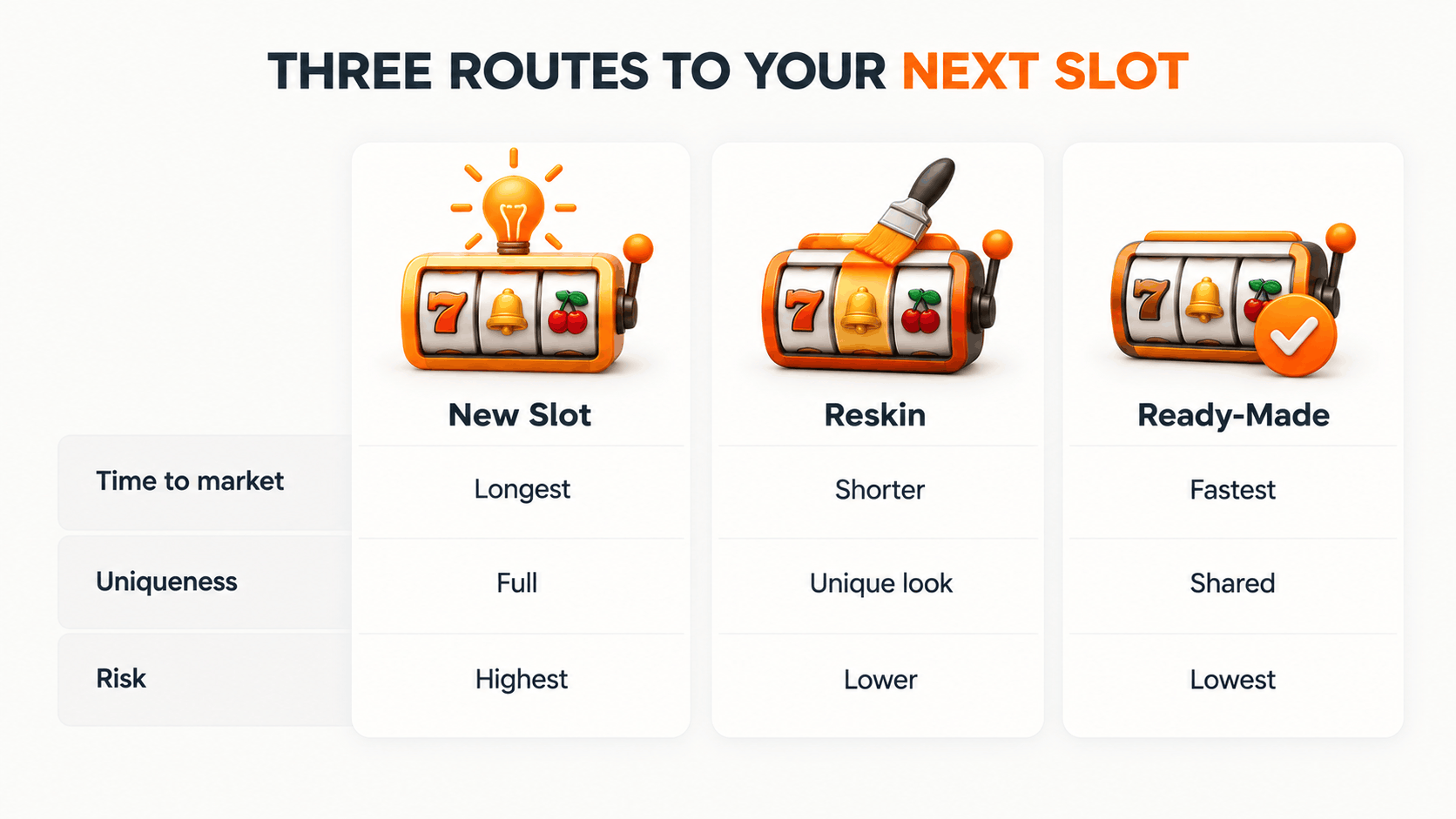
The Three Routes at a Glance
| New slot | Reskin | Ready-made game | |
|---|---|---|---|
| What you get | A completely original game | A new theme, art, and UI on a proven mechanic | An existing, certified game |
| Time to market | Longest | Much shorter than a new build | Fastest: the work is integration |
| Typical cost | $45,000 to $80,000 | $18,000 to $30,000 | Set by licensing terms |
| Uniqueness | Fully unique | Unique look, shared mechanic | Shared with other operators |
| Risk | Highest: the mechanic is untested | Lower: the mechanic has a track record | Lowest: the game is already live |
| Best for | Flagship titles and new mechanics | Growing a portfolio from proven games | Filling a library or entering a market fast |
The price ranges are typical market figures. Every project is scoped individually.
Route 1: Build a New Slot
A new slot is designed from the first idea: theme, math model, features, art, animation, and code. Everything about it is yours.
Choose this route when you want a game no one else has. That means a flagship title, a new mechanic, a branded game built around your own IP, or a product that defines your studio’s identity.
What it involves. A new slot goes through the full production cycle: concept and game design, the math model, art and animation, development, QA, and certification. A standard slot typically takes three to six months, and a complex, feature-heavy game six to twelve. Our own Bank Wagon Heist, for example, took about six months of full-cycle production.
The trade-off. A new mechanic has no track record. However carefully the math is modeled and simulated, how players respond is only proven after launch. That is the risk you accept in exchange for a game that is entirely your own.
For a detailed breakdown of stages and budgets, see our guide to slot game development.
Route 2: Reskin a Proven Slot
A reskin keeps a game’s mechanics and math and gives it a completely new identity: a new theme, symbols, backgrounds, animation, UI, and sound. To the player, it is a new game. Underneath, it runs on a mechanic that has already been built and tested.
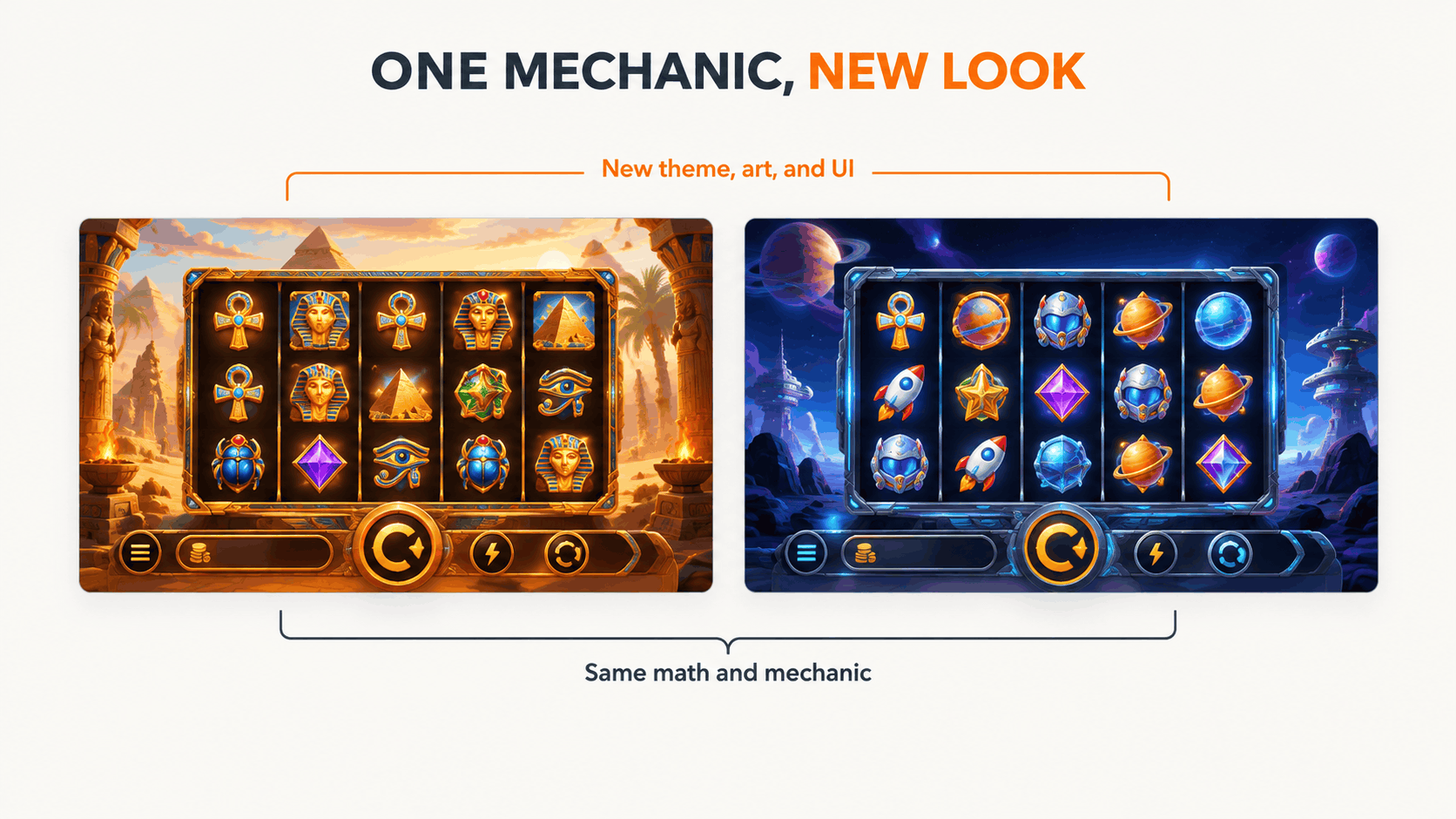
Choose this route when you have a mechanic that works and want more from it, or want to test a new theme or audience without the cost of a full build.
There are two common versions:
- Reskinning your own game. If one of your slots performs well, a reskin lets you release it again for a different audience or market, with its proven math intact.
- Reskinning a studio’s proven game. You can also build on a mechanic a studio has already developed and certified, and give it your own theme.
What it involves. Because the math and features already exist, the work centers on art, animation, UI, and integration. That is why a reskin typically costs a fraction of a new build and reaches players much sooner. A reskin is still released as a new game, so it goes through certification for each target market. Because its math has already been validated, there are far fewer unknowns along the way.
The trade-off. The look is new, the mechanic is shared. A reskin is a strong way to grow a portfolio, and a weaker way to stand out with something players have never seen.
See our slot game reskin services.
Route 3: Add a Ready-Made Game
A ready-made game is a finished, certified title that an operator adds to their casino as it is. There is no production at all, only integration.
Choose this route when speed matters most: filling a game library, launching in a market the game is already certified for, or testing how a game type performs with your players before investing in your own.
What it involves. The game is already built, tested, and certified, so the work is connecting it to your platform. Our own slots, for example, run on our remote game server and are certified for the UK, Malta, Latvia, and Portugal. Our engine’s unified server controller is ready for Swintt and Tom Horn. Our guide to iGaming server infrastructure explains how a game reaches an operator’s casino.
The trade-off. A ready-made game is not exclusive. Other operators can offer the same title, so it fills a library well but does not differentiate it.
Combining the Routes
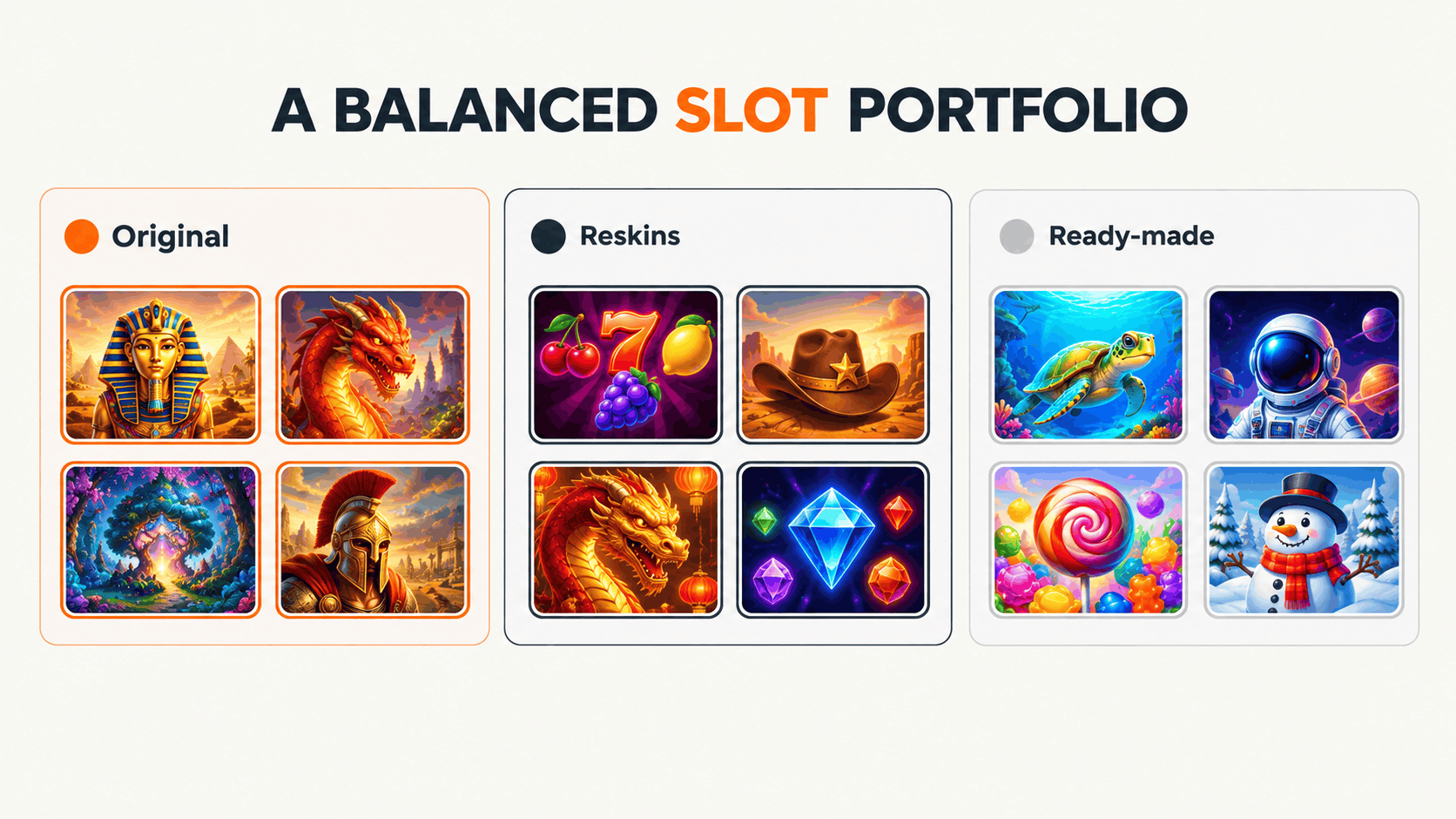
The routes are not mutually exclusive, and the strongest portfolios usually use all three.
A ready-made game can become a reskin. If a ready-made title performs well with your players, it can be reskinned into a branded version of your own, with its proven mechanic unchanged.
A new game can feed future reskins. A slot whose art and code are built for reskins from day one becomes the base for later releases. That turns one investment in original math into several releases.
A portfolio usually mixes all three. A few original flagship titles define the brand, reskins of proven mechanics add volume, and ready-made games fill gaps quickly.
How to Decide: Five Questions
1. How soon do you need the game live? If the answer is weeks, a ready-made game is the realistic route. If it is a few months, a reskin. If the game can take as long as it needs, a new build.
2. Does the game need to be unique? If it carries your brand or defines your studio, build new. If it needs to look unique but can share a mechanic, reskin.
3. Do you already have a mechanic that works? If you do, a reskin multiplies what you have already invested in.
4. How much risk can the budget absorb? A new mechanic is the highest-risk investment. A proven mechanic, reskinned or ready-made, lowers it.
5. Which markets are you launching in? A game already certified for your target market removes a whole stage. For other markets, every route needs certification. Our slot certification guide explains what that involves.
Frequently Asked Questions
What is the difference between a new slot and a reskin?
A new slot is built from scratch, including its own math model and features. A reskin keeps an existing game’s math and mechanics and gives it a new theme, art, UI, and sound. To players, both are new games.
How much does a slot reskin cost compared to a new slot?
A reskin typically costs $18,000 to $30,000, while a new slot typically ranges from $45,000 to $80,000. The difference comes from reusing math, features, and code that already exist.
Does a reskinned slot need certification?
Yes. A reskin is released as a new game, so it is certified for each target market. Because its math has already been validated, the process carries far fewer unknowns than certifying a new mechanic.
What is a ready-made slot game?
It is a finished, certified game an operator adds to their casino through integration, without any production. It is the fastest route to market, but it is not exclusive.
Can a ready-made game be turned into a reskin?
Yes. A ready-made title that performs well can be reskinned into a branded version with a new theme, while its proven mechanic stays the same. The reskinned version is certified as a new game for each target market.
Not Sure Which Route Fits?
We build original slots, reskin proven mechanics, and offer our own certified titles to operators, so we can recommend the route that fits your goals and budget.
Explore our slot game development services, or talk to us about your next game.