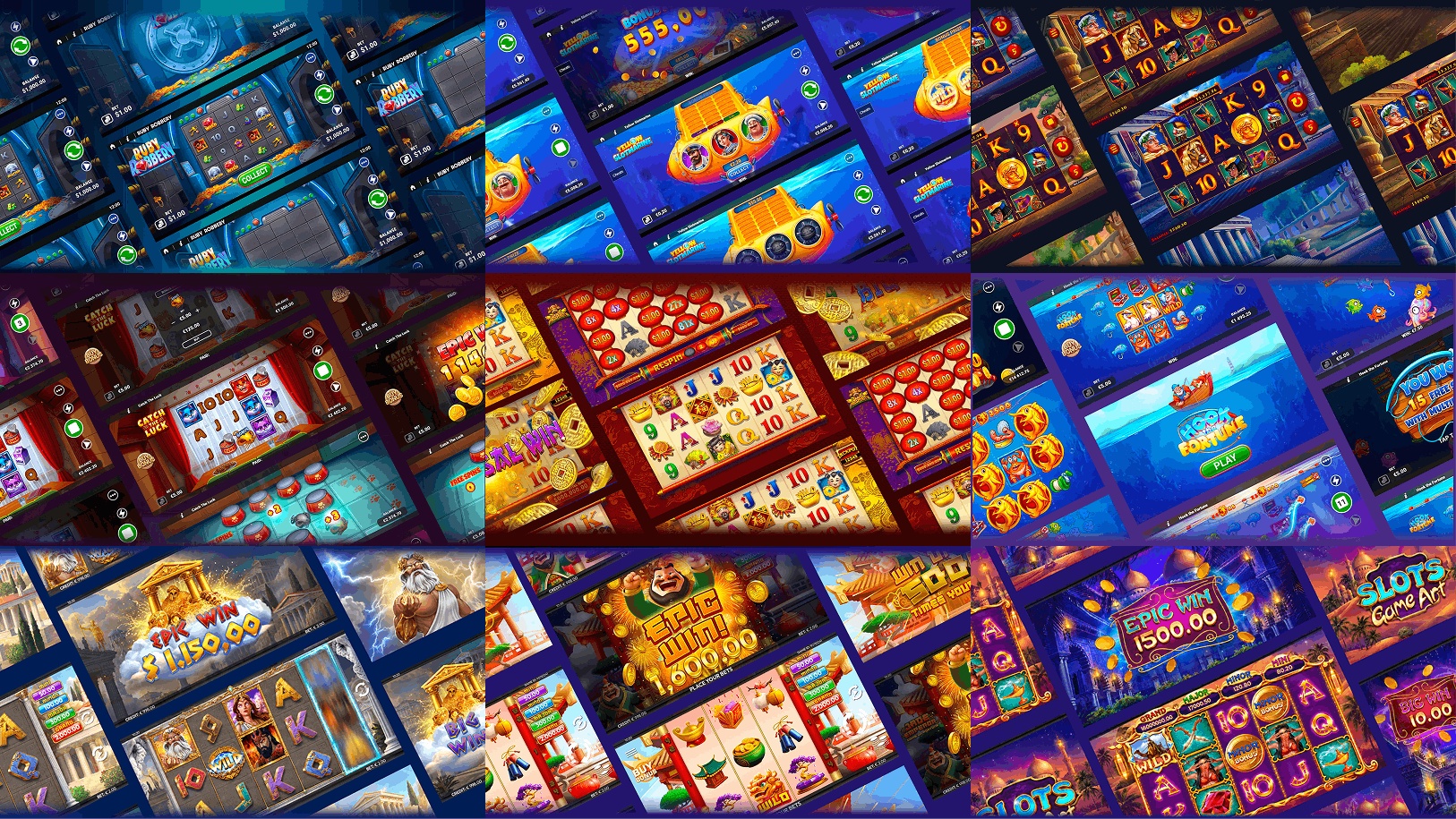

Most articles about 2D game art explain what it is. This one covers how it is actually made.
We produce over 100 slot games a year, which means our artists work through the same production problems every week: a symbol that reads perfectly at full size and turns to mush on a phone, a background that looks beautiful and adds three seconds to load time, a character that animates well but cannot be reskinned without redrawing it.
This guide walks through each stage of a 2D game art pipeline, what gets decided at each one, and the mistakes that cost the most time to fix later.
The examples come from casino game production, where the constraints are tightest: symbols that have to read in a fraction of a second, assets that ship across dozens of markets, and games that get re-themed years after launch. The principles apply to any 2D game, and casino work is where they get tested hardest.
What 2D Game Art Actually Includes
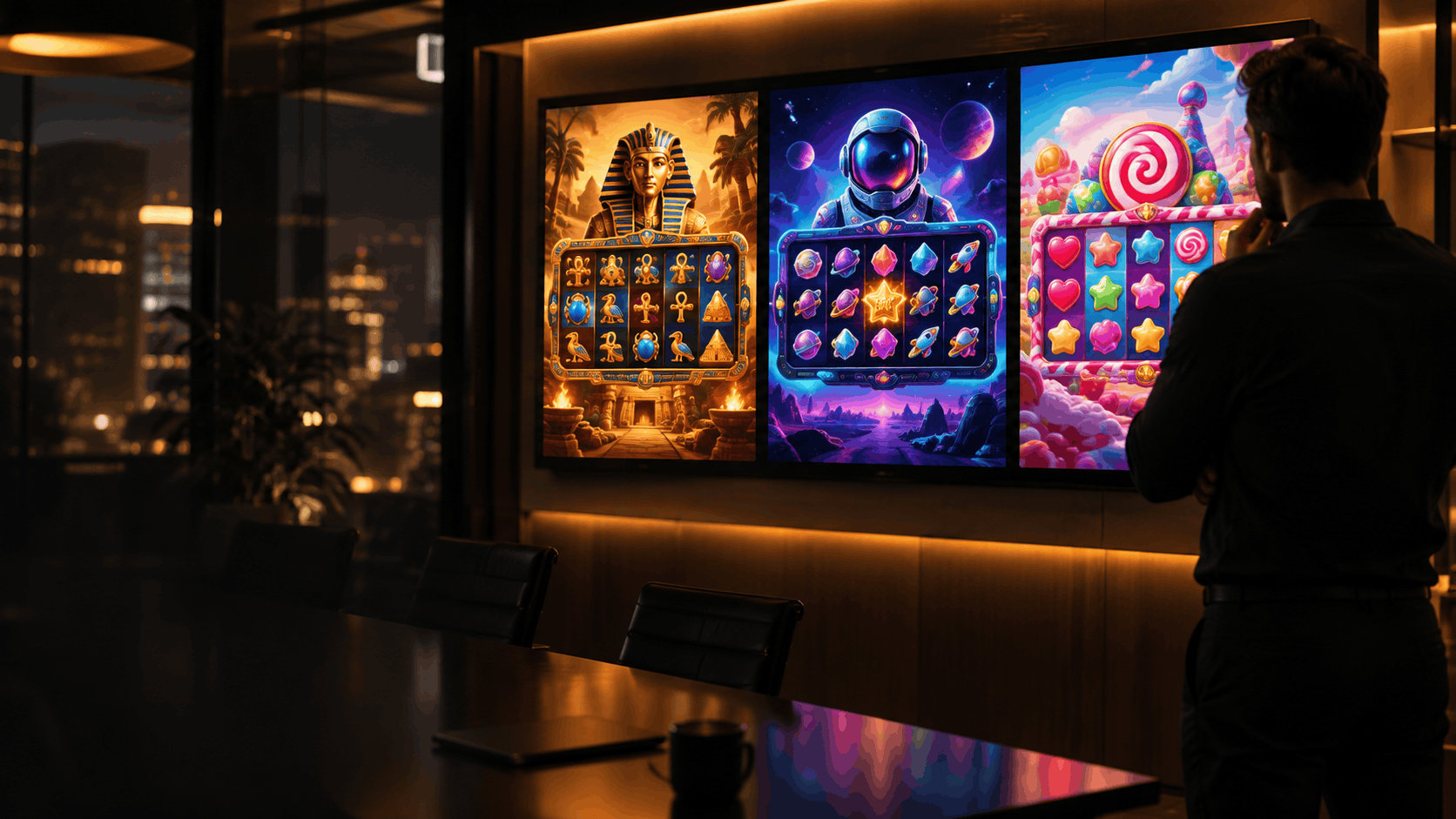
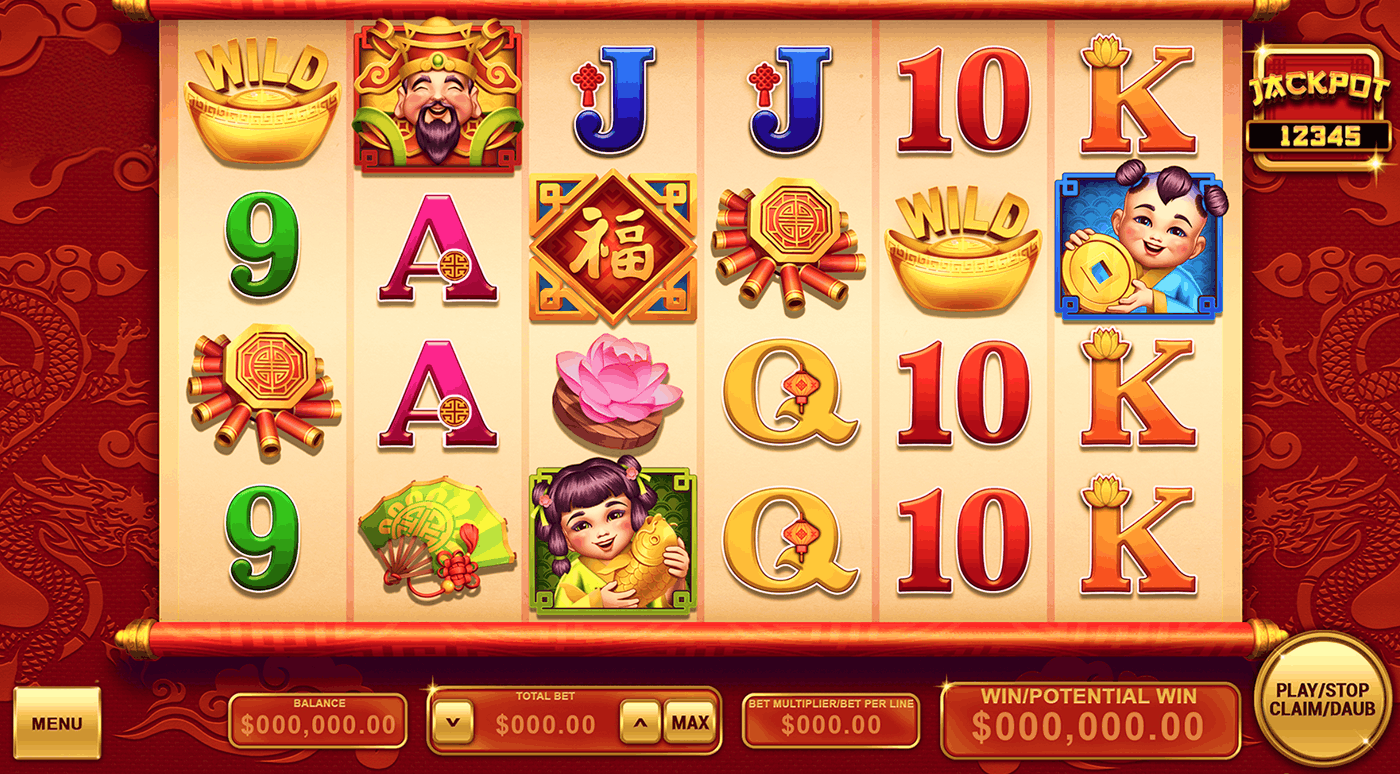
A game art package is a system of connected assets, not a folder of illustrations. A typical casino or mobile title needs:
- Symbols and icons. High-value, low-value, wild, scatter, bonus, and any feature-specific symbols.
- Characters. Often doubling as high-value symbols, with expression and pose variations for features.
- Backgrounds. Base game, free spins, and bonus rounds, frequently in separate layers.
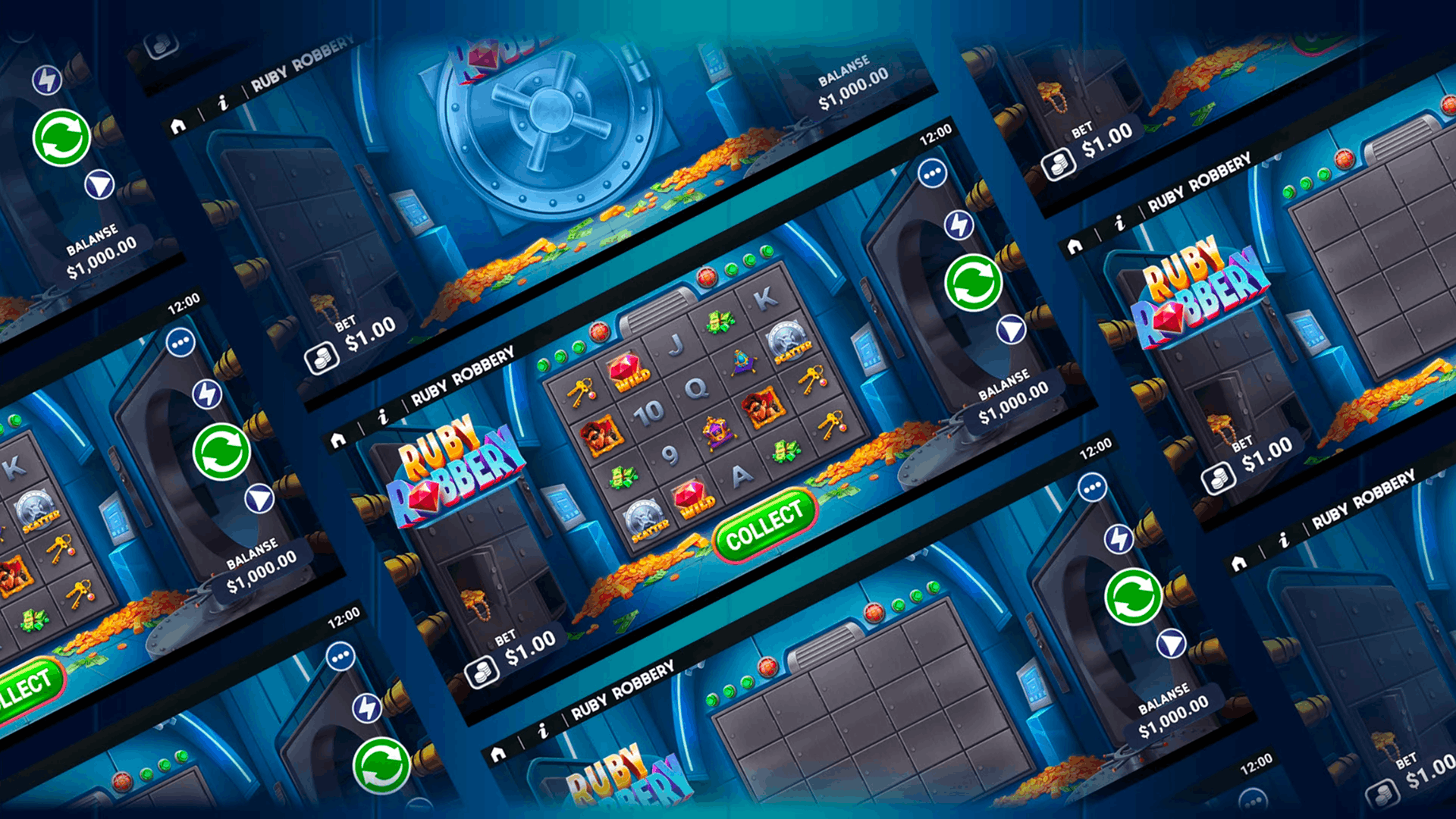
- UI. Bet controls, spin button, menus, info screens, paytable, and win panels.
- Feature screens. Intros, transitions, jackpot displays, and win celebrations.
- Animation. Symbol reactions, anticipation, transitions, and particle effects.
- Promotional assets. Thumbnails, lobby tiles, banners, and marketing artwork.
The important part is that these are designed together. A symbol set drawn without knowing the background contrast will fail on half the screens it appears on. A UI designed before the color palette is locked will need reworking.
Concept Art: Deciding the Visual Language Before Production Starts
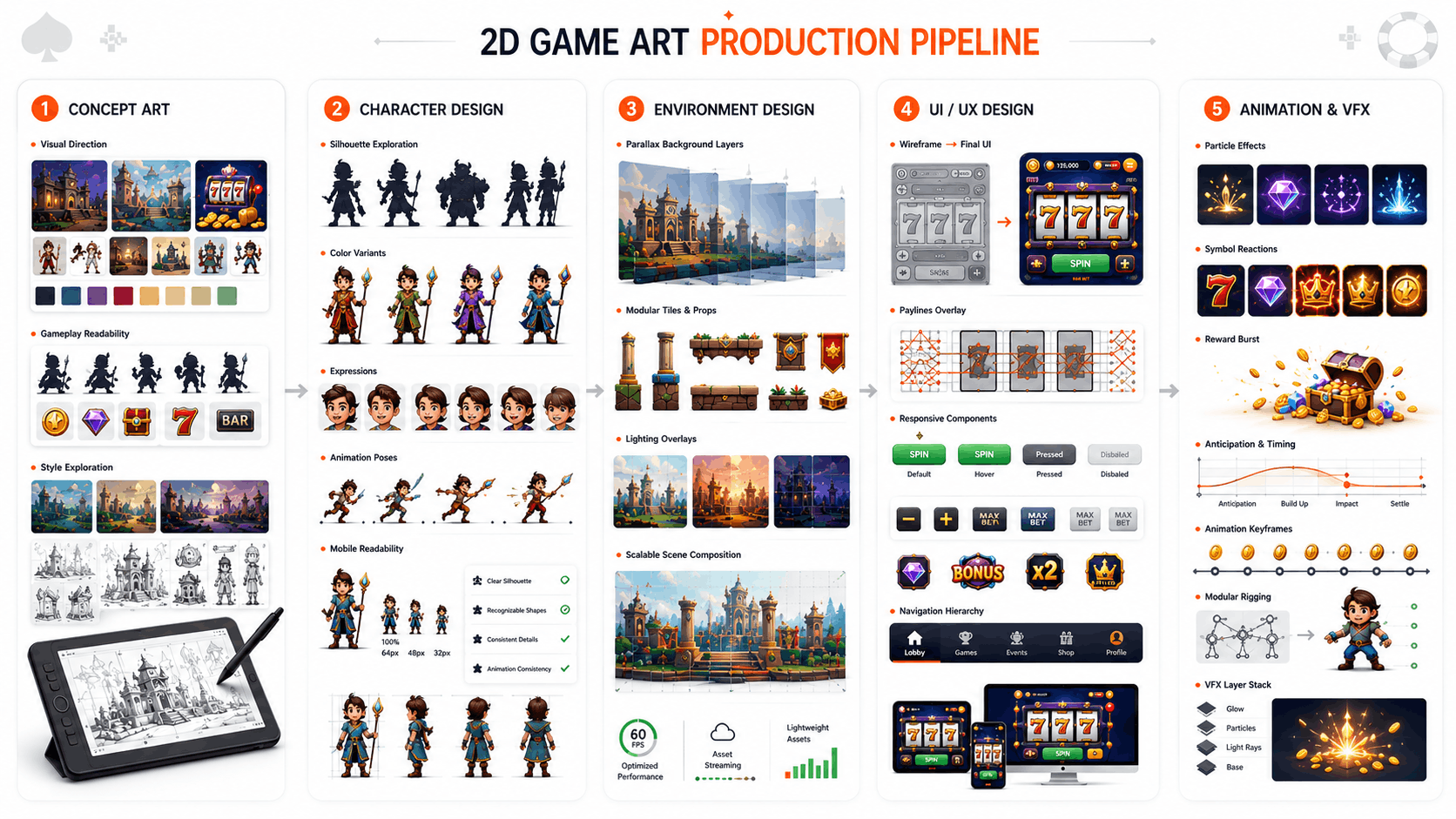
Concept work exists to make decisions, not to produce pretty images. By the end of this stage the project should have answers to:
- What is the color palette, and which colors are reserved for wins, bonuses, and alerts?
- How much detail can a symbol carry before it stops reading at reel size?
- What is the contrast relationship between symbols and background?
- Which elements will need to change for a reskin or a new market?
The most expensive mistake in 2D game art production happens here. When teams skip straight to asset creation, the visual language gets defined by accident, one asset at a time. By the time the twentieth symbol is drawn, the first five no longer match, and fixing them means a redraw.
A locked style guide before production costs a few days. Rebuilding a symbol set midway through costs weeks.
Character Design: Readability Beats Detail
In casino and mobile games, characters appear at a fraction of the size they were drawn at, often in motion, frequently against a busy background.
This changes what good character design means. The test is not how the character looks at full resolution. It is whether a player can identify it instantly inside a reel cell while the reels are still settling.
What survives that test:
- A clear silhouette. If the character is unrecognizable as a black shape, it will be unrecognizable at symbol size.
- A limited palette. Two or three dominant colors read faster than eight.
- One exaggerated identifying trait. A hat, a beard, a color, something a player can lock onto.
- Consistent proportions across states. The character has to stay the same character when it is celebrating, idle, or triggering a feature.
That last point is where production often breaks down. A character drawn once, then redrawn for each new pose, drifts. The face changes slightly, the proportions shift, and the set stops feeling like one character. Building the character as a set from the start, with the variations planned, avoids that entirely.
Environment and Background Art: Depth Without Weight
Backgrounds carry the theme, and they are also the heaviest assets in the package. Both things have to be true at once: atmospheric enough to sell the setting, light enough to load fast on a mid-range phone.
Three techniques do most of the work:
- Layer separation. Splitting the background into foreground, midground, and far background allows parallax movement and lets each layer be optimized separately.
- Controlled contrast behind the reels. The area directly behind the symbols should be the quietest part of the image. Detail belongs at the edges.
- Reusable elements. A background built from modular pieces can be recombined for free spins and bonus rounds without a full redraw.
Symbols and Icons: The Hardest Small-Scale Problem
Slot symbols are where casino art succeeds or fails, and they are the most underestimated part of the package.
A full set usually includes high-value symbols, low-value symbols (often stylized card royals), a wild, a scatter, and one or more bonus symbols. Every one of them has to:
- read instantly at reel size,
- be distinguishable from every other symbol in the set,
- hold up against every background the game uses,
- work in its win state, its blurred spinning state, and its static state.
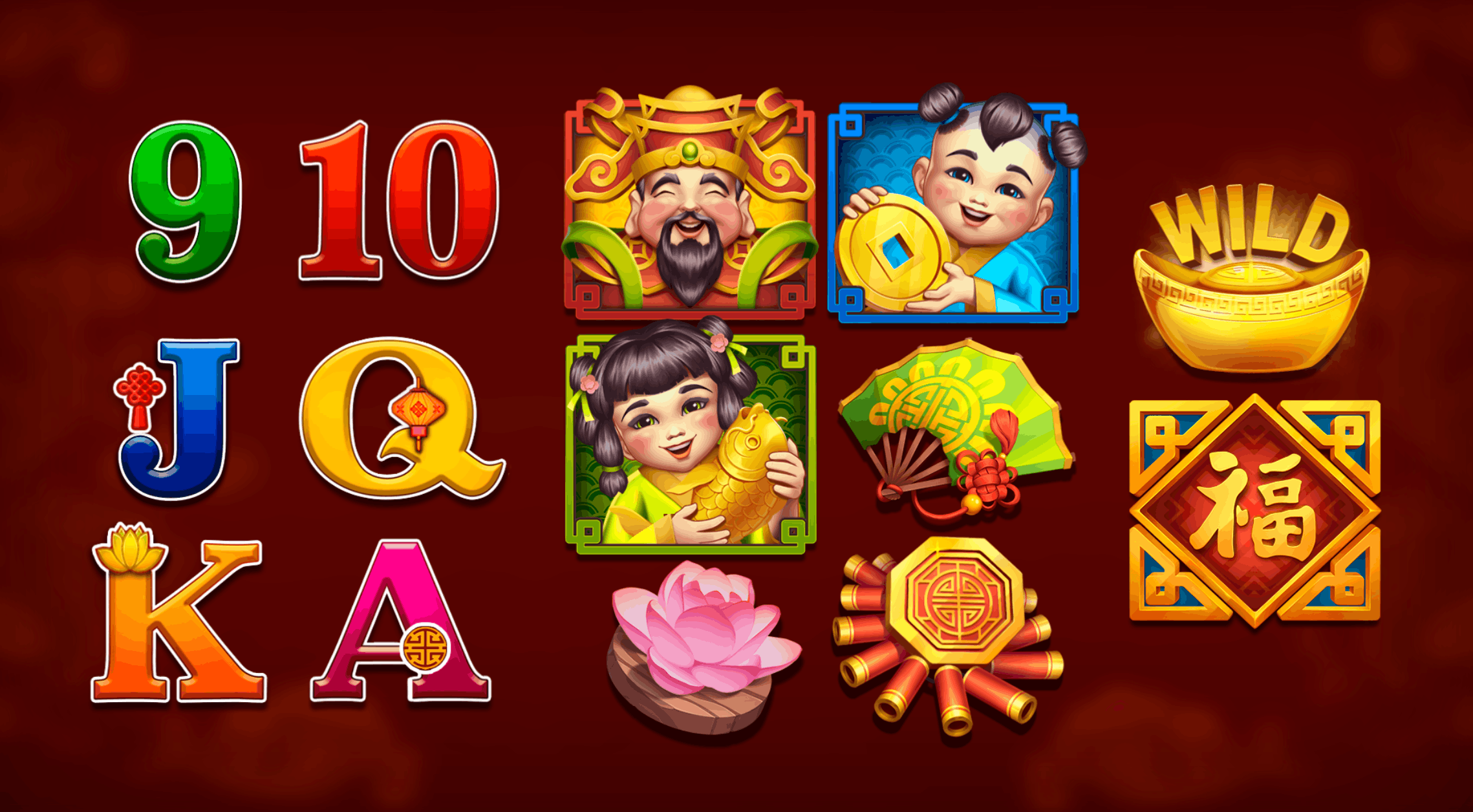
The most common failure is set-internal confusion. Two high-value symbols with similar silhouettes and similar colors will be misread during play, and players will feel the game is unclear without being able to say why.
A practical check: view the entire set at actual reel size, in grayscale, at once. If two symbols are hard to tell apart under those conditions, they will be hard to tell apart in play.
Low-value symbols deserve more attention than they usually get. Card royals appear more often than anything else on screen, so they set the visual tone of the game more than the hero symbols do.
UI and UX: The Part Players Only Notice When It Is Wrong
Interface design carries more weight in casino games than in most genres, because players interact with the same controls hundreds of times per session.
What matters most:
- Hierarchy. Spin is the primary action and should look like it. Everything else steps back.
- Feedback. Every tap needs a visible response. Uncertainty about whether a bet registered is one of the fastest ways to lose a player.
- Win communication. The difference between a small win and a significant one should be readable without reading numbers.
- Thumb reach. On mobile, primary controls belong in the lower third of the screen.
- Localization headroom. A button sized exactly to fit “SPIN” will break when the game ships in German.
That last point is worth repeating, because it is cheap to plan and expensive to retrofit. Text containers should be built with room to grow from the start.
Animation: Feedback, Pacing, and Production Cost
Animation turns static art into a feedback system. It also determines a large share of the production budget, which makes the technical approach a commercial decision as much as a creative one.
Frame-by-frame gives full artistic control and suits short, expressive moments such as a character reaction or a win burst. It is expensive to produce and expensive to change.
Skeletal animation (Spine and similar tools) is the workhorse for most casino production. Assets are rigged once and animated through bones, which means variations and adjustments are far cheaper, and the same rig can carry into a reskin.
Most well-run pipelines combine both: skeletal for anything that needs to scale or change, frame-by-frame reserved for hero moments.
The restraint that matters: animation should support gameplay pacing, never compete with it. When every symbol has a celebration, none of them feel like a win.
Building for Reskins and New Markets from Day One
This section is the difference between art that serves one game and art that serves a portfolio.
Most successful games are eventually re-themed, localized, or given a seasonal version. Whether that is cheap or painful is decided during the original production, long before anyone asks for it.
What to do while building the first version:
Document the palette and the export settings. The team doing the reskin is often not the team that built the original.
Keep source files layered and named consistently. A flattened asset has to be redrawn. A layered one can be re-themed.
Separate text from graphics. Any symbol with baked-in text becomes a new asset for every language.
Build UI from components. Reskinning a button system is quick. Reskinning twenty individually drawn buttons is not.
Keep the rig reusable. A Spine skeleton built cleanly can carry a completely new character design with no re-rigging.
Done properly, a full visual re-theme of a proven game runs in weeks and costs a fraction of original production. Done carelessly, it costs nearly as much as building new.
Tools Used in 2D Game Art Production
- Photoshop and Illustrator. Symbol and asset creation, raster and vector respectively.
- Spine. Skeletal animation for characters, symbols, and features.
- After Effects. Particle work, win effects, and pre-rendered sequences.
- Figma. UI layout, component systems, and developer handoff.
- Blender. 3D-assisted rendering for symbols that need dimensional lighting.
- Texture atlas tools. Packing assets for efficient delivery and fewer draw calls.
Five Mistakes That Cost the Most to Fix
- Starting asset production before the style guide is locked. Everything drawn early gets redrawn.
- Designing symbols at full size only. They have to be checked at reel size, in grayscale, as a complete set.
- Baking text into graphics. Multiplies asset count by the number of languages.
- Flattening source files. Turns every future reskin into a redraw.
- Treating UI as the last step. Interface decisions affect symbol contrast and background composition, so they belong in the early phase.
How Twin Win Games Produces 2D Game Art
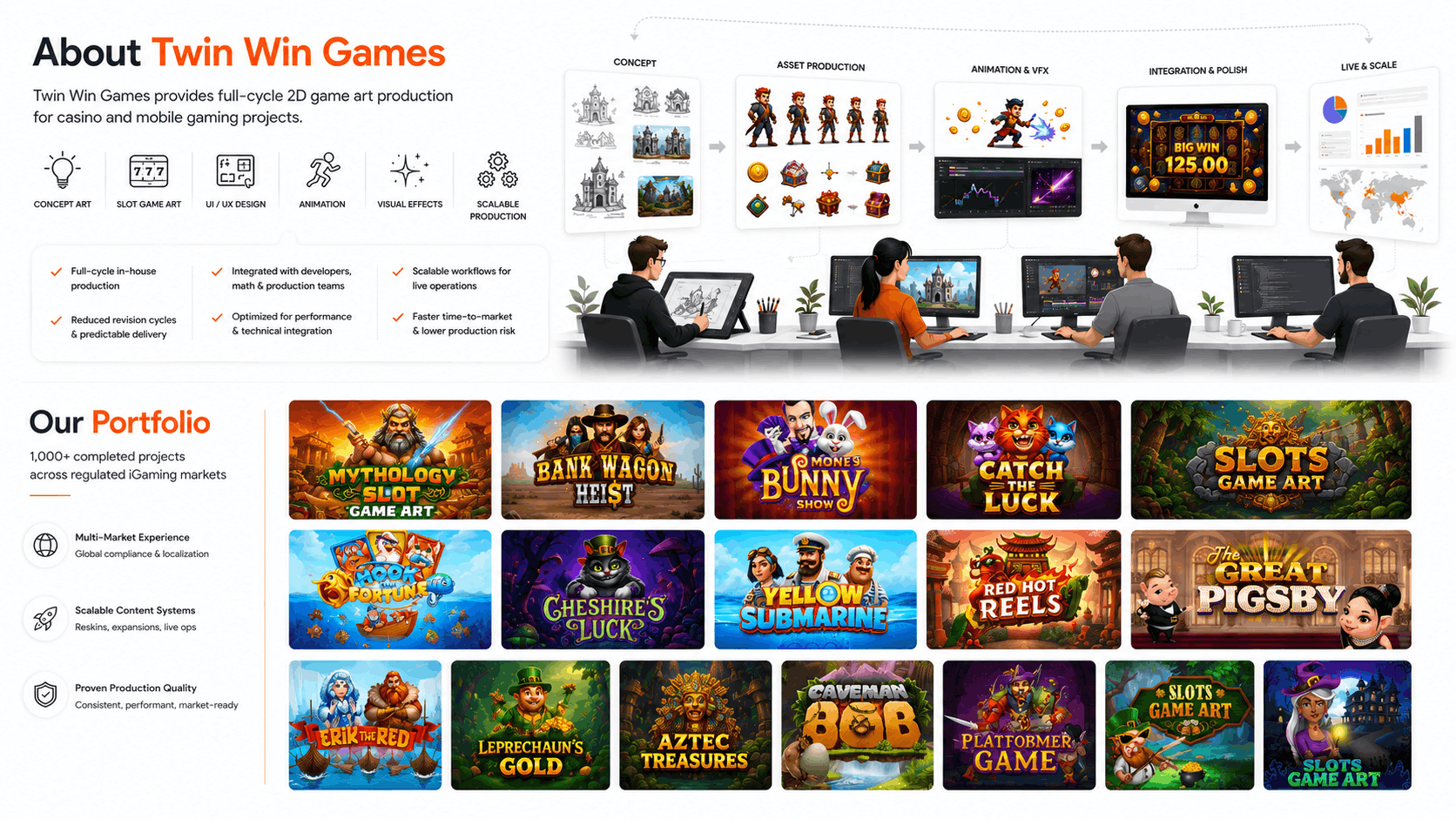
Our artists, animators, UI designers, and developers work inside one production pipeline, so assets are built with both visual quality and technical integration in mind. That means symbol sets checked against the actual backgrounds they will sit on, rigs built for reuse, and export settings agreed with the developers who will integrate them.
With 13+ years in game development, 1,000+ released titles, 198+ clients worldwide, and 110+ in-house specialists, we produce art for over 100 slot games a year across regulated markets.
Frequently Asked Questions
What is 2D game art?
2D game art covers every visual asset created in two dimensions for a game: symbols, characters, backgrounds, UI, animation, and promotional artwork. In casino games it also includes feature screens, jackpot displays, and win celebrations.
Why do casino games still use 2D rather than 3D?
2D pipelines produce faster, load lighter on mobile, and are far cheaper to re-theme and localize. For games where readability during fast play matters more than visual spectacle, 2D is usually the stronger commercial choice.
What tools are used for 2D game art production?
Photoshop and Illustrator handle asset creation, Spine covers skeletal animation, After Effects produces particle and win effects, and Figma is used for UI layout and handoff. Texture atlas tools optimize asset delivery across devices.
What makes a good slot symbol?
A clear silhouette, a limited palette, and enough visual distance from every other symbol in the set. The practical test is viewing the full set at reel size in grayscale. If two symbols are hard to distinguish there, players will misread them in play.
How does art affect player retention?
Visual clarity reduces cognitive friction during fast gameplay loops. Symbols that read instantly, UI that responds visibly, and animation that communicates win value all keep players in the session longer.
Looking for a Game Art Team?
Twin Win Games provides full-cycle 2D art production for casino operators, studios, and aggregators, from concept and symbols to UI systems and animation. With 13+ years in game development and 1,000+ released titles, our in-house teams deliver production-ready assets built for cross-platform performance and future reskins.