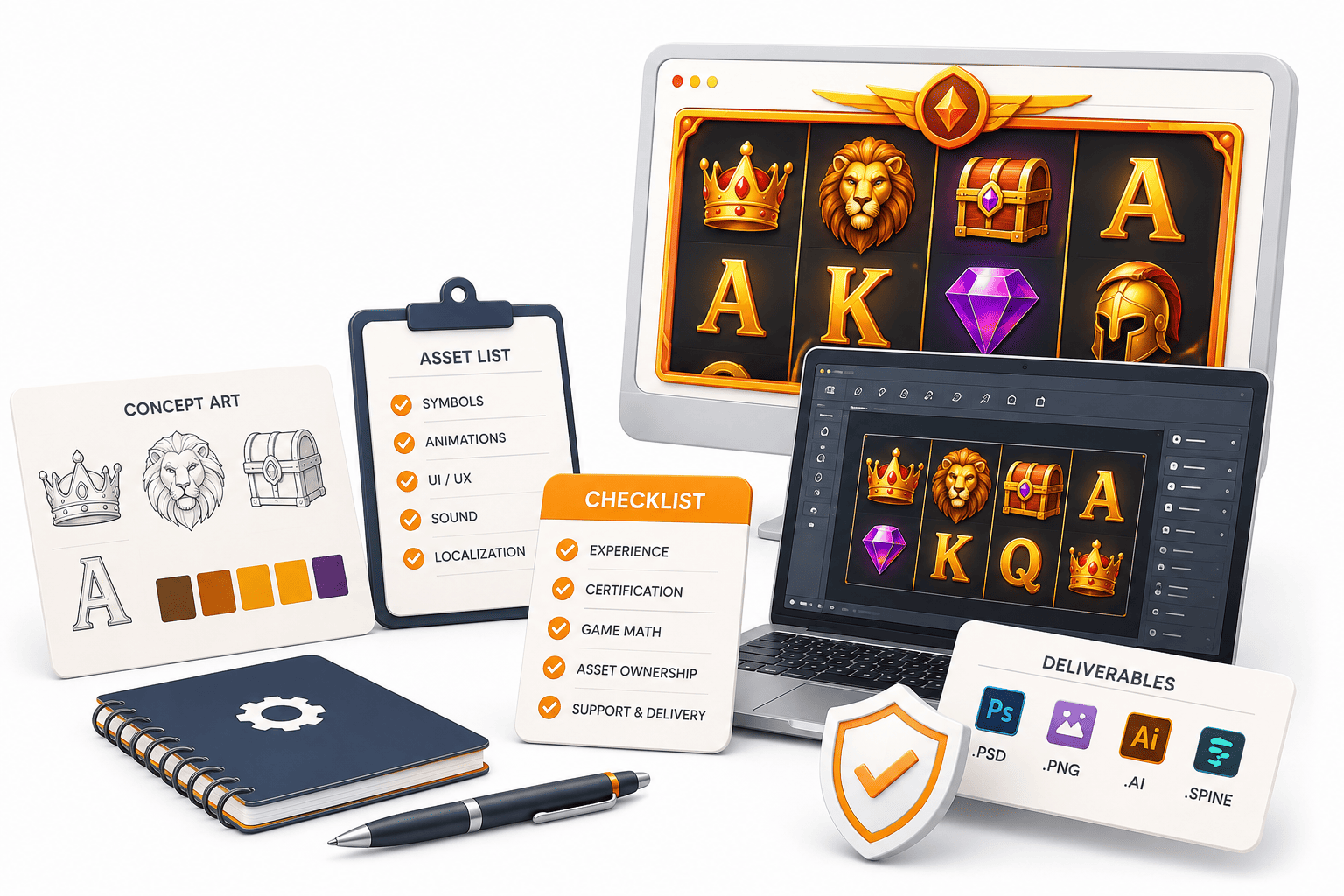

Choosing a slot reskin studio is not the same as hiring an art outsourcing vendor.
A reskin can look simple from the outside. Replace the symbols, change the background, update the UI, and ship. In practice, a production-ready reskin has to work within an existing game structure, preserve the right technical components, meet the expected art quality, support target markets, and fit the required compliance path.
Getting those decisions wrong can leave you with something that looks like a cheap recolor rather than a new game presentation.
The commercial context also makes vendor quality more important. According to Mordor Intelligence’s 2026 slot machine market analysis, the global slot machine market is estimated at $11.47 billion in 2026 and projected to reach $17.01 billion by 2031, representing an 8.18% CAGR.
As digital and online slot distribution expands, operators need studios that can support more than visual replacement. A capable reskin partner should understand production quality, localization, technical integration, compliance boundaries, and the repeatable workflows required to refresh content across multiple markets.
At Twin Win Games, we recommend asking seven questions before choosing a studio for reskin production.
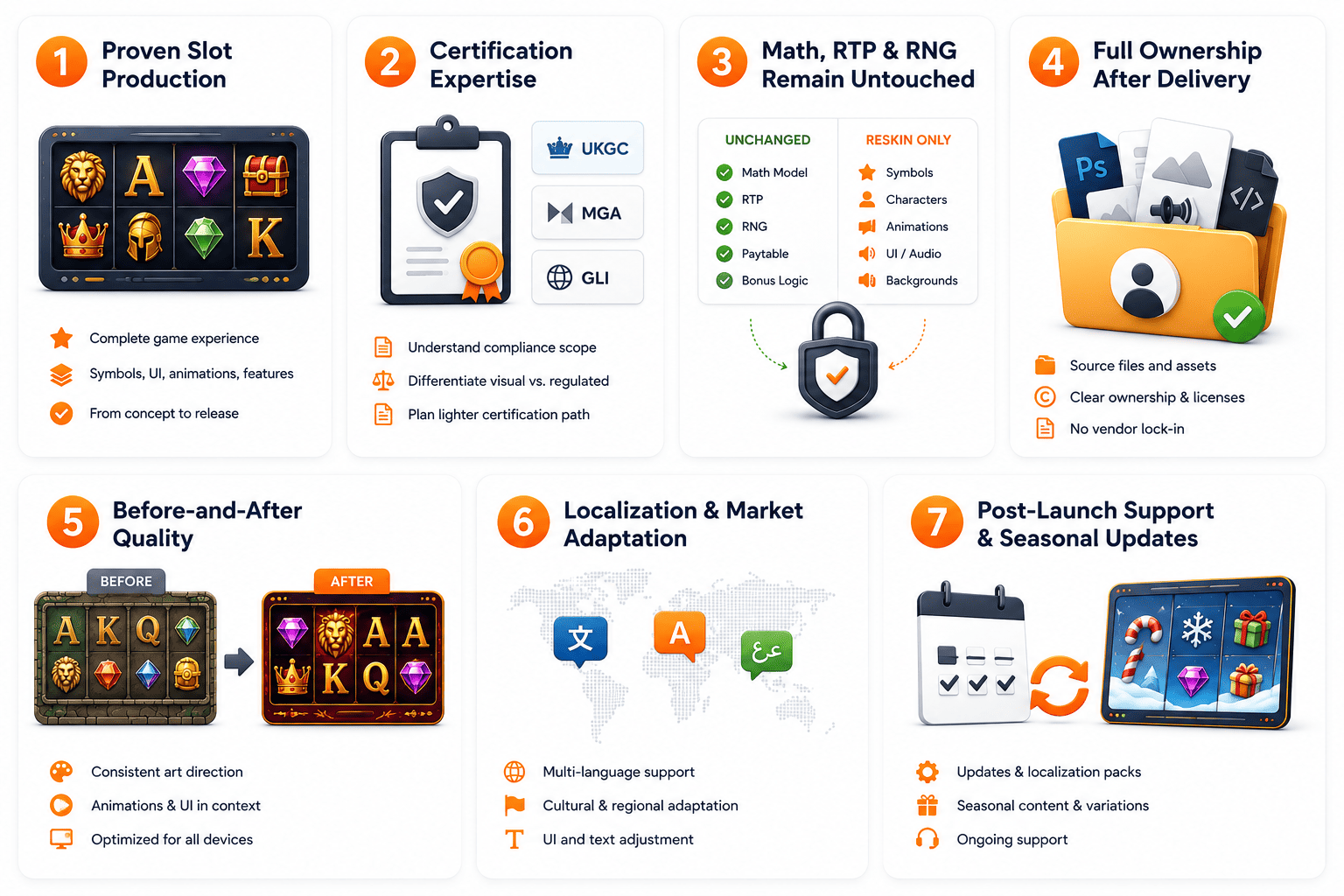
1. Have You Actually Shipped Slots, or Just Recolored Them?
This should be the first question because a slot reskin is more than replacing one set of PNG files with another.
Why It Matters
A production team needs to understand how casino game assets function inside the game.
Symbols can have multiple states. Wilds and scatters may need specific animation behavior. Feature screens have to communicate game events clearly. UI needs to work across devices. Animation has to fit timing and technical constraints.
The new visual identity also needs consistency across symbols, characters, backgrounds, feature assets, UI, animation, and promotional materials.
A team that understands only illustration may produce attractive individual assets that do not work as a complete slot.
At Twin Win Games, slot game art production is part of a wider casino development workflow. Our artists, animators, UI specialists, and developers work with the requirements of the game rather than treating each asset as an isolated image.
What a Strong Answer Looks Like
Ask the studio to explain its actual production role on previous slot projects.
A strong answer should cover more than how many images the team created. The studio should be able to discuss asset structure, animation, UI, implementation requirements, technical handoff, QA, and how its work reached a playable release.
It should also be able to explain the difference between a light visual refresh and a full thematic reskin.
Red Flag
The portfolio shows individual illustrations but no evidence of complete casino game production.
Another warning sign is a studio that describes a reskin primarily as changing colors, backgrounds, and symbol graphics. That may be enough for a very limited refresh, but it is not evidence that the team can deliver an original-release-quality reskin.
2. How Do You Handle Certification and Re-Certification?
A good casino game reskin company should understand where visual production ends and regulated game logic begins.
Why It Matters
One of the advantages of a true visual reskin is the ability to retain the existing technical foundation.
When the math, RNG, RTP, paytable, and core game logic stay unchanged, the compliance path is usually lighter than it is for a completely new game.
But “lighter” does not mean “nothing to do.”
The exact requirements depend on the testing lab, jurisdiction, existing certification, and the changes introduced by the reskin. Documentation, review, change analysis, or additional testing may still be required.
A studio that does not understand this boundary can create unnecessary compliance work by changing components that should have remained untouched.
What a Strong Answer Looks Like
The studio should first ask where the game is certified and where the new version will operate.
It should then distinguish between presentation changes and changes to certified or regulated components.
Experience with environments involving requirements such as UKGC, MGA, and GLI is valuable because the production team needs to understand that compliance considerations belong in project planning, not at the end of the art pipeline.
Red Flag
The vendor promises that a reskin never requires re-certification.
That answer is too absolute. Certification requirements depend on the lab, jurisdiction, existing approval, and exact scope of changes.
3. Do You Keep the Math, RTP, and RNG Untouched?
This question gets directly to the purpose of a reskin.
Why It Matters
If you are reskinning a proven slot, the value often lies in what you are not changing.
The math model defines the game’s behavior. RTP, RNG, paytable, reel configuration, bonus logic, and other technical components can be tied to certification and to the performance characteristics you want to preserve.
A visual reskin should not casually modify these elements.
At Twin Win Games, we treat the presentation layer and core game logic as separate areas whenever the project structure allows it. Our modular slot engine follows the same principle by separating reusable technical components from content and presentation layers.
What a Strong Answer Looks Like
The studio should be able to define exactly which files, systems, and components it expects to change.
For a visual-only reskin, the answer should focus on areas such as symbols, characters, backgrounds, animation, UI, audio, localization, and marketing assets.
If the requested concept requires changes to math or mechanics, a good studio should say so rather than forcing the project into the “reskin” label.
At that point, you may need new slot development instead. That distinction can have a major impact on budget, timeline, and production scope. If you are still deciding which approach fits your project, our reskin vs building a new slot comparison explains when reusing a proven game makes sense and when an original build is the better investment.
Red Flag
The vendor cannot clearly explain which parts of the game will remain untouched.
If the boundary between presentation and game logic is vague before production, it is unlikely to become clearer during implementation.
4. Who Owns the Assets and Source After Delivery?
This question should be answered before the first asset goes into production.
Why It Matters
A reskin can become part of a larger content pipeline.
You may want to update the game later, localize it for another market, create seasonal variations, reuse production workflows, or move future development to another team.
You should know what you receive at handoff and what rights you have to use it.
At Twin Win Games, the client owns the delivered source produced for the project according to the agreed scope. We believe the handoff should leave the client able to operate the product rather than create unnecessary vendor lock-in.
What a Strong Answer Looks Like
The contract should clearly define ownership and deliverables.
Depending on the project, that can include final production assets, layered source artwork, animation project files, UI sources, audio assets, exported files, documentation, and other agreed materials.
Also ask about third-party components. Fonts, stock assets, plugins, licensed IP, audio libraries, and other external materials may have their own licensing conditions.
Ownership should be clear before production starts.
Red Flag
The studio is vague about source files or only discusses final exported assets.
Another warning sign is discovering licensing restrictions after the art has already been approved.
5. Can You Show Before-and-After Work at Original-Release Quality?
Do not evaluate a reskin studio only by its best standalone artwork.
Ask to see what changed from the original game to the final reskinned version.
Why It Matters
A successful reskin should feel intentional.
The new symbols should belong to the same visual world as the characters. Animation should support the art direction. UI should look like part of the new theme rather than an old interface with new colors. Feature screens and promotional assets should maintain the same quality level.
This is where the difference between a reskin and a recolor becomes visible.
Twin Win Games has worked in game development for 13+ years, with 1,000+ games released, 198+ clients worldwide, and a team of 100+ in-house specialists. That production depth allows slot game art to be developed alongside animation, UI, engineering, and integration requirements.
When evaluating any studio, however, do not rely on the numbers alone. Look at the work.
What a Strong Answer Looks Like
Ask for comparable projects.
If you need a character-driven slot, review character-driven work. If your game depends heavily on feature animation, ask to see animation. If you need multiple regional versions, ask for examples that demonstrate localization capability.
Before-and-after examples are particularly useful because they show whether the studio can create a genuinely new identity while working within an existing game structure.
Red Flag
The studio shows polished concept art but cannot show how that quality translates into complete game assets.
A beautiful key visual does not tell you whether reel symbols remain readable, animations work in context, or UI survives on mobile.
6. Can You Localize and Adapt for My Target Markets?
Localization is more than translating button labels.
Why It Matters
A theme that works in one market may not have the same relevance in another.
Regional adaptation can affect language, symbols, characters, cultural references, visual details, audio, promotional materials, and even how information is presented in the interface.
For operators targeting several markets, these requirements can multiply quickly if they are not considered when the base reskin is designed.
A studio with localization experience can structure assets so future regional versions are easier to produce and maintain.
What a Strong Answer Looks Like
The studio should ask about target countries, languages, jurisdictions, platforms, and regional requirements during scoping.
It should also identify which assets contain text and which visual elements may need alternative versions.
Good localization planning separates reusable assets from market-specific ones. This reduces unnecessary rework when another language or region is added.
Red Flag
The vendor treats localization as a final translation task.
If regional requirements appear only after the master artwork is finished, you may end up rebuilding graphics, UI, and animations that could have been designed for localization from the start.
7. Do You Support Post-Launch Updates and Seasonal Reskins?
The first launch may not be the end of the project.
Why It Matters
Operators increasingly manage content as a pipeline rather than as isolated releases.
A successful game may need additional languages, promotional assets, seasonal content, technical updates, or another thematic version. A studio that understands the original asset structure can usually handle those changes more efficiently than a new team starting from zero.
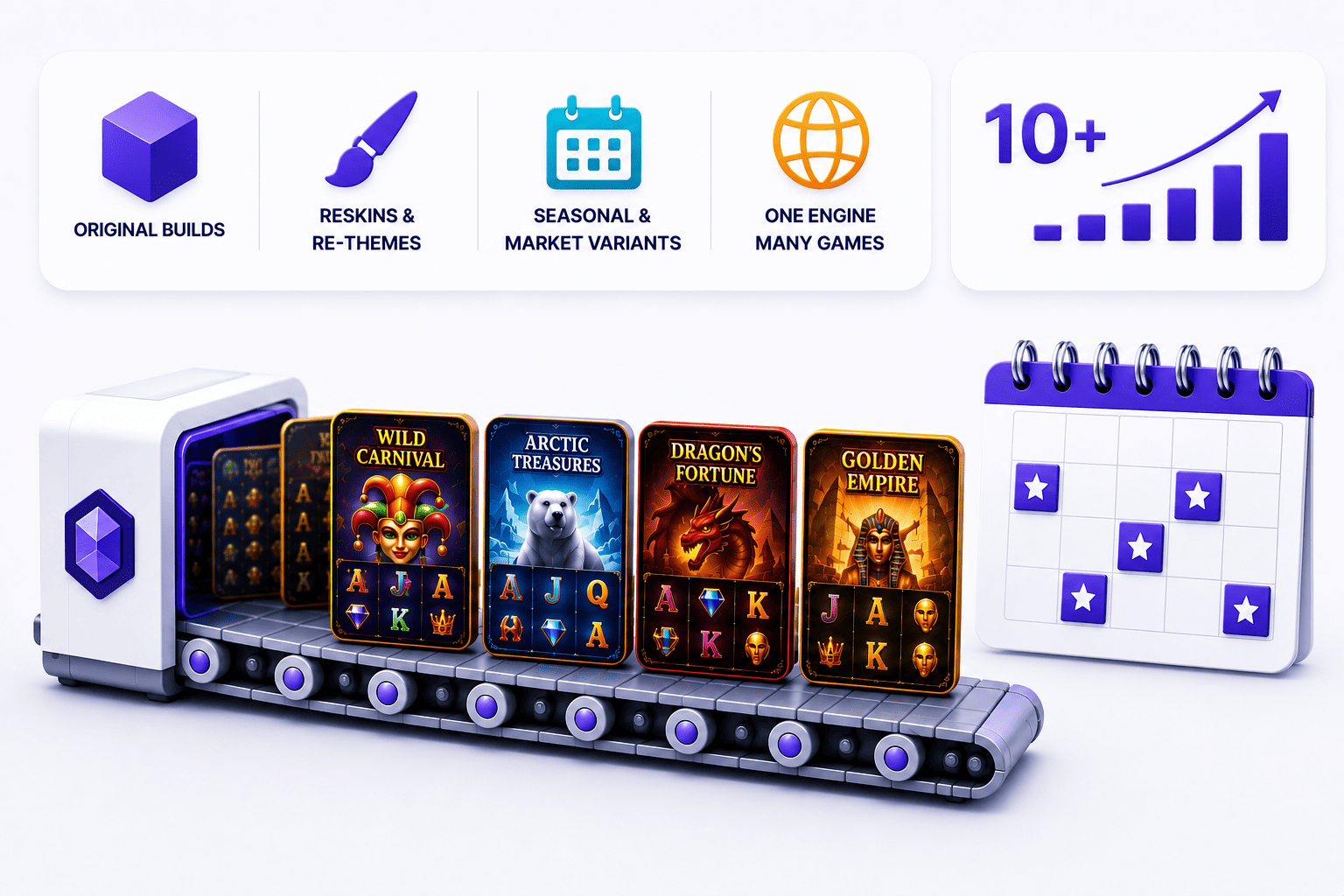
This is also where a modular production approach becomes valuable. A reusable technical foundation can support multiple content directions when the game architecture and asset pipeline were designed with that goal in mind.
What a Strong Answer Looks Like
Ask what happens after delivery.
Can the studio produce additional localization packs? Can it update individual assets without rebuilding the complete theme? Can it create seasonal versions? Can it support implementation if your platform changes?
The answer should also explain how source files and documentation are organized for future work.
Red Flag
The relationship effectively ends when the final exports are delivered.
That may be acceptable for a one-off art project. It is less useful if your goal is to build a repeatable reskin or content-production pipeline.
If budget planning is part of your vendor comparison, our slot game reskin cost guide explains how art complexity, asset count, animation, localization, UI, and integration affect the final scope.
Red Flags at a Glance
A single warning sign does not always disqualify a vendor. Several together should make you look more closely.
- “We can reskin anything in a few days.” A production-ready reskin requires scoping, art production, implementation, review, and QA.
- No shipped slot experience. Casino game art has technical and product requirements that general illustration work does not demonstrate.
- The process sounds like a recolor. Replacing colors and a few symbols is not the same as building a coherent new visual identity.
- No clear boundary around math and game logic. The studio should know what it is changing and what it is preserving.
- Guaranteed zero re-certification. Compliance requirements depend on the testing lab, jurisdiction, and actual changes.
- Unclear source ownership. You should know what files and rights you receive before production.
- Only beauty shots in the portfolio. Ask to see complete game assets and, where possible, before-and-after examples.
- Localization comes last. Multi-market requirements should influence the production structure from the start.
- No post-launch process. This matters if the game will receive updates or further reskins.
- A quote appears before the studio understands the asset list. A serious estimate should reflect actual scope.
Price deserves context too. A lower quote can reflect an efficient workflow, but it can also mean fewer assets, simpler animation, limited source delivery, or less implementation support.
For budgeting, slot reskins commonly sit around $30,000–$40,000, depending on scope. The useful comparison is not which studio gives the smallest number. It is what is included in that number and what you will receive at handoff.
How Twin Win Games Answers These Questions
The seven questions above should work whether you are evaluating Twin Win Games or another production partner.
Here is how we approach them.
We have spent more than 13 years in game development and have contributed to 1,000+ released games for 198+ clients worldwide. Our team includes 100+ in-house specialists, covering the disciplines required to move from concept and art through animation, UI, development, and integration.
For reskin projects, we define the presentation layer that needs to change and identify the technical foundation that should remain intact. We account for certification requirements during scoping, with experience around UKGC, MGA, and GLI environments, while recognizing that the final compliance path depends on the relevant testing lab and jurisdiction.
We define source delivery and ownership in the project scope. We can also structure production for localization, future updates, and additional thematic versions when those are part of the content roadmap.
Most importantly, we scope the game before pricing it.
If you are comparing studios, send us the existing game, target markets, desired visual direction, and available source materials. We can show you how our reskin production would be structured and what the project would require.
FAQ
What should I look for in a slot reskin studio?
Look for shipped casino game experience, strong complete-game artwork, clear technical boundaries, certification awareness, transparent source ownership, localization capability, and post-launch support. A good slot reskin studio should understand how art, animation, UI, game logic, integration, and compliance interact rather than treating the project as a simple graphics replacement.
How do I avoid a low-quality reskin?
Ask for before-and-after examples and review complete game assets rather than standalone illustrations. Define the visual direction, asset list, animation scope, UI requirements, source deliverables, and QA process before production begins. If the proposed process sounds mainly like recoloring existing graphics, clarify what will actually be redesigned.
Does the studio need slot-specific experience?
Slot-specific experience is highly valuable because casino games have requirements that go beyond illustration. The studio needs to understand symbol readability, game states, animation timing, UI, technical implementation, regulated components, and the asset structure required for a playable release.
Who should own the source files?
Ownership should be agreed in the contract before production starts. At Twin Win Games, clients receive ownership of the project source delivered under the agreed scope, while any third-party materials remain subject to their applicable licenses. The deliverables should clearly state which source and production files are included.
Should a reskin studio handle certification?
The studio should at minimum understand certification boundaries and prepare its work so unnecessary changes to regulated game components are avoided. A visual-only reskin can follow a lighter compliance path when math, RNG, RTP, paytable, and game logic remain unchanged, but the exact requirements depend on the testing lab and jurisdiction.
Choose a Studio That Understands the Game, Not Just the Artwork
The best way to choose a casino game reskin company is to look beyond the portfolio cover image.
Ask what the team has shipped. Ask what stays unchanged. Ask how certification is handled. Ask what source you receive. Review before-and-after work. Discuss localization. Find out what happens after launch.
Those answers will tell you much more than a sales presentation or a low headline quote.
If you have an existing slot and want to understand what a production-ready reskin would require, Get a Reskin Quote from Twin Win Games. We can review the game, define the scope, and identify the right production path before work begins.