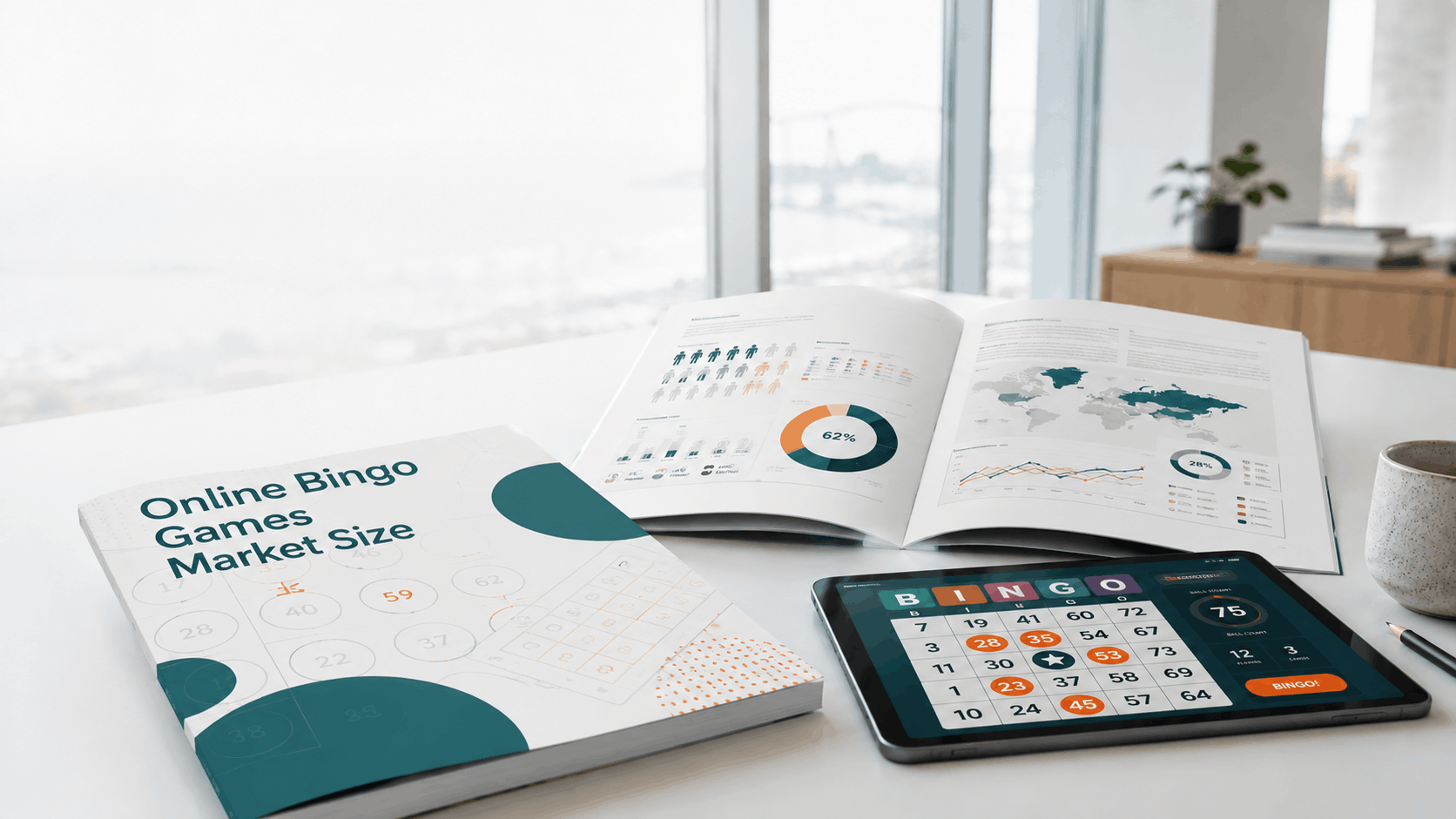

Bingo game development is the process of building digital bingo products for mobile, web, or desktop platforms, covering game engine, social mechanics, monetization, and where relevant, real-money compliance. The global online bingo market is valued at $3.37 billion in 2026 and growing at 6.47% CAGR. The primary opportunity for studios and operators is the gap between a large, loyal, underserved female audience and a market still dominated by legacy operators. Twin Win Games builds bingo games for both social and real-money contexts.
The Market: What the Numbers Actually Show
The online bingo games market is worth $3.37 billion in 2026 and is projected to reach $5.96 billion by 2035 at a CAGR of 6.47% (Business Research Insights, 2026). When bingo is counted within the broader online casino and lottery segment, the combined market reached $89.6 billion in 2025 and is projected to expand to $231.8 billion by 2034 (DataIntelo, 2026).
Statista projects the global lottery and bingo segment will reach $167.47 billion by 2029, with the United States generating $39.61 billion by 2026.
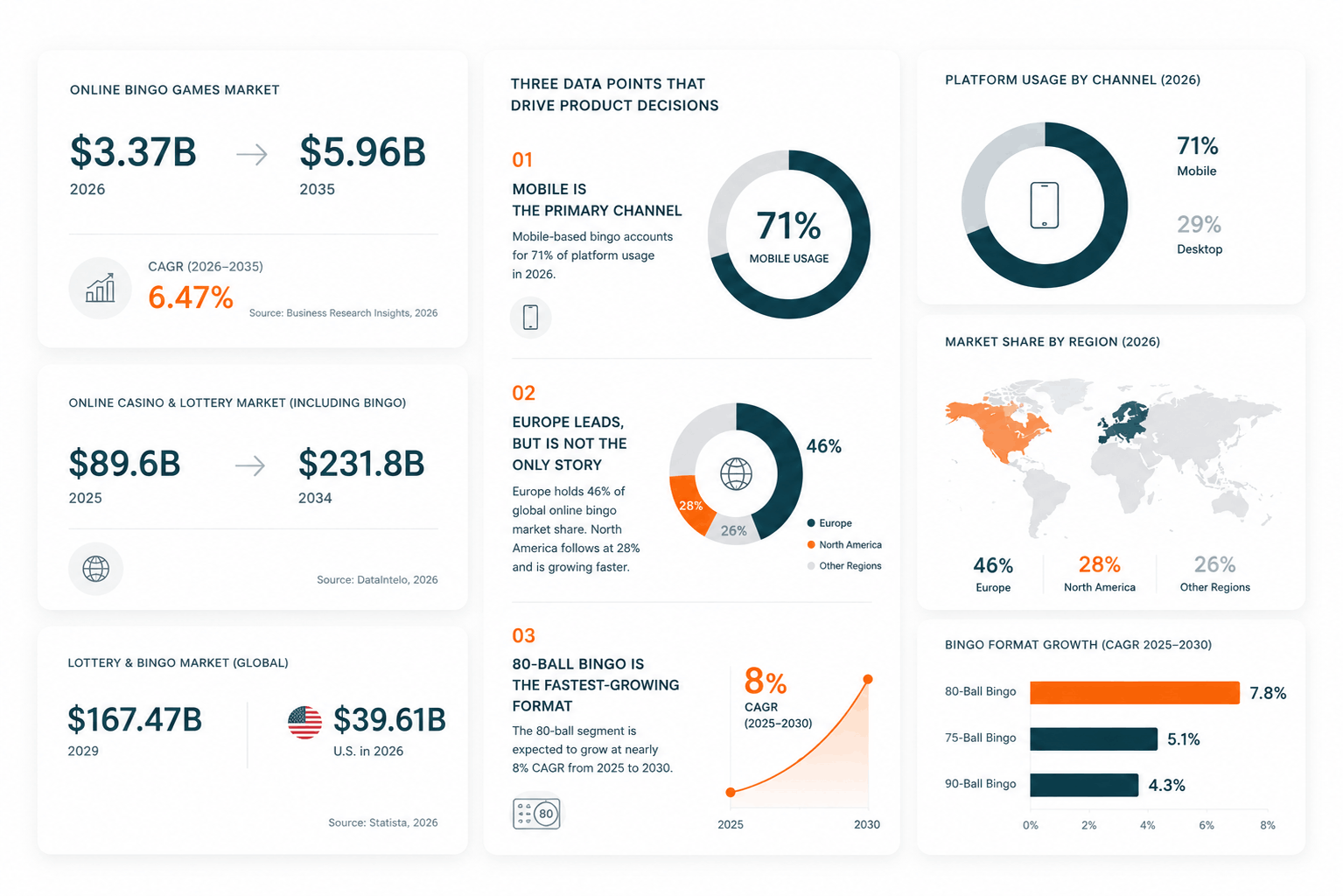
Three data points matter most for product decisions:
Mobile is the primary channel. Mobile-based bingo accounts for 71% of platform usage in 2026 (Business Research Insights). App-based solutions are the fastest-growing segment, expected to post the highest CAGR from 2025 to 2030 (Grand View Research). Any bingo product built desktop-first is building for the wrong screen.
Europe leads, but is not the only story. Europe holds 46% of global online bingo market share. North America follows at 28% and is growing faster as US state-by-state online casino legalization continues.
80-ball bingo is the fastest-growing format. The 80-ball segment is expected to grow at nearly 8% CAGR from 2025 to 2030 (Grand View Research), driven by operators adopting dynamic ticket pricing and themed room events.
Understanding the market is only the first step. Once you’ve validated the opportunity, the next question is how to design and build a modern bingo product. Our technical guide explains the complete development process, from game architecture and RNG to multiplayer infrastructure, LiveOps, and certification.
→ Read our guide: How to Build a Bingo Game.
The Fundamental Choice: Social Bingo vs Real-Money Bingo
Before any production decision is made, a studio or operator must answer one question: which product type are you building? Social bingo and real-money bingo are not the same product in different regulatory wrappers. They require different mechanics, different monetization models, different backend architecture, and different go-to-market strategies.
| Factor | Social Bingo | Real-Money Bingo |
| Monetization | In-app purchases, rewarded ads, virtual currency | Ticket sales, GGR, jackpot rake |
| Regulation | App store compliance only | Gambling licence (UKGC, MGA, etc.) |
| RNG requirement | Internal, uncertified | Third-party certified, audited |
| Backend | Standard game server | Wallet, KYC, AML, RG tools |
| Key markets | US, APAC, LatAm | UK, Ireland, Spain, Italy |
| Leading examples | Bingo Blitz (Playtika), Bingo Bash (GSN) | Tombola, Mecca Bingo (Gamesys) |
| Revenue ceiling | High volume, lower ARPU | Lower volume, higher ARPU |
| Time to market | 4 to 8 months | 12 to 18 months including licensing |
The choice determines everything. A studio that builds a social bingo game and then tries to retrofit real-money mechanics will rebuild the product from the backend up. Decide before the first wireframe.
Key Markets: Where the Opportunity Is and What It Requires
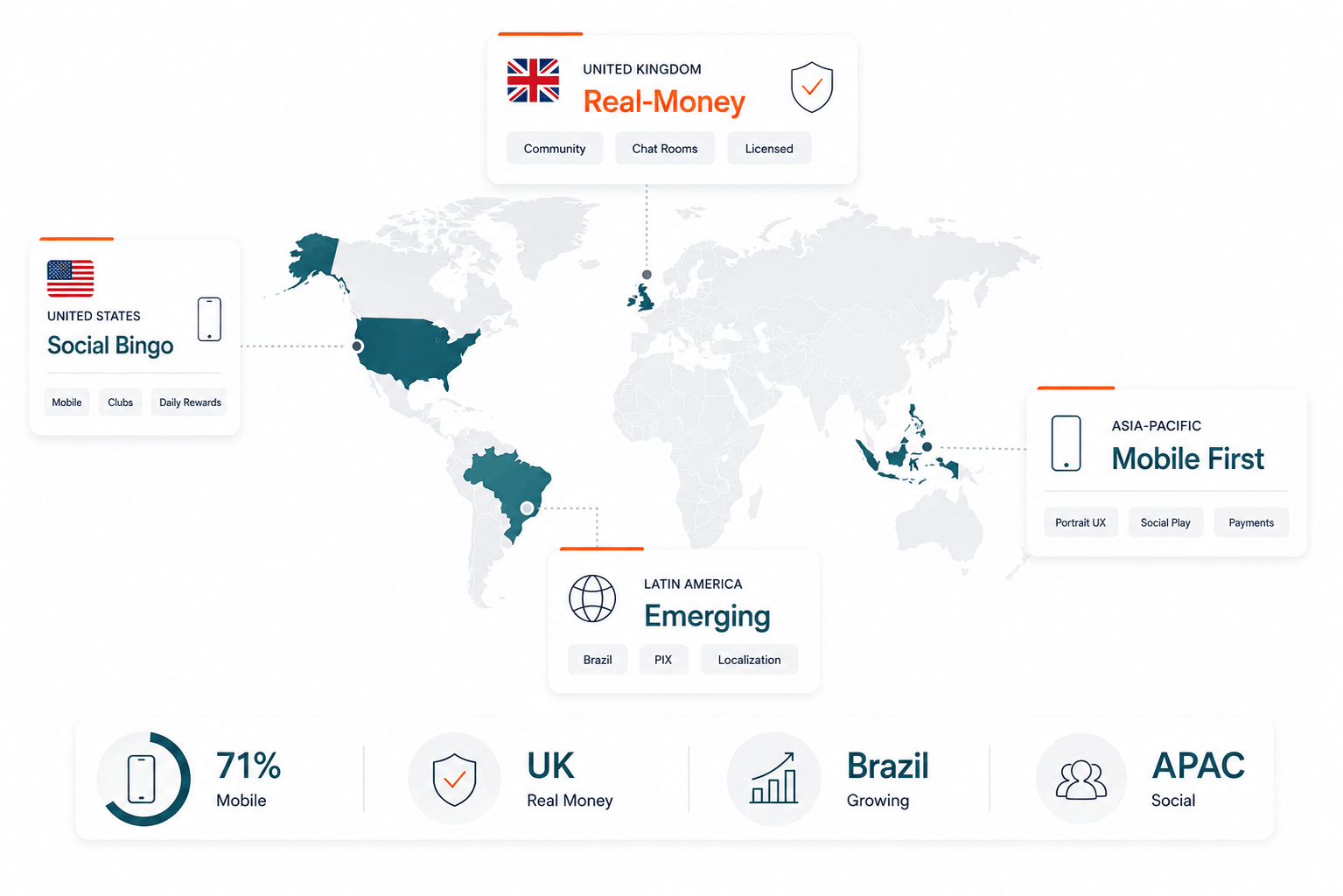
United Kingdom: The Real-Money Benchmark
The UK is the largest real-money bingo market globally and the most mature regulated environment. Remote Casino, Betting, and Bingo generated £2.0 billion in GGY in Q3 2025 alone (UK Gambling Commission). Online bingo participation in the UK skews strongly female, with 70% to 80% of players being women aged 30 to 55.
What this means for product: The UK real-money bingo player expects chat rooms, community features, and a familiar hall-bingo atmosphere translated to mobile. Tombola built its dominant position on community mechanics and a deliberately simple UI. Mecca Bingo retained brand equity from its physical estate by emphasizing familiarity and trust signals in its digital product.
UK entry requires a UK Gambling Commission licence and RNG certification from an approved testing laboratory (GLI, eCOGRA, or equivalent). Responsible gambling features, including deposit limits, reality checks, and self-exclusion integration with GAMSTOP, are mandatory from launch.
United States: Social First
Federal law prevents real-money bingo from operating across the US at scale. The market is social casino. Bingo Blitz by Playtika and Bingo Bash by GSN Games have collectively generated hundreds of millions of downloads by building social bingo products that monetize through virtual currency and in-app purchases rather than real stakes.
The US social bingo audience is large, mobile-first, and highly competitive to acquire. What works here is daily reward loops, seasonal events, club or team mechanics, and gifting systems. The monetization ceiling per user is lower than UK real-money, but the addressable audience is several times larger.
As US state-level online casino legalization expands, a subset of states may eventually create real-money bingo opportunities. New Jersey, Pennsylvania, and Michigan are the states most likely to be relevant first. Studios building social bingo products for the US should architect for potential real-money conversion in regulated states.
Latin America: The Emerging Window
Brazil’s regulated online gambling market opened in January 2025 and reached 22.1 million active bettors in its first year. Bingo has deep cultural roots in Brazil, where physical bingo halls were historically popular before they were shut down by federal law. The reopening of regulation creates a realistic path for licensed online bingo in the Brazilian market.
Colombia and Argentina have existing regulated online gambling frameworks that include bingo. These are smaller markets but provide a lower-risk entry point for operators testing LatAm distribution before committing to Brazilian licensing.
Localization requirements for LatAm bingo: Portuguese and Spanish language UI, PIX payment integration in Brazil, culturally resonant themes, and pricing in local currency.
Asia-Pacific: Social Bingo Growth
APAC does not have significant real-money bingo markets due to regulatory restrictions in most jurisdictions. The opportunity is social bingo, particularly in markets with high mobile penetration and strong social gaming engagement: the Philippines, Indonesia, and India.
Mobile-based bingo accounts for 71% of usage globally, and this figure is higher in APAC markets where desktop gaming is less established. Social bingo products targeting APAC need portrait-mode mobile design, local payment method integration, and community features that support team or group play, which resonates strongly with Southeast Asian social gaming behavior.
Choosing a market is the first decision. Building the right product for it is the second. Twin Win Games has built bingo products for both UK real-money and US social contexts. See our bingo game development services →
Bingo Player Types: What Each Needs from the Product
Bingo has one of the most clearly defined player demographics in gaming. Understanding player type before defining the feature set prevents building mechanics that miss the primary audience.
A full breakdown of casino player types and how they map to product decisions is here.
For bingo specifically, three player types dominate:
The Social Player is the core bingo audience. This player comes for community, not just to win. Chat rooms, named dealers or callers, gifting other players, and team features are not nice-to-haves for this type. They are the primary reason for session length. Tombola’s community chat is cited by players as the reason they stay on the platform, not the game mechanics themselves.
The Casual Visitor plays bingo occasionally as entertainment. Simple mechanics, fast onboarding, and a low minimum ticket price are what converts this player. Complexity kills conversion for this type. Classic 90-ball bingo with a familiar card layout and a £0.01 minimum ticket price is more effective than a feature-rich variant that requires explanation.
The Completionist engages with progression systems, loyalty tiers, and milestone rewards. This player responds to daily login streaks, card collection systems, and level-based unlocks. In social bingo, this type drives IAP conversion. In real-money bingo, this type drives loyalty program engagement and higher frequency of return.
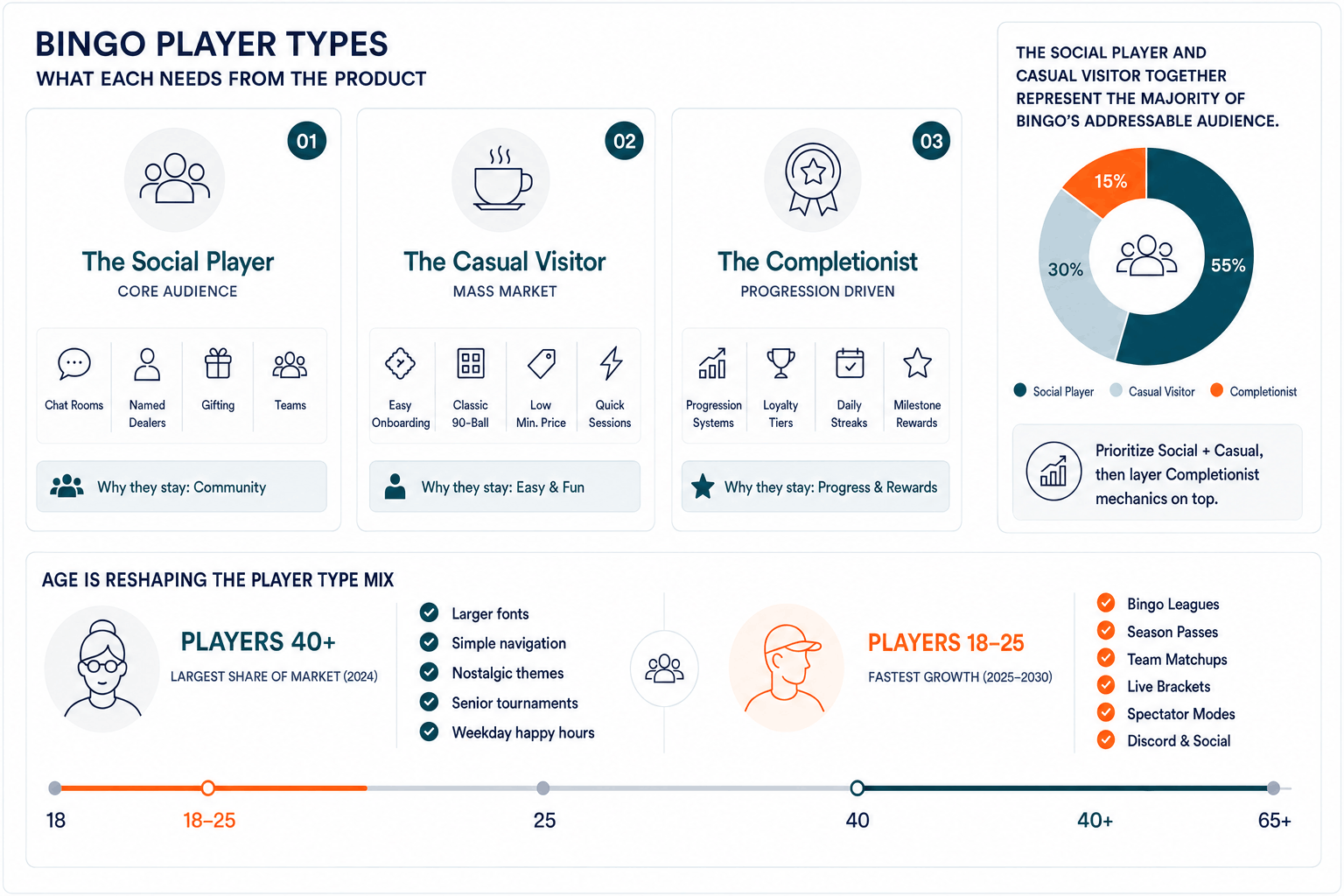
The Social Player and the Casual Visitor together represent the majority of bingo’s addressable audience. Product decisions that optimize for these two types first, then layer Completionist mechanics on top, consistently outperform products built around the inverse priority.
Age Is Reshaping the Player Type Mix
Age data adds a layer the three types do not fully capture. Players above 40 hold the largest share of the online bingo market in 2024 (Grand View Research). This confirms the Social Player thesis. Operators serving this segment adjust font size, simplify navigation, and lean into nostalgic themes. Senior tournaments and weekday happy hours build loyalty here.
Players aged 18 to 25 show the fastest projected growth from 2025 to 2030. This group does not map cleanly to the Casual Visitor or the Completionist. They respond to an esports-style format: scheduled Bingo Leagues, season passes, team matchups, live brackets, and spectator modes. Discord and social channels support team recruitment and post-game discussion.
For studios building for growth, not just current volume, league and tournament mechanics belong in the MVP. Treating them as a post-launch feature misses the fastest-growing segment in the market.
Why Bingo Specifically, in 2026
Three structural reasons make bingo a stronger product investment right now than it was three years ago.
Community mechanics are a genuine retention driver. Slots do not have chat rooms. Table games do not have team events. Bingo’s core mechanic is inherently social. In an era where operators are struggling to build retention without constantly escalating bonus spend, bingo delivers organic repeat sessions through community engagement that no other casino game format replicates.
Retention is structurally higher than slots. Bingo players return more consistently than slot players. The shared session format, where everyone plays the same card draw simultaneously, creates appointment viewing behavior. Players come back for a specific session time. Tombola has maintained player lifetime values significantly above industry slot averages for this reason.
The female audience is the largest underserved segment in iGaming. Women represent 70% to 80% of real-money bingo players in the UK and a substantial majority of social bingo players globally. Most casino game development investment goes into slots, table games, and crash formats that over-index on male demographics. Bingo is the format with the largest, most loyal female audience and the least crowded competitive field for new entrants.
Honest Risk Assessment: What Makes Bingo Entry Difficult
UK real-money market is dominated by entrenched players. Tombola holds a disproportionate share of the UK real-money bingo market and has been building its community for over two decades. Gamesys, which operates Jackpotjoy, Botemania, and multiple other bingo brands, controls significant operator-side market share. A new entrant competing for the same UK audience without a meaningful product differentiation will spend heavily on acquisition against established brands with strong organic return rates.
Licensing timelines are long. UK Gambling Commission licensing for a new bingo operator takes 16 weeks minimum from application to approval, and this assumes a clean application. RNG certification from an approved testing laboratory adds 6 to 12 weeks to the timeline depending on the scope of games to be certified. Studios underestimating this consistently miss planned launch dates.
Social bingo user acquisition costs are high. The major social bingo titles in the US (Bingo Blitz, Bingo Bash) have substantial paid acquisition budgets and well-established organic funnels from years of community building. A new social bingo entrant in the US market without a clear differentiation in mechanics or theme will struggle to reach sustainable unit economics on paid acquisition alone.
The realistic path to bingo market entry in 2026 is one of two approaches. First, enter a regulated market other than the UK with an established real-money licence and build a community product designed specifically for that market’s player demographics. Second, build a social bingo product with a highly specific audience focus, a differentiated theme, or a partner distribution channel that provides an alternative to cold paid acquisition.
Licensing timelines, RNG certification, and market-specific mechanics are exactly where new entrants lose months. Twin Win Games handles bingo development from game design through certification support. Talk to our team →
FAQ
What is the difference between social bingo and real-money bingo?
Social bingo is free-to-play and monetizes through virtual currency purchases and advertising. Real-money bingo involves actual stakes, requires a gambling licence, certified RNG, and responsible gambling features. The two types require fundamentally different tech stacks and go-to-market approaches.
Which is the largest market for online bingo?
The UK is the largest real-money bingo market globally, generating billions in GGY annually through licensed operators. For social bingo, the US is the dominant market by player volume, led by titles from Playtika and GSN Games.
Who are the main competitors in real-money bingo?
In the UK, Tombola and Gamesys (operating Jackpotjoy and related brands) hold dominant positions. In southern Europe, 888 Holdings and local operators have established presences. Any new entrant to real-money bingo needs a clear differentiation in product or audience to compete against these catalogues.
How long does it take to build and launch a bingo game?
A social bingo mobile game takes 4 to 8 months from spec to launch. A real-money bingo platform, including licensing, RNG certification, and backend integration, typically takes 12 to 18 months.
What player demographic does bingo serve best?
Female players aged 30 to 55 represent 70% to 80% of real-money bingo players in the UK. Social bingo audiences are similarly female-skewed. Bingo has a larger, more loyal female audience than any other casino game format, making it a strategically important product category for operators aiming to diversify beyond male-dominated verticals.
Twin Win Games builds bingo games from game design through backend integration and certification support, for both social and real-money contexts.