
Building a bingo game takes 3 to 10 months and costs $30,000 to $150,000 depending on product type. Social bingo and real-money bingo are fundamentally different scopes: different backend architecture, different certification requirements, different compliance obligations. The choice between them determines the entire production plan before a single feature is specced. Twin Win Games builds both types.
The First Decision: Social Bingo vs Real-Money Bingo
Every downstream production decision follows from this choice. Studios that treat it as a late-stage commercial question and start building before answering it consistently rebuild core systems mid-production.
| Factor | Social Bingo | Real-Money Bingo |
| RNG requirement | Internal, uncertified | Third-party certified (GLI, eCOGRA, BMM) |
| Licence | App store only | Gambling licence (UKGC, MGA, PAGCOR, etc.) |
| Backend requirements | Standard game server, IAP | Wallet, KYC, AML, RG tools, audit logging |
| Monetization | Virtual currency, IAP, rewarded ads | Ticket sales, GGR rake, jackpot contribution |
| Retention mechanics | Daily rewards, missions, gifting | Loyalty programs, progressive jackpots, VIP tiers |
| Estimated timeline | 3 to 6 months | 10 to 18 months including licensing |
| Estimated cost | $30,000 to $80,000 | $80,000 to $200,000 |
| Platform | Unity for mobile, HTML5 optional | HTML5 mandatory for aggregator distribution |
Answer this before writing the spec. Everything else is execution.
Core Bingo Game Features
These features are non-negotiable regardless of whether you are building social or real-money bingo. They define the playable game.
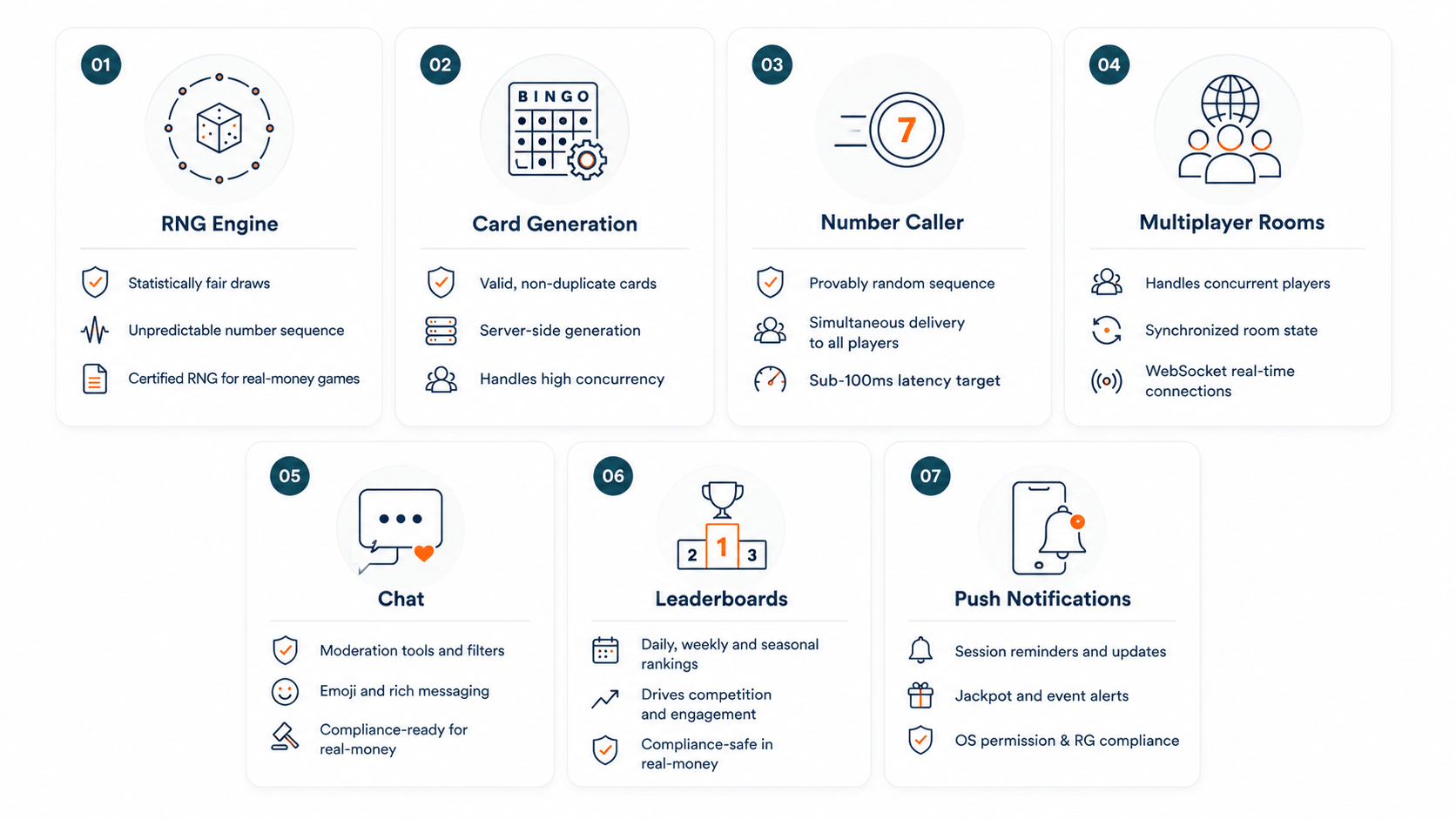
RNG Engine
The RNG draws numbers in a statistically fair sequence and prevents pattern prediction. For social bingo, an internal pseudo-random number generator with standard statistical distribution is sufficient. For real-money bingo, the RNG must be certified by an approved testing laboratory and produce an auditable event log for every draw. The RNG is not a minor component. It is the legal and technical foundation of the product.
Card Generation
The card generation system must produce valid, non-duplicate bingo cards at scale across all active rooms simultaneously. In a multi-room environment with hundreds of concurrent players, card generation runs server-side and must handle peak load without latency. A card generation system that runs client-side is a fraud risk in any real-money context.
Number Caller
The caller sequence must be provably random and communicated to all players in a room simultaneously. In real-time multiplayer, sub-100ms latency between the server draw and the player-visible display is the production target. Any delay longer than 200ms creates perceived unfairness in competitive rooms.
Multiplayer Rooms
Rooms handle concurrent players, room state, ticket assignments, and win detection simultaneously. The technical challenge is consistency: every player in a room must see the same game state at the same moment. WebSocket connections with server-authoritative game state are the standard architecture. Polling-based alternatives do not handle the concurrency requirements of a competitive bingo room.
Chat
Chat is not a secondary feature in bingo. It is part of the core product for the Social Player demographic that drives bingo retention. Moderation tools, profanity filters, and emoji support are scope items, not post-launch additions. For real-money bingo, chat moderation is a compliance consideration in regulated markets.
Leaderboards
Daily, weekly, and seasonal leaderboards drive competitive engagement and repeat sessions. For social bingo, leaderboards integrate with the progression system. For real-money bingo, leaderboards must not display information that creates regulatory compliance problems (visible win amounts above certain thresholds are restricted in some jurisdictions).
Push Notifications
Session start reminders, jackpot alerts, and daily reward prompts drive return visits. Mobile push notification systems require OS-level permission handling for both iOS and Android. In regulated markets, notification content is subject to responsible gambling advertising rules.
Social Layer Features: Social Bingo Specific
Social bingo retention is built on the social layer. These features are what differentiate a social bingo product from a standalone bingo game.
Daily rewards and login streaks. A daily reward calendar with escalating value drives habit formation. The reward curve needs to be designed by a game economist, not added arbitrarily. Poor reward curve design produces players who collect the daily reward and immediately leave.
Missions and seasonal events. Time-limited missions (complete 3 games before midnight, collect 5 lucky charm symbols) increase session frequency. Seasonal events tied to holidays extend engagement during otherwise low-activity periods.
Gifting mechanics. Players sending virtual gifts to other players in their room or club creates social bonds that make leaving the platform costly. Gifting is one of the primary retention mechanics in Bingo Blitz and Bingo Bash for this reason.
Club and team play. Club mechanics, where groups of players contribute to shared goals and earn collective rewards, produce the highest retention rates in social bingo. Players with active club memberships have 3 to 5 times longer median session lengths than solo players in well-designed social bingo products.
Social login. Facebook login and friend discovery are acquisition and retention tools simultaneously. A player who connects their social graph to the product is significantly harder to churn than an anonymous player.
iGaming Features: Real-Money Bingo Specific
Real-money bingo requires a compliance and operations layer that has no equivalent in social bingo. Each of these components is a distinct scope item with its own development and integration timeline.
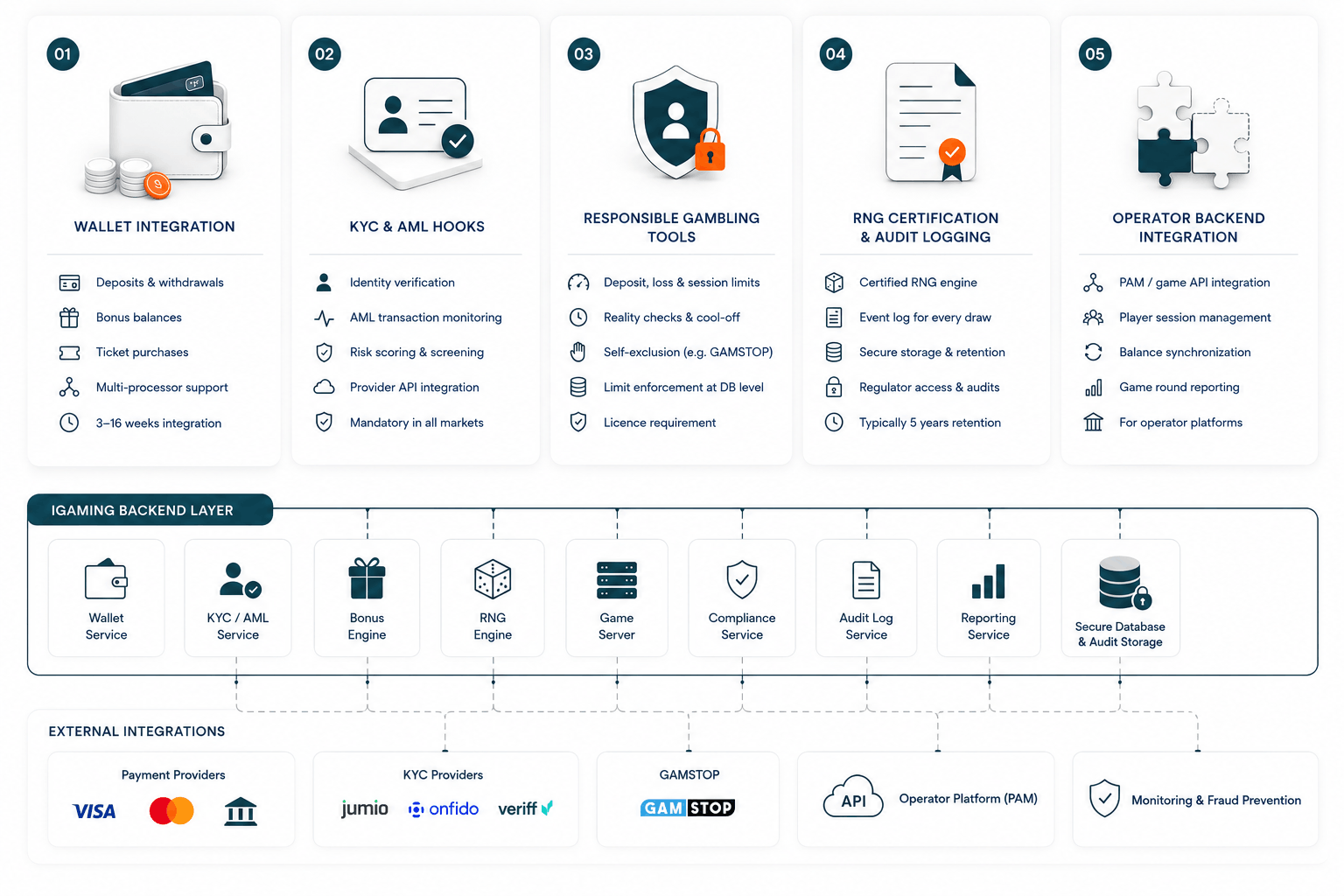
Wallet integration. The player wallet handles deposits, withdrawals, bonus balances, and real-money ticket purchases. It connects to payment processors (cards, e-wallets, bank transfer), bonus engines, and the game accounting system. Wallet integration with a single payment processor takes 3 to 6 weeks. Multi-processor wallet integration with bonus engine connectivity takes 8 to 16 weeks.
KYC and AML hooks. Know Your Customer verification is mandatory before a player can deposit in every regulated market. The KYC flow connects to third-party identity verification providers (Jumio, Onfido, Veriff) via API. AML transaction monitoring flags unusual deposit or withdrawal patterns for manual review. These systems are not optional features. They are licence conditions.
Responsible gambling tools. Deposit limits, loss limits, session time limits, reality checks, cooling-off periods, and self-exclusion integration are all mandatory in regulated markets. In the UK, GAMSTOP integration (the national self-exclusion register) is a UKGC licence condition. These tools must be built into the player account layer, not bolted onto the frontend. A player who has set a deposit limit must be unable to exceed it at the database level, not just at the UI level.
RNG certification documentation. The certified RNG produces an event log for every draw: timestamp, draw sequence, room ID, ticket IDs, and win outcomes. This log must be stored securely, accessible to the regulator, and retained for the period specified by the target jurisdiction (typically 5 years in the UK). The audit trail is a backend architecture requirement, not a reporting feature.
Operator backend integration. For studios supplying real-money bingo to operators rather than running their own platform, the game must integrate with the operator’s backend via a standard game API (PAM integration). This covers player session management, balance synchronization, and game round reporting. Backend game development for regulated bingo is a distinct scope from the game frontend.
Tech Stack for Bingo Development
Frontend
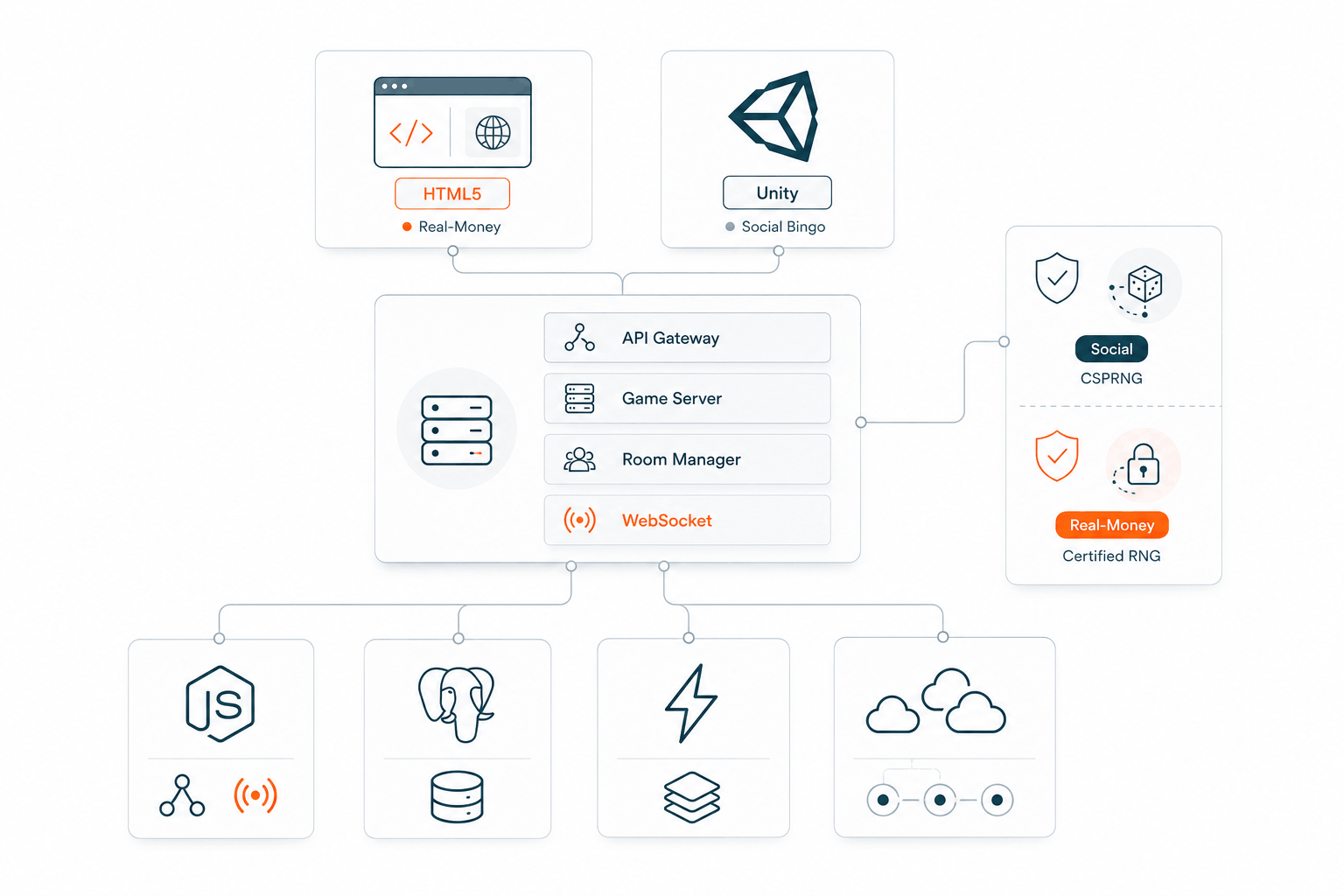
HTML5 is the mandatory delivery format for real-money bingo distributed through operator platforms and aggregators. HTML5 runs in browser without installation, supports cross-platform deployment, and is the format aggregators (Relax Gaming, Yggdrasil, Everi) accept for certified game submission.
Unity is the practical choice for social bingo mobile apps. Unity provides cross-platform export to iOS and Android, a strong 2D toolset for bingo card and room UI, Spine animation support for character and caller animation, and a large developer ecosystem.
Backend
Node.js with WebSocket is the standard backend architecture for real-time bingo. Node.js handles the concurrent connection load that bingo rooms require. WebSocket provides persistent bidirectional connections that deliver number calls and room state updates to all players simultaneously. HTTP polling is not a viable alternative for rooms with more than 50 concurrent players.
Database: PostgreSQL for player accounts, game history, and audit logs. Redis for real-time game state caching in active rooms. A bingo room’s active game state needs sub-millisecond read access; a relational database cannot provide this under concurrent load.
Cloud infrastructure: AWS, Google Cloud, or Azure. Auto-scaling is required for bingo because player load is time-concentrated (session start times create traffic spikes). A fixed server deployment sized for peak load wastes infrastructure cost during off-peak hours.
RNG
For social bingo: a cryptographically secure pseudo-random number generator (CSPRNG) implemented server-side. Seeded from hardware entropy on initialization.
For real-money bingo: either a certified third-party RNG service (Scientific Games RGS, Gaming Laboratories International) or an in-house RNG submitted for third-party audit. The in-house approach is slower and more expensive but gives the studio full control over the audit trail architecture.
Technology is only one side of a successful bingo product. Market demand, player expectations, and monetization strategy determine whether a game succeeds after launch. We cover these trends in our comprehensive market analysis.
→ Read: The State of Bingo Game Development in 2026
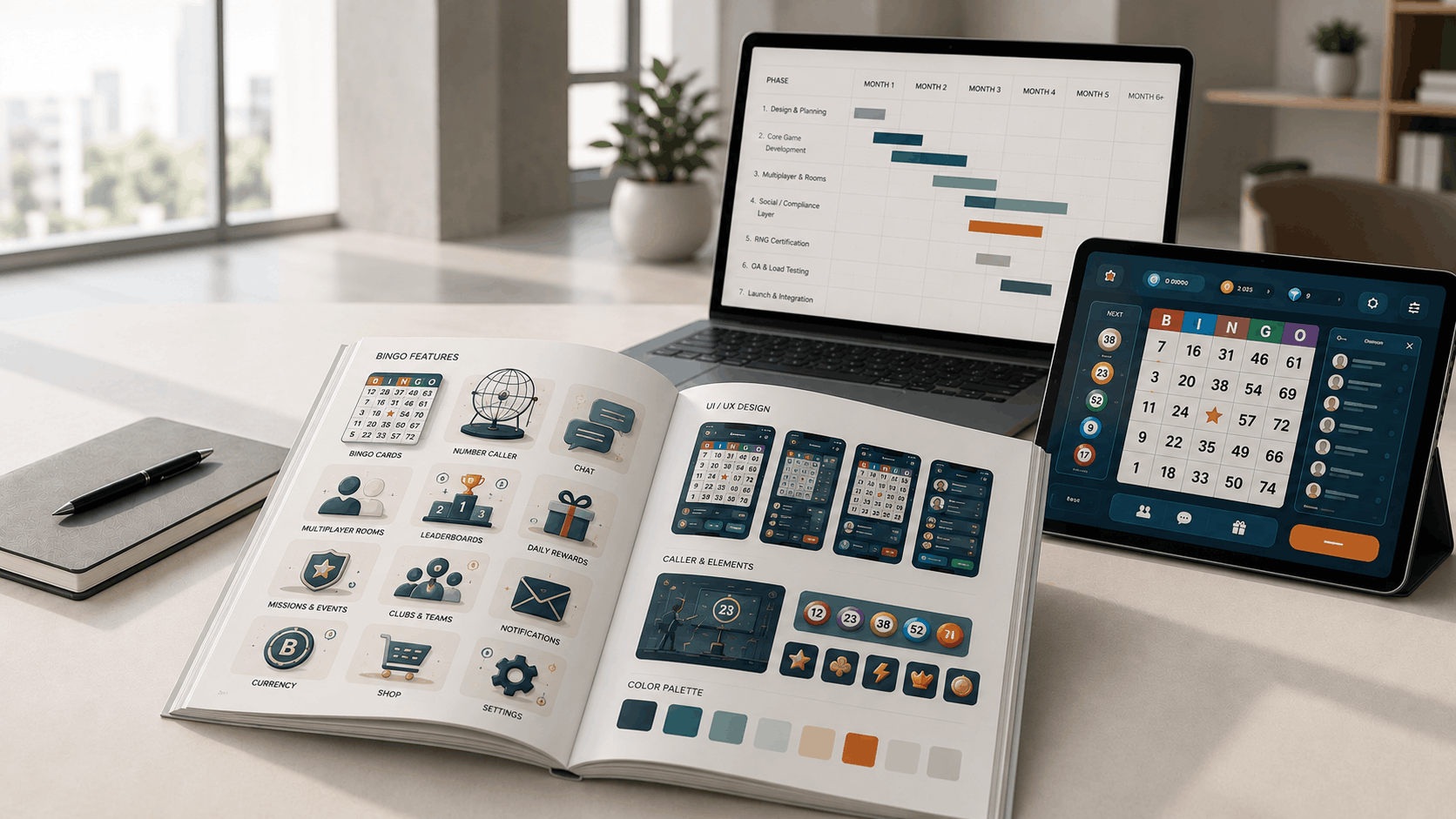
Bingo Development Timeline by Phase
| Phase | Social Bingo | Real-Money Bingo | What Happens |
| Design and spec | 3 to 5 weeks | 4 to 6 weeks | GDD, math model, UX wireframes, feature list locked |
| Core game build | 6 to 10 weeks | 8 to 14 weeks | RNG, card gen, number caller, basic room |
| Multiplayer and rooms | 4 to 8 weeks | 6 to 10 weeks | WebSocket backend, concurrent room handling, chat |
| Social or compliance layer | 4 to 8 weeks | 10 to 20 weeks | IAP/missions OR wallet, KYC, RG tools, audit log |
| RNG certification | N/A | 6 to 12 weeks | Lab submission, testing, remediation, certificate |
| QA and load testing | 3 to 5 weeks | 4 to 8 weeks | Device testing, concurrent load, security audit |
| Launch | 1 to 2 weeks | 2 to 4 weeks | App store submission OR operator integration |
| Total | 3 to 6 months | 10 to 18 months |
The compliance and certification phase is where real-money bingo projects most commonly run over schedule. RNG certification from a testing laboratory involves initial submission, a testing period of 4 to 8 weeks, a findings report, remediation of any issues found, and resubmission. Studios that do not start certification until the game is feature-complete consistently add 3 to 5 months to their timeline. Start certification parallel to the compliance layer build.
Bingo Development Cost Ranges and What Drives Them
| Scope | Cost Range | Primary Variables |
| Social bingo, single platform (iOS or Android) | $30,000 to $55,000 | Feature depth, art style, social layer complexity |
| Social bingo, cross-platform (iOS + Android + web) | $50,000 to $80,000 | Unity cross-platform build + HTML5 variant |
| Real-money bingo, operator-supplied platform | $60,000 to $120,000 | PAM integration complexity, RNG certification scope |
| Real-money bingo, own platform | $120,000 to $200,000 | Wallet, KYC, full compliance stack, certification |
These ranges assume a studio with existing bingo game experience and established architecture. A first-time bingo build without reusable components runs 20% to 40% higher.
5 Things Most Studios Underestimate When Building Bingo
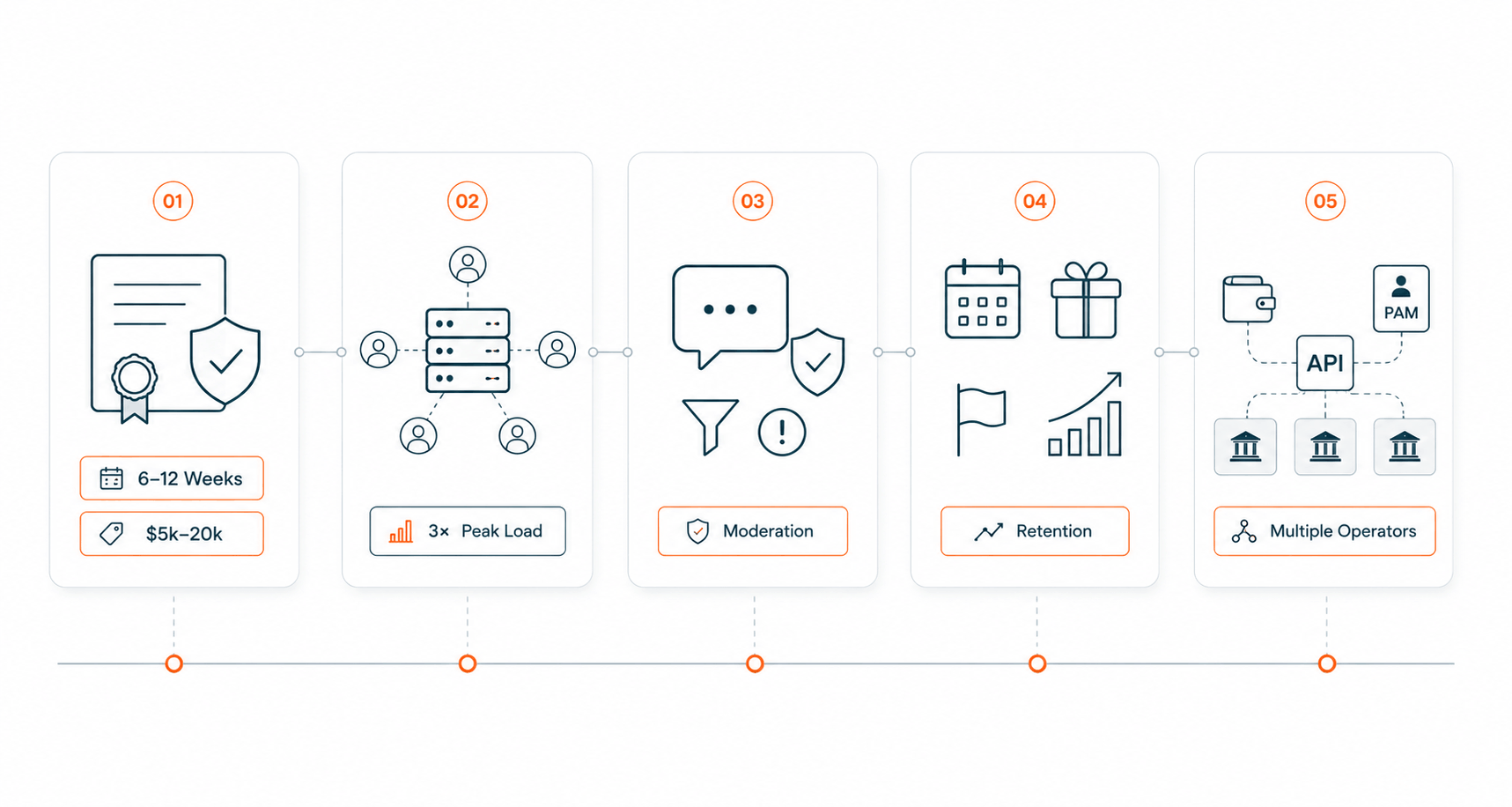
1. RNG Certification Takes Longer Than Expected
RNG certification is a separate project phase, not a QA task. Depending on the target markets and certification provider, approval typically takes 6–12 weeks and should be included in the launch timeline from day one.
2. Real-Time Backend Performance
Bingo servers must synchronize hundreds of players simultaneously. Without proper load testing and scalable infrastructure, performance issues quickly impact player experience and retention.
3. Chat Requires Moderation
Community chat needs moderation tools, profanity filters, and reporting systems. In regulated markets, these are often compliance requirements rather than optional social features.
4. Retention Doesn’t Happen Automatically
Daily rewards, missions, tournaments, clubs, and seasonal events require dedicated design and backend support. These systems drive long-term retention and should be planned from the start.
5. Operator Integration Takes Time
Each operator uses different PAM systems, wallet APIs, and technical requirements. Supporting multiple operators usually means multiple integration and QA cycles—not a single deployment.
Working with Twin Win Games on Your Bingo Project
Twin Win Games builds custom bingo games for both social and real-money contexts. The engagement starts with product type definition, target market, and compliance requirements before any production scope is set. Casino game development at Twin Win Games includes HTML5 delivery, backend architecture, RNG certification support, and operator integration across the major platform aggregators.
For producers and studios with a bingo project in scoping, the starting point is a production brief review and scope estimate based on your specific requirements.
Request a quote.
FAQ
How much does it cost to build a bingo game in 2026?
Social bingo costs $30,000 to $80,000 depending on platform count, art complexity, and social layer depth. Real-money bingo costs $80,000 to $200,000 depending on whether you are building on an existing operator platform or building your own compliance stack. RNG certification and backend scaling are the two most commonly underestimated cost items.
How long does bingo game development take?
Social bingo takes 3 to 6 months from spec to launch. Real-money bingo takes 10 to 18 months including RNG certification, licensing, and operator integration. The compliance phase is where most real-money projects run over their initial timeline estimate.
What is the difference in tech stack between social and real-money bingo?
Social bingo uses Unity for mobile native apps and Node.js with WebSocket for the backend. Real-money bingo uses HTML5 for the game frontend (mandatory for aggregator distribution), Node.js with WebSocket for the backend, and adds wallet integration, KYC/AML API connections, RG tools, and audit log architecture.
Do I need RNG certification for a social bingo game?
No. Social bingo (free-to-play, no real money) does not require third-party RNG certification. An internal CSPRNG implementation is sufficient. RNG certification is required for real-money bingo in every regulated jurisdiction and is a condition of the gambling licence.
What should I define before starting bingo game development?
Three things: product type (social vs real-money), target market and regulatory jurisdiction, and primary player demographic. These three decisions determine the tech stack, compliance requirements, feature priority, and go-to-market timeline. Starting development before any of these are locked is the primary cause of scope changes mid-production.