
Card games have been played for over 600 years. The oldest European card game on record dates to the 15th century. In 2026, digital card games generate billions in annual revenue, attract hundreds of millions of players globally, and represent one of the most commercially durable formats in the gaming industry.
The format’s longevity is not accidental. Card games deliver something that few other game types can match: strategic depth accessible to casual players, infinite replayability through randomness and skill interaction, and social competition that scales from two players at a kitchen table to global competitive tournaments.
For studios and operators evaluating card game development, the opportunity is real but so is the complexity. Whether you’re figuring out how to make a card game from scratch, how to design a card game mechanic that holds up at scale, or how to create your own card game for a regulated market, the process follows the same structured path. This guide covers everything you need to make informed decisions: game types, development process, costs, team structure, tech stack, and what separates the card games that build lasting player bases from those that don’t survive their first quarter.
Card Game Development: Scope and Complexity
Card game development is the process of designing, building, and launching a digital game where cards are the primary mechanic. Cards are the means by which players take actions, manage resources, and pursue win conditions.
Digital card game development encompasses everything from simple solitaire apps to enterprise-scale real-money poker platforms and full collectible card game (CCG) ecosystems with hundreds of unique cards, real-time multiplayer matchmaking, and live-service content operations.
The defining challenge of card game development is not technical complexity in isolation. It is the intersection of game design, mathematics, software engineering, art production, and (for real-money products) regulatory compliance. Studios that excel in one or two of these disciplines but lack the others consistently produce card games that underperform or fail to launch.
How to create a card game that succeeds commercially is, at its core, a question of how well you integrate all of these disciplines from the start.
Types of Card Games You Can Build
The first strategic decision in card game development is game type. Each type carries distinct design requirements, development complexity, audience profile, and monetization model. If you’re exploring card game ideas to make, or trying to figure out which format best fits your audience and budget, the overview below maps the full range from simple to enterprise-scale.
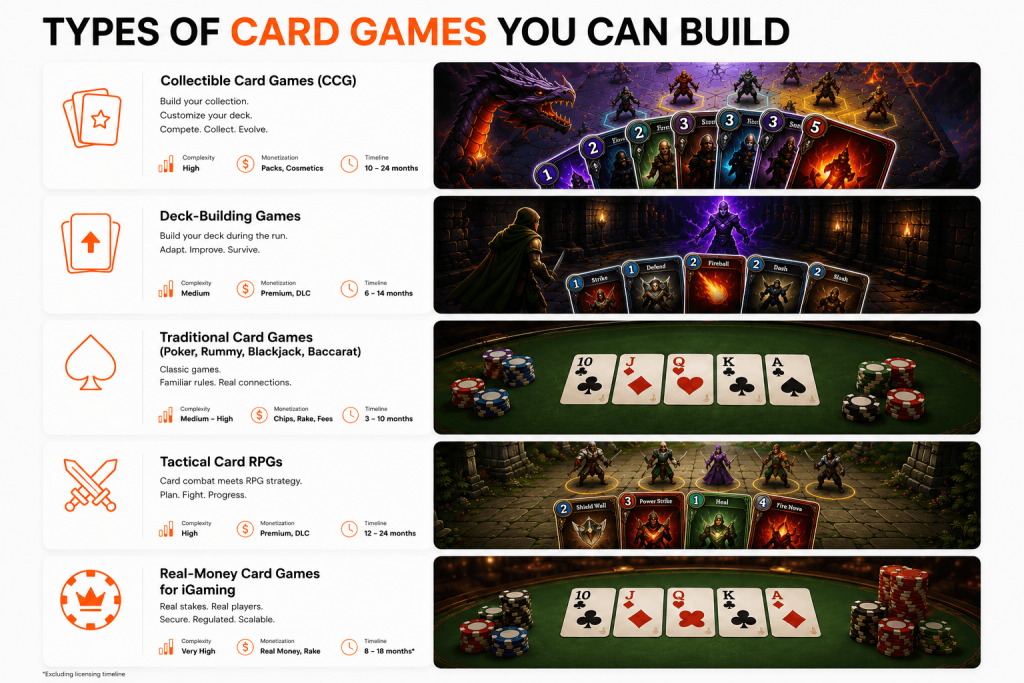
For those looking to make their own card game without the complexity of a full CCG, deck-building games and traditional card game formats offer a more contained starting point with easier card game design scope and proven player demand.
Collectible Card Games (CCG)
In a CCG, players build custom decks from a personal card collection and compete using those decks. The collection phase, acquiring cards through packs, crafting, or gameplay rewards, is itself a primary engagement loop alongside match play.
CCGs are the most commercially ambitious card game type: high development cost, high art production scope, complex live-service operations, but also the highest revenue potential and longest player lifetime value. Hearthstone, Magic: The Gathering Arena, and Legends of Runeterra are the commercial benchmarks.
Development complexity: High
Monetization: Card packs, cosmetics, battle pass, tournament entry
Timeline: 10 to 24 months for commercial launch
Deck-Building Games
In a deck-building game (DBG), players construct their deck during the game session rather than from a persistent collection. Players begin with a small base set and acquire cards as they play, creating emergent strategy within each session.
DBGs have lower development scope than full CCGs (no persistent collection infrastructure, smaller card sets, simpler progression systems) and suit roguelike or session-complete formats. Slay the Spire is the defining modern reference.
Development complexity: Medium
Monetization: Premium purchase, DLC, cosmetics
Timeline: 6 to 14 months
Traditional Card Games (Poker, Rummy, Blackjack, Baccarat)
Digital adaptations of established card games use fixed standard decks and pre-defined rules. Development focuses on faithful rule implementation, smooth UX, and multiplayer infrastructure rather than card design.
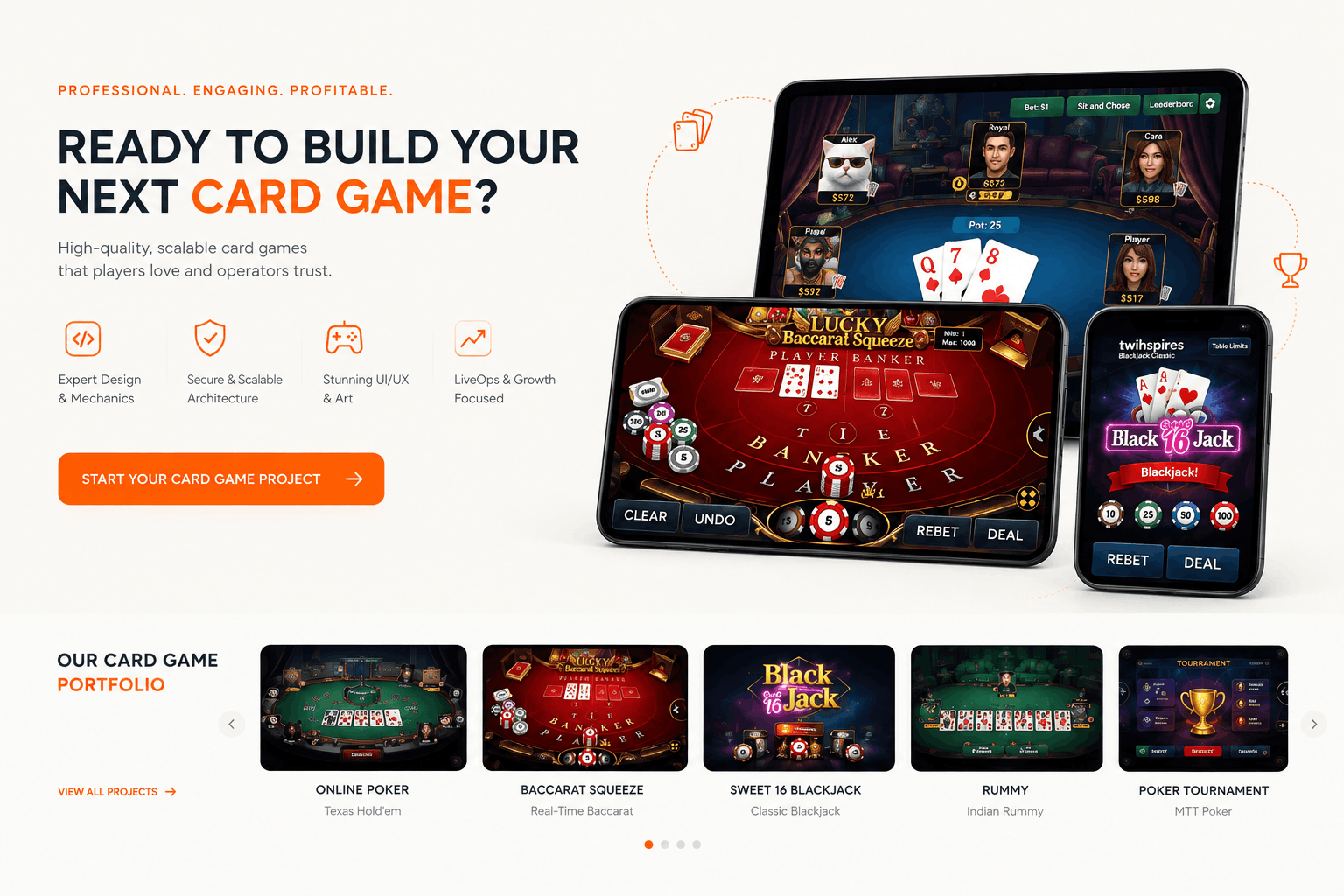
Traditional card games have the largest casual audience and the clearest product-market fit. Players already know the rules. For real-money implementations, they operate under casino gambling regulations in most jurisdictions. Our work spans poker game development, blackjack game development, and baccarat game development for operators across regulated markets.
Development complexity: Medium (social) to High (real-money regulated)
Monetization: Cosmetics, chips, tournament fees, real-money rake
Timeline: 3 to 10 months depending on real-money requirements
Tactical Card RPGs
Tactical card RPGs integrate card mechanics into a broader strategy or RPG framework where cards represent abilities, units, or actions within a larger game system. Inscryption and Slay the Spire represent this hybrid approach.
The design challenge is balancing card mechanics with the RPG/strategy layer without either becoming subordinate. These games tend toward premium pricing rather than free-to-play monetization.
Development complexity: High
Monetization: Premium purchase, DLC
Timeline: 12 to 24 months
Real-Money Card Games for iGaming
Real-money card games for iGaming platforms combine the engagement mechanics of card games with regulated gambling infrastructure. This category includes licensed online poker rooms, real-money rummy platforms, casino-integrated blackjack and baccarat products, and increasingly, real-money CCG variants in permissive jurisdictions.
This is the highest-complexity card game type from a regulatory and technical standpoint. Full casino compliance infrastructure (RNG certification, KYC/AML, responsible gaming tools, licensing) is required alongside game development. It also offers the highest revenue potential per active player of any card game format.

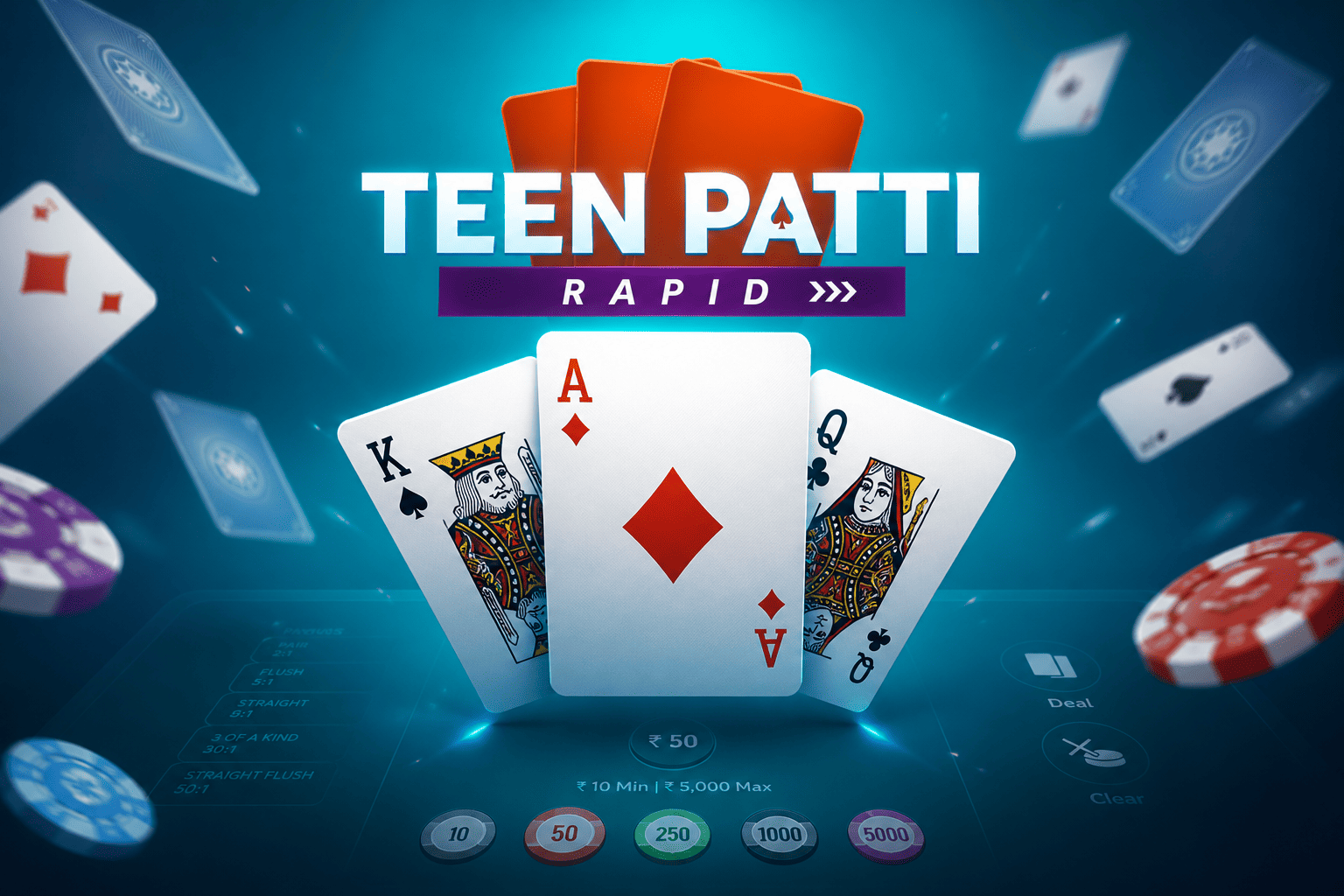
See our Teen Patti Rapid case study for a real production example of how we approach real-money card game delivery from brief through launch.
Development complexity: Very High
Monetization: Real-money rake, tournament fees, cosmetics
Timeline: 8 to 18 months (excluding licensing timeline)
Card Game Development Process: Step by Step
Game Design and Concept
Every card game begins with a Game Design Document (GDD) that defines what the game is, how it plays, and what makes it compelling to its target audience. For card games, the GDD must specify:
- Game type and format (CCG, traditional, hybrid)
- Core mechanics: how cards are played, what they do, how turns work
- Win conditions and loss conditions
- Deck construction rules (for CCGs and DBGs)
- Card type taxonomy and interaction rules
- Target platform and player demographic
- Monetization model overview
The GDD is a production commitment document, not a creative wishlist. Underdefined GDDs produce mid-production scope changes that are disproportionately expensive. Every hour spent on design specification before development begins saves five to ten hours of engineering rework later.
If you’re asking how to design a card game that retains players long-term, the answer starts here: with a complete, tested GDD before a line of code is written. Card game design ideas that aren’t stress-tested in the design phase become expensive engineering problems. Designing a card game well means making hard tradeoffs on paper, not in production.
For traditional card games, the GDD is primarily a UX and feature specification since the rules are already established. For CCGs, the GDD is an extensive design document that may take weeks to complete properly.
Math Model and RNG Design
Card game mathematics determines whether your game feels fair, strategic, and replayable, or arbitrary, exploitable, and frustrating. This is a specialized discipline that general software developers don’t carry.
For traditional card games: The math governs shuffling algorithms, deal fairness, probability distributions for draw outcomes, and for real-money products, house edge implementation and RTP configuration. Certified RNG implementation is mandatory for regulated real-money markets.
For CCGs: The math covers card draw probability modeling, mana curve optimization, card power level calibration, win rate targeting by rarity tier, and combo detection to prevent degenerate card interactions before launch.
For real-money iGaming products: The math model must be certified by an independent testing laboratory (GLI, iTech Labs, BMM Testlabs) before the game can operate in a licensed jurisdiction. The certification process verifies that the RNG produces statistically fair outcomes and that the game’s actual payout performance matches its documented theoretical model.
Math errors in card games are often invisible until they manifest as player behavior: dominant strategies that reduce the competitive meta to a single viable deck, shuffle patterns that produce statistically improbable outcomes, house edge implementations that fail certification review. Engaging a specialist from the beginning is substantially cheaper than fixing math errors discovered post-launch.
Tech Stack and Architecture
The technology stack for a card game must be selected with the game’s specific requirements in mind. The wrong architecture, too simple for the game’s complexity or too heavy for its scale, creates technical debt that compounds throughout the project.
Frontend / Client:
- HTML5/JavaScript (Phaser, PixiJS) for web-first card games
- Unity for cross-platform (PC, mobile, console) with rich animation
- React Native or Flutter for mobile-primary products
Backend / Server:
- Node.js or Go for real-time game servers (high-concurrency WebSocket handling)
- Python for game logic prototyping and data science (balance analysis)
- Java or C# for enterprise-scale casino backend infrastructure
Database:
- PostgreSQL for transactional data (player accounts, card collections, match history)
- Redis for real-time session state (active game state, matchmaking queues)
- MongoDB for flexible card data storage (CCG card databases with variable attributes)
Infrastructure:
- AWS, Google Cloud, or Azure with auto-scaling configuration
- Docker and Kubernetes for containerized deployment
- CDN for card art and asset delivery at global scale
Real-money / Compliance stack:
- Certified RNG module (hardware or software, jurisdiction-dependent)
- KYC/AML verification service integration (Jumio, Onfido, or equivalent)
- Payment gateway integration (multi-currency, regional payment methods)
- Responsible gaming tools (deposit limits, session timers, self-exclusion)
Art and Animation Production
Card game art production is one of the most significant cost and timeline variables in the entire development process. The visual quality of cards is the primary quality signal players use to evaluate a card game. Before they understand the mechanics, before they experience the gameplay, they see the art.
Production scope by game type:
For a traditional card game (poker, rummy): UI design, table environment art, avatar system, card back designs, and win/loss screen art. Relatively contained scope at $15,000 to $60,000 for a complete visual package.
For a CCG with 150 to 300 cards: unique illustration for every card, board/playmat environments, hero/class avatars, card back variants, UI icon set, and marketing assets. This is a substantial production at $120,000 to $400,000 for art alone at professional studio quality.
Animation requirements scale with game ambition. Basic win/play animations are table stakes. Unique legendary card animations, spell VFX, and board interaction effects are competitive differentiators that require meaningful additional investment.
AI-assisted art pipelines, now standard at leading studios, have compressed concept iteration and certain production phases by 30 to 55% without quality compromise. For large card sets, this represents a material cost and timeline reduction.
Backend Development
The backend is the invisible infrastructure that determines whether a card game can operate reliably at scale. For card games, backend development covers:
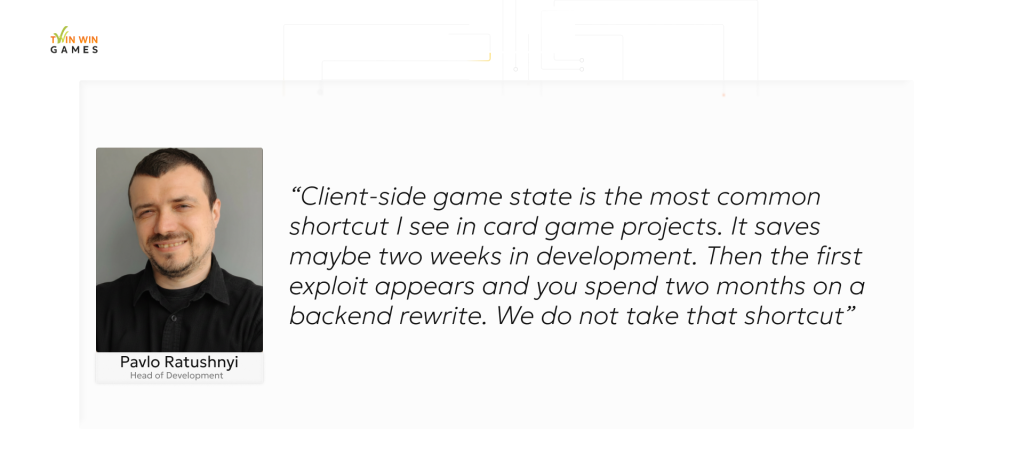
Game server: Processes game actions, maintains authoritative game state, enforces rules server-side, and manages turn flow. Server-side authority is essential. Any card game where the client controls game state is vulnerable to manipulation.
Matchmaking: Pairs players by skill rating, format preference, and geographic region. Handles queue management, wait time optimization, and bot fill for low-population scenarios.
Collection and progression: Stores player card libraries, deck configurations, achievement states, and progression metrics. For CCGs, this system handles card acquisition, pack opening, and crafting.
Payment and wallet: Processes deposits, withdrawals, in-game purchases, and virtual currency transactions. For real-money products, this system must meet PCI DSS standards and integrate with licensed payment processors.
Analytics and reporting: Tracks card play rates, win rates, session metrics, and financial performance in real time. These data feeds drive balance decisions and business operations.
Frontend and Client Development
The client is what players interact with. Card game client development is distinct from general mobile app development. The specific interaction patterns of card games (hand management, board state reading, drag-and-drop plays, information density) require specialized design and engineering expertise.
Key client development requirements:
Card hand management: Displaying 5 to 10 cards in hand on a mobile screen, allowing players to inspect individual cards, select and play them, and manage their hand without accidental misplays. Fan layouts, spread gestures, and zoom-to-inspect interactions must feel fluid.
Board state clarity: Players must be able to read the full board state (their cards, opponent’s cards, shared resources, health totals, and active effects) at a glance. Information hierarchy in the board layout is a game design decision as much as a UI decision.
Animation integration: Card play animations, attack sequences, spell effects, and win celebrations must integrate with game state transitions without creating timing inconsistencies or desync between visual feedback and actual game state.
Cross-platform optimization: Card games on mobile require different UI scaling, touch interaction handling, and performance optimization than desktop versions. If mobile is a target platform, design for it from the start rather than porting a desktop design.
QA and Playtesting
Card game QA covers two disciplines with different methodologies and different goals.
Technical QA validates correctness: does every card effect execute as specified in every possible context? Do card interactions at the edges of the rules system (simultaneous triggers, chain reactions, empty deck edge cases) resolve correctly? Does the backend maintain consistent game state under network stress and concurrent load?
Card games have exponential edge case complexity. A set of 200 cards with 10 possible game states creates interaction spaces that cannot be fully enumerated manually. Automated test coverage for rule execution is essential, not optional.
Playtesting validates the game itself: is it fun to play? Are there dominant strategies that reduce competitive diversity to a single viable approach? Does the onboarding experience successfully teach new players the mechanics without overwhelming them? Does the late-game feel different from the early game in ways that maintain engagement?
Playtesting requires real players, not QA engineers, and should begin with the earliest playable build. Balance problems discovered in playtesting before art production begins cost a card stat change. The same problem discovered after launch costs player trust that is expensive to recover.
Compliance and Certification
For real-money card games, compliance is not a post-development checkbox. It is a development constraint that shapes architecture decisions from day one.
RNG certification: The random number generation system must be certified by an approved independent testing laboratory. Different jurisdictions have different approved labs and different technical standards. UKGC-licensed products require GLI or iTech Labs certification against UKGC technical standards. MGA-licensed products require certification against MGA technical standards. Plan for 6 to 10 weeks of certification review time in each target jurisdiction.
KYC/AML compliance: Know Your Customer and Anti-Money Laundering programs are mandatory in all licensed real-money gaming jurisdictions. Player identity verification workflows, transaction monitoring, suspicious activity reporting, and PEP/sanctions screening must be implemented at the platform level.
Responsible gaming tools: Deposit limits, session time limits, reality checks, self-exclusion, and integration with national self-exclusion registers (GamStop in the UK, CRUKS in the Netherlands) are mandatory in regulated markets.
Loot box regulation (CCGs): Randomized card pack purchases with real-money payment are classified as gambling in several jurisdictions. Belgium and the Netherlands require a gambling license for this mechanic. Most major app stores require probability disclosure. Legal analysis for target markets should precede monetization model finalization.
Launch and Live Operations
A card game launch is the beginning of a live-service operation, not the conclusion of a development project. The studios and operators that succeed long-term treat launch day as one milestone in an ongoing product lifecycle.
Soft launch: Release to a limited audience (geography-restricted or invite-only) before full launch. Identifies infrastructure problems, balance issues, and UX friction under real conditions that testing cannot fully replicate.
Content calendar: Planned expansions, seasonal events, balance patches, and feature updates scheduled 6 to 12 months in advance. Players need to anticipate new content to maintain engagement between releases. A card game with no announced content roadmap loses momentum within 90 days of launch.
Community management: CCG and competitive card game communities form on Discord, Reddit, and social platforms. Active studio participation in these communities, responding to feedback, previewing upcoming content, acknowledging balance problems, builds trust that directly impacts player retention.
Balance monitoring: Real-time tracking of card play rates, win rates by deck archetype, and player drop-off points provides the data needed to make balance decisions quickly. Balance problems that persist for more than 2 to 3 weeks after community identification cause disproportionate churn.
Card Game Development Cost in 2026
The cost of making a card game varies as widely as the games themselves. Creating a card game for casual social play sits at one end of the spectrum; building a real-money platform for regulated markets sits at the other. Below are the four main tiers, with the variables that move you between them.
Simple Card Game App
Scope: Single traditional card game (solitaire, simple poker), social/practice play, 2 to 4 players, web or single platform, standard UI.
Cost: $30,000 to $60,000
Timeline: 2 to 4 months
Suitable for: Casual apps, practice platforms, market validation.
Mid-Tier Multiplayer Platform
Scope: One or two card game variants, real-time multiplayer, basic matchmaking, cross-platform delivery (web and mobile), player profiles, leaderboards, social features.
Cost: $80,000 to $200,000
Timeline: 4 to 8 months
Suitable for: Social gaming operators, freemium card game platforms.
Real-Money Licensed Card Game
Scope: Full card game implementation, real-money play with complete payment stack, KYC/AML integration, single-jurisdiction compliance and RNG certification, tournament infrastructure, admin panel, responsible gaming tools.
Cost: $200,000 to $500,000
Timeline: 8 to 14 months (including certification)
Suitable for: Licensed operators entering real-money card gaming in a single jurisdiction.
Enterprise Multi-Game Platform
Scope: Multiple card game variants, real-money play, multi-jurisdiction compliance (3+ markets), full CCG or advanced card game features, white-label capability, affiliate management, CRM, analytics dashboard.
Cost: $500,000 to $1,200,000+
Timeline: 14 to 24 months
Suitable for: Established operators scaling across multiple regulated markets.
What Drives the Cost Up
Art production at volume is the most commonly underestimated variable. A CCG with 200+ cards requires $100,000 to $350,000 in illustration and animation costs independently of development.
Real-money compliance adds 40 to 70% to base development cost. Certification, KYC/AML implementation, payment infrastructure, and responsible gaming tools are not incremental additions. They are substantial parallel workstreams.
Multi-jurisdiction support multiplies compliance costs. Each additional regulated market requires jurisdiction-specific math tuning, certification submission, and ongoing reporting compliance.
Post-launch operations typically cost 15 to 25% of the original build cost annually, covering content updates, balance patches, platform maintenance, and security updates.
Card Game Development Timeline
| Phase | Simple App | Mid-Tier Platform | Real-Money Game | Enterprise |
| Design & GDD | 2 to 3 weeks | 3 to 5 weeks | 4 to 6 weeks | 6 to 10 weeks |
| Math & RNG | 1 to 2 weeks | 2 to 4 weeks | 4 to 8 weeks | 6 to 10 weeks |
| Backend Dev | 4 to 6 weeks | 8 to 12 weeks | 12 to 20 weeks | 20 to 32 weeks |
| Frontend Dev | 4 to 6 weeks | 8 to 12 weeks | 10 to 16 weeks | 16 to 28 weeks |
| Art Production | 3 to 5 weeks | 6 to 10 weeks | 8 to 14 weeks | 16 to 32 weeks |
| QA & Testing | 2 to 3 weeks | 3 to 5 weeks | 4 to 8 weeks | 8 to 14 weeks |
| Certification | n/a | n/a | 6 to 10 weeks | 8 to 14 weeks |
| Total | 2 to 4 months | 4 to 8 months | 8 to 14 months | 14 to 24 months |
Note: Art production and backend development run in parallel in well-managed projects. Certification cannot begin until development and QA are complete and must be scoped as a critical path item.
Team Structure for Card Game Development
Core Roles and Responsibilities
| Role | Responsibility | Simple App | Mid-Tier | Real-Money | Enterprise |
| Game Designer | Rules, UX flows, balance | 1 | 1 to 2 | 1 to 2 | 2 to 3 |
| Math Specialist | RNG, probability, balance data | n/a | 1 | 1 | 1 to 2 |
| Backend Engineers | Server, APIs, infrastructure | 1 to 2 | 2 to 3 | 3 to 5 | 5 to 8 |
| Frontend Engineers | Client, UI, animation | 1 to 2 | 2 to 3 | 3 to 4 | 4 to 6 |
| UI/UX Designer | Interface, card layout | 1 | 1 to 2 | 1 to 2 | 2 to 3 |
| Artists | Card and UI illustration | 1 to 2 | 2 to 4 | 3 to 5 | 6 to 10 |
| Animators | Card and VFX animation | n/a | 1 to 2 | 2 to 3 | 3 to 5 |
| QA Engineers | Testing, playtesting | 1 | 2 to 3 | 3 to 4 | 4 to 6 |
| Project Manager | Delivery, client comms | 1 | 1 | 1 | 1 to 2 |
| Compliance Specialist | Licensing, certification | n/a | n/a | 1 | 1 to 2 |
Full-Cycle vs Partial Outsourcing
Full-cycle outsourcing means engaging a single studio to handle all disciplines from design through launch. It is the most efficient model for most operators. It eliminates coordination overhead between separate vendors, creates single-point accountability for delivery, and allows the studio to make integrated decisions across design, engineering, and art rather than optimizing each in isolation.
Partial outsourcing works when an operator has strong in-house capability in one discipline (typically game design or engineering) and needs to supplement specific areas (art production, math modeling, compliance support). The coordination overhead of partial outsourcing is manageable when roles are clearly defined and communication processes are structured from the start.
Tech Stack for Card Game Development
Frontend Technologies
HTML5/JavaScript is the standard for web-first card games. Frameworks like Phaser and PixiJS provide the rendering performance needed for smooth card animations and board state management. Single-codebase deployment across desktop and mobile browsers is the primary advantage.
Unity is the preferred choice for cross-platform card games targeting native mobile (iOS, Android) alongside PC/Mac. Unity’s animation system and asset pipeline suit games with rich card animations and visual effects. The build pipeline for simultaneous iOS, Android, and web delivery is mature and well-documented.
React Native and Flutter suit card games where mobile is the primary platform and native performance and device integration (push notifications, offline capability) matter more than rich animation. Rummy platforms and poker apps frequently use this approach. For a detailed breakdown of rummy platform development costs specifically, see our rummy game development cost guide.
Backend and Server Architecture
The card game backend must be designed for the game’s specific concurrency and latency requirements. A real-time multiplayer card game with 10,000 concurrent players needs different architecture than a turn-based asynchronous game with the same player count.
WebSocket connections for real-time games: Persistent bi-directional connections between client and server allow instantaneous game state updates without the latency of repeated HTTP requests. Essential for any game where player actions and responses need to feel immediate.
Server-side game state authority: The game server maintains the authoritative state of every active game. Client-side state is display-only. This architecture is mandatory for any competitive or real-money card game. Client-controlled game state is trivially exploitable.
Horizontal scaling: Game servers must be designed to scale out (adding more server instances) rather than up (adding more resources to a single server). This allows infrastructure to respond to traffic growth without architectural changes.
RNG and Math Certification
For real-money card games, the random number generation system is a regulatory requirement, not just a technical component. Production-grade RNG for casino and iGaming products must:
- Use cryptographically secure pseudorandom number generation (CSPRNG)
- Be isolated from game logic to prevent deterministic manipulation
- Maintain auditable logs of all random outcomes
- Be certified by an approved testing laboratory for each target jurisdiction
The distinction between a software RNG and a hardware RNG (HRNG) matters in some jurisdictions. Certain regulators require hardware entropy sources for specific game types. Your compliance advisor and testing lab will specify the requirement for each target market.
Monetization Models for Card Games
The right monetization model depends on your game type, target market, and audience.
Free-to-play with card pack purchases (CCGs): Players access the base game for free and purchase randomized card packs to expand their collection. Dual-currency systems (earned and purchased) allow progression for non-paying players while maintaining monetization paths for paying ones. Pack odds disclosure is required in most major markets.
Cosmetics only (competitive card games): Gameplay content is fully earnable; real-money purchases are limited to visual items (card backs, avatars, board skins). This model builds the strongest player trust and is the most defensible against regulatory scrutiny of pay-to-win mechanics.
Battle pass (seasonal CCGs): Tiered seasonal rewards earned through gameplay, with a premium track offering additional cosmetics and currency. Creates recurring revenue without locking gameplay content behind purchase.
Tournament and entry fees (competitive platforms): Players pay to enter premium tournaments or draft formats. Entry fees can be paid with earned or purchased currency. Reward structures (card packs, premium currency, exclusive cosmetics) create a self-sustaining competitive economy.
Real-money rake (poker, rummy, traditional card games): The platform takes a percentage of each pot or charges tournament entry fees. This model requires a gambling license in virtually all regulated markets and carries the highest regulatory burden alongside the highest revenue potential per active player.
Challenges in Card Game Development
Balance and Power Creep
Maintaining competitive balance across a growing card set is the most persistent design challenge in CCG development. Power creep, the tendency for new cards to be incrementally stronger than older ones, erodes the collection value of existing cards, destabilizes the competitive meta, and frustrates players who invested in older card sets.
Addressing power creep requires designing expansions around lateral movement (new mechanics, new strategies) rather than vertical power escalation (strictly better versions of existing cards). Regular statistical analysis of card play rates and win rates enables data-driven balance interventions before problems become entrenched.
Real-Time Multiplayer Performance
Real-time card games require consistent, low-latency synchronization across all connected players. Every card play, every game state change, every turn transition must update simultaneously for all participants. Poor multiplayer architecture produces desync states where players experience different game states, which creates perceived cheating and destroys player trust rapidly.
Solving this requires experienced backend engineers with real-time game infrastructure expertise, rigorous load testing at 2 to 3x anticipated peak concurrency, and infrastructure designed for horizontal scaling from the start.
Compliance for Real-Money Markets
Regulatory compliance is the challenge most commonly underestimated by studios and operators entering real-money card gaming. Licensing timelines (4 to 8 months for MGA or UKGC licensing), technical certification requirements, KYC/AML program implementation, and ongoing regulatory reporting represent a parallel operational workstream that must be scoped alongside technical development.
Attempting to retrofit compliance onto a product built without regulatory requirements in mind is substantially more expensive than building compliance in from the start. Architecture decisions made in month one affect certification outcomes in month twelve.
Player Retention After Launch
The competitive card game market is crowded. Players have many alternatives, and switching costs are lower than in most gaming categories. Retention requires a continuous investment in new content, responsive balance management, and community engagement that many studios underbudget at launch.
The studios and operators that sustain card game player bases treat their game as a live product with an ongoing development team, not a shipped artifact. Budget for the first year of operation, including content, balance, and community, before committing to development investment.
How to Choose a Card Game Development Company
Domain expertise matters more than general capability. Card game development requires specialized knowledge in card game design, math modeling, real-time multiplayer engineering, and (for real-money products) regulatory compliance. A studio that builds enterprise software or casual mobile apps but has never shipped a card game will learn on your project budget.
The most common question studios and operators ask us is some version of: how do I make card games that actually retain players, and how do I make a good card game without discovering the expensive lessons mid-production? The honest answer is that it starts with choosing a partner who has solved that problem before, for game types like yours, in markets like yours.
Ask for verifiable track record. How many card games has the studio shipped commercially? What are their documented delivery rates? Can they provide references from card game clients you can contact directly? Portfolio screenshots are not evidence of reliable delivery.
Evaluate the full-cycle capability. Does the studio handle design, math, engineering, art, and compliance under one roof? Fragmented vendor stacks with separate design studio, art studio, engineering team, and compliance consultant introduce coordination overhead and accountability gaps that consistently inflate costs and timelines.
Assess compliance knowledge specifically. For real-money products, ask how many certified real-money products the studio has shipped, which testing labs have certified their RNG implementations, and what their process is for preparing compliance documentation. Studios without demonstrated compliance experience cannot give you reliable advice on certification timelines or regulatory requirements.
Check post-launch support terms. What is included in the development contract after launch? What triggers additional cost? A studio that provides no post-launch support is not a viable long-term partner for a live-service card game product.
Why Twin Win Games
Twin Win Games is a full-cycle casino and iGaming development studio with 110+ in-house specialists covering every discipline required for production-quality card game development: game design and math modeling, frontend and backend engineering, art and animation production, QA, and compliance support across UKGC, MGA, and other regulated markets.
We have delivered 1,000+ casino and card game projects for clients including Aristocrat, Relax Gaming, and William Hill. Our average delivery timeline is 3 to 6 months, which is 30 to 40% faster than the industry standard, enabled by proprietary engine infrastructure, pre-built compliance frameworks, and AI-assisted art production pipelines that reduce art production time by 30 to 55%.
Our average client partnership is 7+ years. We build card game products that operators can scale into, not systems they outgrow or abandon.
👉 Discuss your card game project with our team.
Conclusion
Card game development in 2026 spans a wider range of product types, technical requirements, and market opportunities than at any point in the format’s history. From simple social card apps to enterprise real-money platforms serving regulated markets across multiple jurisdictions, the development complexity and commercial opportunity scale together.
The decisions that determine success are consistent across this range: clear game type definition before development begins, math modeling that creates genuinely fair and strategic play, architecture designed for the game’s scale from day one, and a post-launch operational plan that treats launch as a beginning rather than an end.
Studios and operators who invest in getting these decisions right, with partners who have solved them before, consistently outperform those who discover the hard lessons during production.
FAQ
How much does card game development cost?
A simple social card game app costs $20,000 to $60,000. A mid-tier multiplayer platform costs $80,000 to $200,000. A real-money licensed card game for a single regulated market costs $200,000 to $500,000 including compliance infrastructure. An enterprise multi-market platform costs $500,000 to $1,200,000+. Art production for CCGs with large card sets ($100,000 to $350,000) and real-money compliance infrastructure (40 to 70% cost addition) are the two most commonly underestimated cost drivers.
How long does it take to develop a card game?
A simple card game app takes 2 to 4 months. A mid-tier multiplayer platform takes 4 to 8 months. A real-money licensed card game takes 8 to 14 months including certification. An enterprise multi-game platform takes 14 to 24 months. Regulatory certification (6 to 10 weeks per jurisdiction) is a fixed timeline item that cannot be compressed and must be scoped as a critical path dependency.
What platform should I build my card game for?
Most card games should target web and mobile simultaneously. HTML5/JavaScript deployment from a single codebase reaches desktop browsers, mobile browsers, and through wrapper apps, iOS and Android app stores. If rich native animations or device integrations are priorities, Unity-based development supports simultaneous iOS, Android, PC, and web delivery from a single project. Choose your platform target before architecture decisions are made. Retrofitting cross-platform support late in development is expensive.
Do I need a license to operate a real-money card game?
Yes, in all major regulated markets. Poker, rummy, blackjack, baccarat, and other real-money card games require a gambling operator license from the relevant jurisdiction authority: UKGC for UK players, MGA for Malta-licensed operations, AGCO for Ontario, applicable US state gaming commissions for US markets. Licensing timelines range from 4 weeks (Curaçao) to 8+ months (UKGC, MGA). Licensing requirements should shape platform architecture decisions from the beginning of development. Compliance retrofits are substantially more expensive than compliance-first builds.
Can you develop both the game and the backend?
Yes. Full-cycle card game development covering design, math, frontend, backend, art, QA, and compliance support under one roof is the most efficient delivery model for most operators. It eliminates vendor coordination overhead, creates single-point accountability for delivery outcomes, and allows integrated decisions across disciplines that separate vendors cannot make. At Twin Win Games, all production disciplines are in-house. The same team that designs the game builds the backend and produces the art.
How do I make my own card game if I don’t have a development team?
Operators who want to create their own card game without building an in-house team typically work with a full-cycle development studio. You provide the product vision, target market, and business requirements. The studio handles design, engineering, art, and compliance. This is how most commercially successful real-money and competitive card game products are built: the operator owns the product, the studio delivers it. When evaluating how to make your own card game this way, the key decisions are game type, platform, monetization model, and whether you’re targeting regulated real-money markets.
What are the key card game mechanics I need to design first?
The core card game mechanics that need to be fully specified before development begins are: turn structure (who acts when and in what order), card type taxonomy (what categories of cards exist and what each can do), resource system (mana, energy, action points, or equivalent), win and loss conditions, and deck construction rules for games where players build their own decks. These mechanics interact with each other, and changes to any one of them late in production cascade through the entire system. Card game design decisions made on paper are cheap; the same decisions made during engineering are expensive.