
Launching an online casino in 2026 is simultaneously more accessible and more complex than it has ever been. The market is larger, the regulatory landscape is more demanding, and player expectations have risen sharply. For operators who want to move fast without building everything from scratch, turnkey casino solutions have become the dominant launch strategy.
This guide covers everything you need to know about turnkey online casino creation: what’s included, how it compares to alternatives, the full step-by-step process, what it costs, common mistakes, and how to choose a provider capable of delivering what they promise.
What Does Turnkey Online Casino Mean?
A turnkey online casino is a complete, ready-to-operate gambling platform delivered by a technology provider. The name comes from the concept of receiving something fully built. You turn the key, and it works. In practice, a turnkey casino package bundles the core infrastructure components required to operate a licensed online casino: the gaming platform, game content, payment systems, licensing support, and operational tools.
The critical distinction is scope. A turnkey solution covers the full stack of what you need to open and run a casino. Contrast this with a white-label solution, which is typically a pre-branded platform template with limited customization, or a custom build, which is developed entirely to your specifications from the ground up.
Turnkey doesn’t mean identical. The best turnkey packages are modular. A provider delivers proven infrastructure components that are then configured, branded, and integrated to create a product that operates under your brand and reflects your market positioning.
Key Components Included in a Turnkey Package
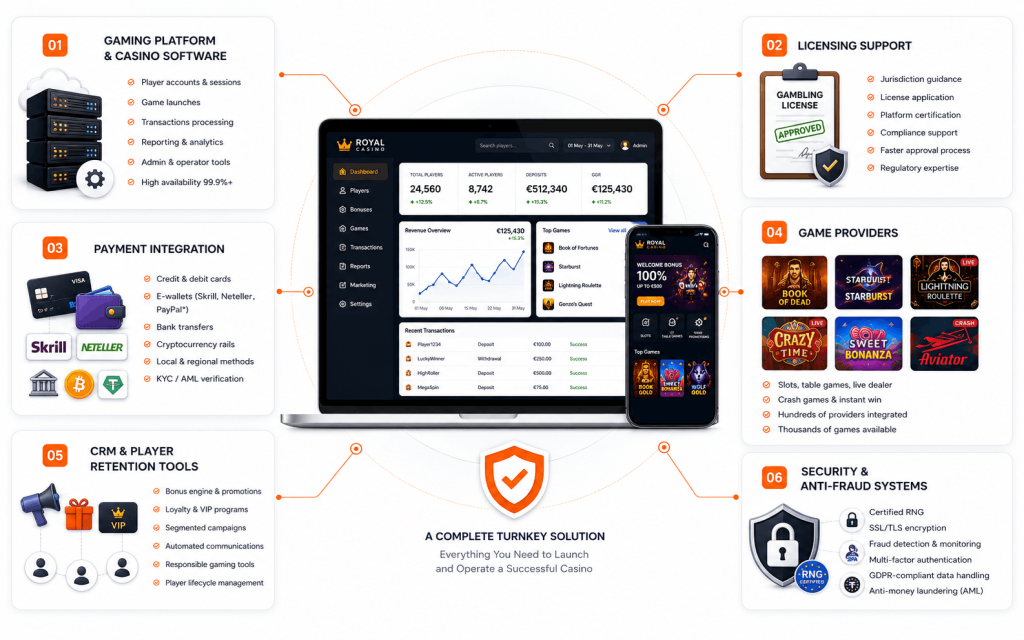
Understanding what a turnkey casino package actually contains is essential before evaluating any provider. A complete turnkey solution covers the following components.
Gaming Platform and Casino Software
The platform is the operational core: the software layer that manages player accounts, sessions, game launches, transaction processing, and reporting. It must handle concurrent users at scale, maintain high availability (99.9%+ uptime), and provide the administrative tools operators need to manage the business day-to-day. Platform quality varies enormously between providers, and the difference between a robust, battle-tested system and an underpowered one becomes apparent under real traffic conditions.
Licensing Support
Obtaining a gambling license is among the most time-intensive and capital-intensive steps in launching an online casino. Established turnkey providers have pre-existing relationships with licensing jurisdictions and understand the specific technical and operational requirements each authority imposes. Some providers offer platforms that are already certified and accepted in key jurisdictions, which significantly compresses your licensing timeline. This is a critical differentiator. A provider without demonstrated compliance expertise will cost you months and potentially your entire launch budget.
Payment Integration
Players need to deposit and withdraw using their preferred payment methods. A comprehensive payment stack covers credit and debit cards, bank transfers, e-wallets (Skrill, Neteller, PayPal where permitted), cryptocurrency rails, and region-specific local payment methods. Your turnkey provider should handle the technical integration of payment gateways and support your payment processor relationships, including the KYC/AML verification flows that regulated markets require.
Game Providers
Game content is the product your players interact with. Most turnkey packages include integrations with aggregated game libraries spanning hundreds or thousands of titles from multiple software providers: slots, table games, live dealer, and increasingly crash games and instant win products. The breadth and quality of the game library is often the single most visible competitive differentiator in the player-facing product.
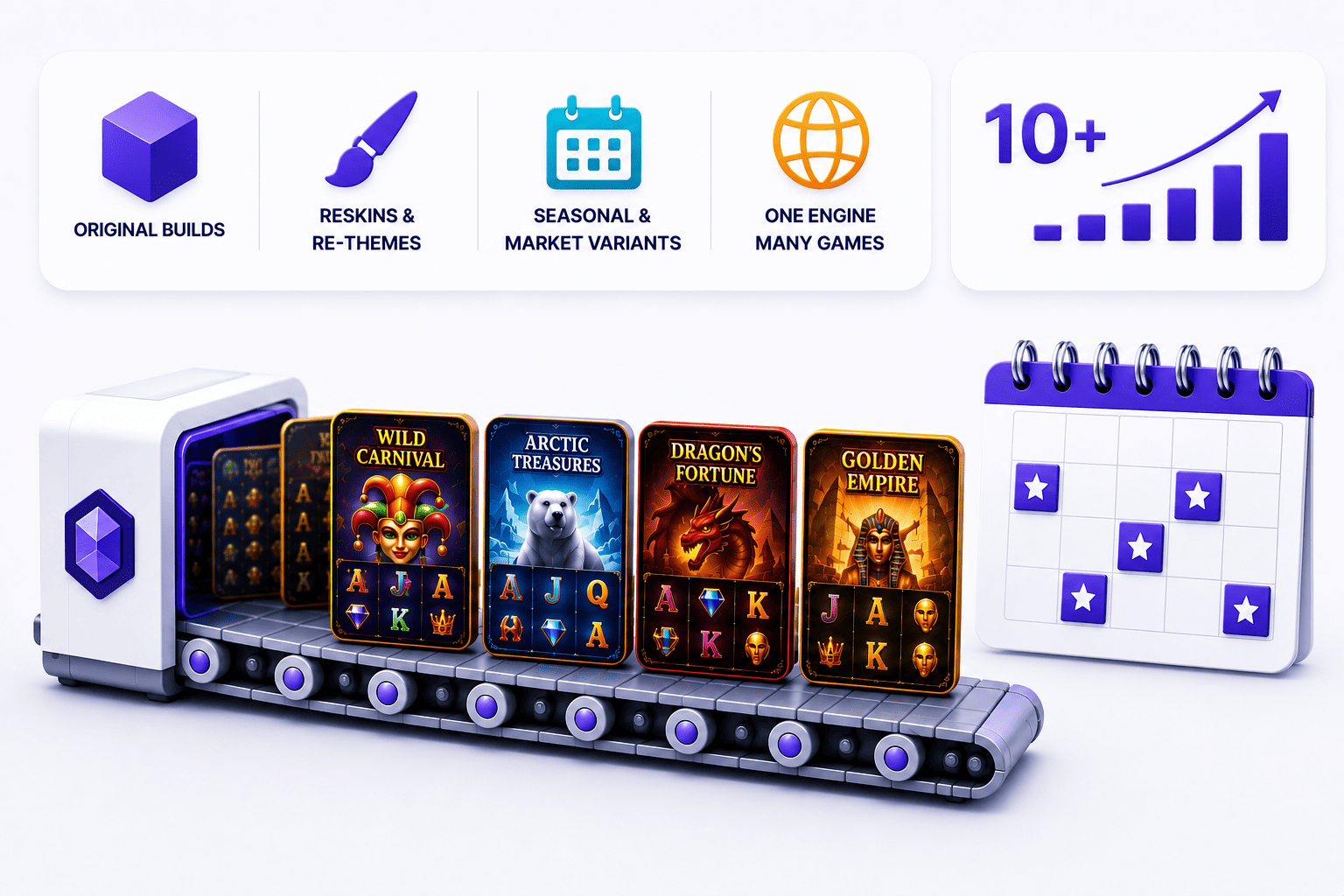
Operators who want to go beyond aggregated content and build a library competitors cannot replicate commission custom games from specialist studios. Twin Win Games delivers full-cycle casino game development through a Product-as-a-Service model that integrates directly with major aggregators including EveryMatrix, SoftSwiss, and Relax Gaming. Custom games give your casino exclusive content that runs on your platform and no one else’s.
CRM and Player Retention Tools
Acquiring players is expensive. Retaining them requires systematic tools: bonus engine (welcome packages, reload bonuses, free spins), loyalty and VIP program management, segmented promotional campaign delivery, automated player lifecycle communications, and responsible gaming tools (deposit limits, session limits, self-exclusion). These systems should be integrated at the platform level, not bolted on as afterthoughts.
Security and Anti-Fraud Systems
Real-money gambling platforms are high-value targets for fraud, account takeover, and money laundering. A production-ready turnkey solution includes certified RNG implementation, SSL/TLS encryption across all data transmission, fraud detection and transaction monitoring systems, multi-factor authentication, and GDPR-compliant data handling. These are not optional features. They are prerequisites for licensing and for maintaining player trust.
Turnkey vs White Label vs Custom Casino Development
Operators evaluating their launch strategy encounter three primary models. The right choice depends on your capital, timeline, technical capacity, and strategic ambitions.
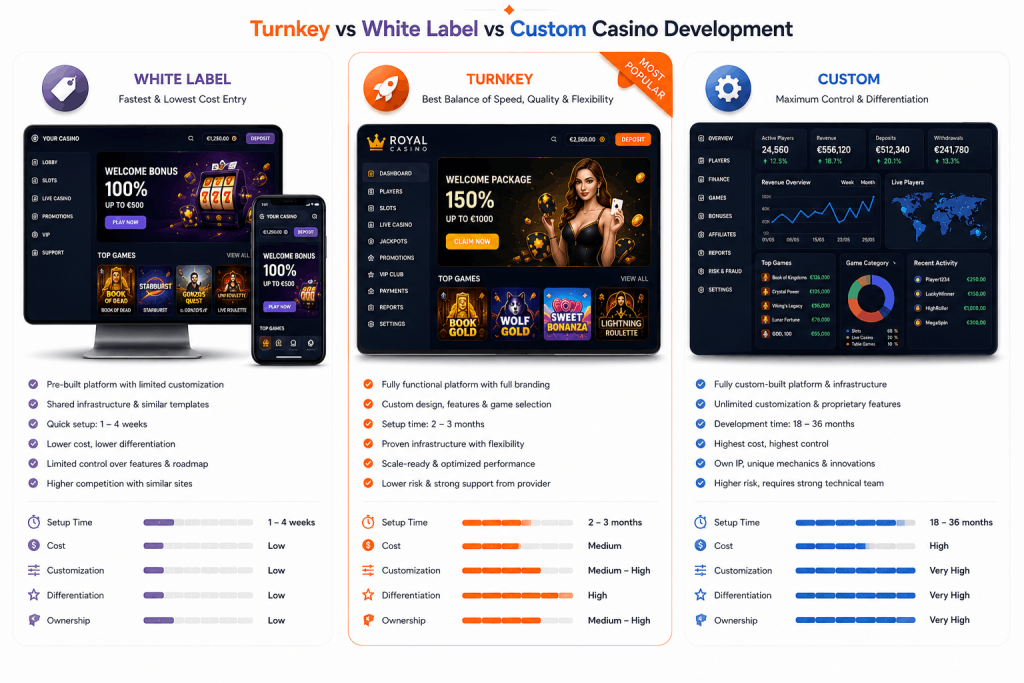
White-label solutions are the fastest and cheapest entry point. You receive a pre-built, pre-branded platform with minimal customization capability. White-label casinos share infrastructure with many other operators on the same platform. They are appropriate for operators with limited budgets who want rapid market validation, but the ceiling on differentiation is low. Player experience is largely dictated by the platform provider, and switching costs are high once you have built a player base on someone else’s infrastructure.
Turnkey solutions provide a complete, production-ready platform with meaningful customization: your brand, your design, your game selection, your promotional mechanics, built on proven infrastructure. Turnkey is the middle path: faster and less risky than custom development, more capable and differentiable than white-label. This is the model most serious operators choose when entering established regulated markets.
Custom casino development gives you maximum control and differentiation. You own the IP, can build proprietary mechanics, and are not constrained by any provider’s platform limitations. The tradeoff is time (18 to 36 months for a full custom build), cost (substantially higher than turnkey), and execution risk. Custom is appropriate for operators with significant capital, long investment horizons, and proprietary game or feature concepts that genuinely require a bespoke platform.
Why Choose a Turnkey Online Casino Solution?
For most operators entering the market in 2026, turnkey represents the most rational risk-adjusted approach.
Faster Time to Market
A well-scoped turnkey casino can go from signed agreement to live operation in 3 to 6 months. Custom development at equivalent scope takes 18 to 36 months. In a competitive market where player acquisition windows and licensing slots have real time value, the faster path to revenue is significant. Turnkey providers absorb years of infrastructure development so you don’t have to.
Lower Technical Risks
Building a casino platform from scratch means accepting every technical risk: architecture decisions, security vulnerabilities, scalability failures, integration incompatibilities, and the operational learning curve of a new system. Turnkey solutions have absorbed these risks through years of live operation. The infrastructure has been stress-tested, the integrations are proven, and the failure modes are known and addressed.
Ready Licensing and Compliance
Reputable turnkey providers maintain platforms that are pre-certified or certification-ready across multiple jurisdictions. Their compliance expertise covering UKGC technical standards, MGA certification requirements, and Ontario AGCO specifications is built into the platform design. This reduces your licensing preparation time dramatically compared to presenting a novel custom build to a regulatory authority.
Ongoing Technical Support
A turnkey provider’s business model depends on your continued operation. That alignment of incentives typically translates into proactive technical support, platform maintenance, security updates, and feature development that benefits all operators on the platform. You don’t need to build and maintain an internal engineering team to keep the infrastructure running.
Step-by-Step Process of Creation of a Turnkey Online Casino
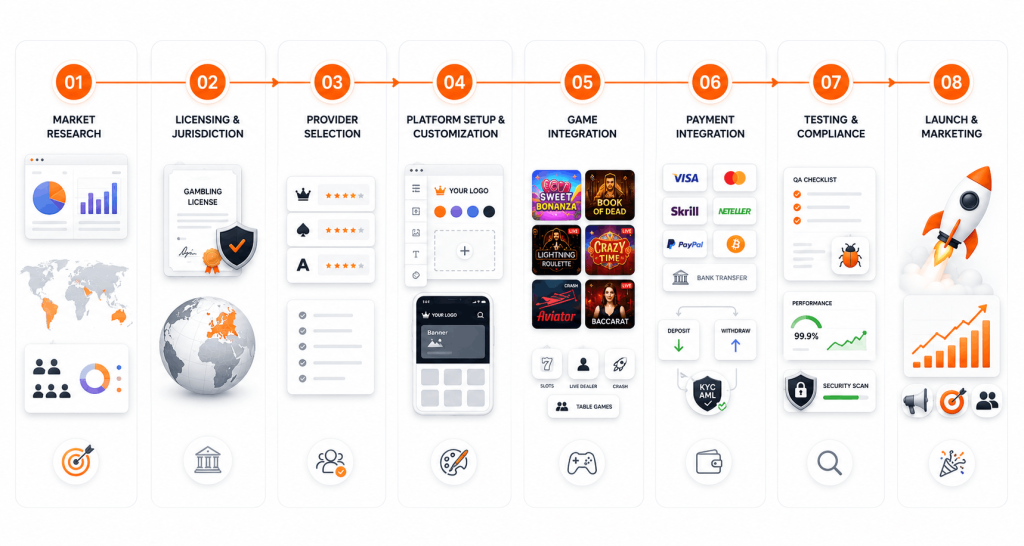
Market Research and Business Planning
Before speaking to any provider, build a clear picture of your target market. Which player demographic are you serving? What geography are you entering? What are the dominant game preferences in that market? Who are your primary competitors, and what gaps can you exploit?
Your business plan should model player acquisition costs, expected LTV, revenue share structures with game providers, and licensing costs alongside your platform investment. The economics of online casino operation are well understood. Model them honestly before committing capital.
Choosing Jurisdiction and License
Your licensing jurisdiction determines which player markets you can legally serve, what technical and operational standards you must meet, and how credible your brand will appear to payment processors and affiliate partners.
The most established regulated jurisdictions include:
- UK Gambling Commission (UKGC)
- Malta Gaming Authority (MGA)
- Gibraltar Regulatory Authority
- Isle of Man Gambling Supervision Commission
- Curaçao (widely used for emerging market operations due to lower barriers)
- Ontario AGCO and applicable US state gaming commissions for North American operators
Licensing timelines and costs vary substantially. MGA licensing typically takes 4 to 6 months and costs €25,000+ in application fees, plus ongoing compliance costs. UKGC licensing takes 4 to 8 months and imposes stringent technical and operational requirements. Curaçao licensing can be obtained in 4 to 8 weeks but is increasingly rejected by payment processors and affiliates in tier-one markets.
Your choice of jurisdiction should align with your target player geography and your operational budget for compliance.
Selecting a Turnkey Provider
Provider selection is the decision with the longest-lasting consequences. A platform switch after launch is operationally disruptive and expensive. You will typically lose data portability, player relationship continuity, and months of operational momentum.
Evaluate providers on:
- Platform stability and documented uptime history
- Game library breadth and quality of content partnerships
- Licensing jurisdiction coverage and demonstrated compliance track record
- Payment integration depth for your target markets
- Customization capability (how much of the UX can you actually control?)
- Reference clients you can speak to directly
- Quality and responsiveness of technical support
Ask specifically how many operators are live on their platform today, what their average operator retention rate is, and what their post-launch SLA looks like. Providers who struggle to answer these questions clearly have not yet earned the level of trust the decision warrants.
Platform Customization and Branding
Once you have selected a provider and agreed commercial terms, the customization phase begins. This covers brand identity implementation across all player-facing surfaces: lobby design, game presentation, promotional banner systems, email and notification templates, responsible gaming interfaces, and mobile UX.
The depth of customization available varies significantly by provider. Some turnkey platforms offer genuine UX flexibility where you can build a distinctive player experience. Others offer superficial skinning with limited structural control. If brand differentiation matters to your strategy, pressure-test the customization depth in your provider evaluation process, not after you have signed.
Game Integration and Content Management
Your game library is your product catalogue. Work with your provider to curate an opening content set that covers the game types your target players prioritize, includes titles from the major studios (Pragmatic Play, NetEnt, Evolution, Play’n GO), and has depth in the specific verticals you are emphasizing.
Set up your content management processes: how new titles are added, how promotional featured game placements work, how seasonal content rotations are scheduled, and how underperforming content is managed.For operators who want proprietary content alongside aggregated titles, a dedicated game development partner handles the full production cycle. Twin Win Games’ proprietary game engine is built for fast integration with casino platforms, enabling custom slot and table game delivery in 3 to 6 months with compliance documentation included. The PaaS model means you scale game output without expanding your team or managing a fragmented vendor stack.
Need custom casino games for your platform? Twin Win Games develops certified, aggregator-ready slot and table game content in 3 to 6 months.
Payment System Integration
Payment is the highest-friction point in the player journey. Deposit failures and withdrawal delays are the leading causes of player churn and negative reviews. Ensure your payment stack covers the specific methods dominant in your target geography: iDEAL in the Netherlands, Trustly in Scandinavia, PayNearMe in the US, PIX in Brazil, not just generic global options.
Configure your KYC/AML verification flows to balance conversion optimization (frictionless for low-risk depositors) with regulatory compliance (appropriately rigorous for higher-risk transaction patterns). Most licensed jurisdictions have specific KYC trigger thresholds that your compliance advisor can guide you through.
Testing and Compliance Check
Before launch, your platform undergoes several layers of testing. Technical QA covers functionality, payment processing, game integrity, and cross-device performance. Load testing validates that the infrastructure handles peak concurrent user volumes without degradation. Security testing including penetration testing and vulnerability scanning is required by most licensing authorities and is essential regardless.
Compliance review covers your RNG certification documentation, responsible gaming tool implementation, player protection policy documentation, and technical standards submission to your licensing authority. Allow 6 to 8 weeks for certification review in most tier-one jurisdictions, assuming a well-prepared submission.
Launch and Marketing
A phased launch reduces risk. Begin with a soft launch, limited traffic, invite-only or geographically restricted, to validate the full player journey under real conditions: registration, KYC verification, deposit, game play, bonus triggering, withdrawal, and customer support. Identify and resolve friction points before your main marketing spend activates.
Your launch marketing strategy should cover paid acquisition (affiliate programs, display advertising, search campaigns), content and SEO, influencer and streamer partnerships, and promotional offer strategy that maximizes first-deposit conversion without creating unsustainable bonus liability.
How Much Does It Cost to Create a Turnkey Online Casino?
Cost ranges vary based on scope, licensing jurisdiction, customization depth, and provider selection. Realistic 2026 budgets by tier:
Entry-level turnkey (single jurisdiction, standard game library, basic customization): €80,000 to €200,000 for platform setup, plus €30,000 to €80,000 in licensing fees, plus ongoing revenue share and monthly platform fees.
Mid-tier turnkey (1 to 2 jurisdictions, curated premium game library, meaningful brand customization, full payment stack): €200,000 to €500,000 total first-year investment including licensing.
Premium turnkey (multi-jurisdiction, deep customization, proprietary bonus mechanics, dedicated technical support): €500,000 to €1,000,000+ in first-year investment.
Ongoing operational costs include platform fees (typically a percentage of GGR or a fixed monthly fee), game content revenue share (15 to 25% of GGR to aggregators and studios), payment processing fees (1 to 5% depending on method mix), licensing renewal fees, and marketing.
Budget for marketing at a level commensurate with your acquisition targets. In competitive regulated markets, customer acquisition costs for casino players range from €150 to €500+ per depositing player. Underestimating marketing budget is among the most common reasons well-built casinos fail to reach scale.
Key Features of a Successful Turnkey Casino
Mobile Optimization
More than 70% of online casino sessions now occur on mobile devices. A casino that is not genuinely mobile-first, not just mobile-responsive but designed with thumb navigation, fast load times on mobile connections, and native-quality interactions, is starting at a structural disadvantage. Evaluate your provider’s mobile UX critically before signing.
Multi-currency and Crypto Payments
Players in 2026 expect to transact in their local currency and, increasingly, in cryptocurrency. Crypto payment support covering Bitcoin, Ethereum, and stablecoins expands your addressable market, reduces payment processing friction in markets with restrictive banking for gambling, and appeals to a technically sophisticated demographic that typically shows above-average LTV. Ensure your turnkey provider supports multi-currency wallet architecture natively, not as an afterthought integration.
Anti-Fraud and KYC Integration
Fraud and money laundering exposure is existential risk for a licensed operator. Your platform must include real-time transaction monitoring, automated KYC trigger workflows, AML screening against sanctions and PEP lists, and device fingerprinting for account fraud detection. These systems should operate in the background without creating unnecessary friction for legitimate players.
CRM and Player Retention Tools
The bonus engine, loyalty program, segmented promotional delivery, lifecycle automation, and responsible gaming tools should be configurable by your team without requiring developer involvement. An inflexible CRM that requires tickets to your provider every time you want to run a promotion is a competitive handicap. Evaluate the marketing toolkit with the same rigor you apply to the core platform.
Common Mistakes in Turnkey Casino Creation
Choosing the Wrong Provider
The most expensive mistake in turnkey casino creation is selecting a provider based on price or sales presentation rather than operational track record. Low-cost platforms typically reflect low investment in infrastructure stability, compliance readiness, and support quality. A platform failure during peak traffic, a rejected license application due to insufficient RNG documentation, or a support team that takes days to respond to critical issues will cost more than the savings that led you to the cheaper option.
Reference checks matter. Speak to operators currently live on the platform, not just the reference contacts provided by the sales team. Ask them specifically about platform stability, support responsiveness, and whether the provider’s compliance support was genuinely helpful during licensing.
Ignoring Licensing Requirements
Some operators defer licensing research until after platform selection, treating it as a box to check rather than a strategic decision. This produces misalignment: a platform that is not certification-ready for your chosen jurisdiction, a go-to-market timeline that does not account for 6-month licensing delays, or a compliance infrastructure that does not meet the technical standards of the market you actually want to operate in.
Licensing requirements should drive platform selection, not the reverse. Identify your target markets and their regulatory requirements before shortlisting providers, then evaluate which providers have demonstrated certification success in those specific jurisdictions.
Poor UX and UI Design
A technically sound casino with a confusing, dated, or slow UI will struggle to retain players regardless of game library quality or bonus generosity. The player experience, from first impression at registration through deposit flow, game lobby, and withdrawal process, determines conversion and retention more reliably than any other single factor.
Invest in quality UX design. If your turnkey provider offers limited customization, work with experienced casino UX designers to make the most of what is available. Treat the player experience as a product that requires continuous improvement, not a launch deliverable that is finished on go-live day.
Treating Game Content as a Commodity
Every operator on the same aggregated game library is competing with identical product catalogues. The operators who build lasting player bases treat game content as a differentiator, not a commodity. Commissioning exclusive game titles gives your casino content competitors cannot replicate. Twin Win Games’ PaaS model makes full-cycle custom game development accessible for operators at mid-tier budgets, with delivery in 3 to 6 months and compliance documentation included.
How to Choose the Right Turnkey Casino Provider
Reputation and Experience
How long has the provider been operating? How many casinos are currently live on their platform? What is their track record in your target licensing jurisdictions? Providers with 10+ years of operation and dozens of active operator deployments have survived market cycles, regulatory changes, and technology evolution that newer entrants have not faced. That operational history is genuinely valuable.
Look beyond the company’s own marketing. Review industry publications (iGaming Business, Gambling Insider, Casino Beats), check licensing authority lists for platforms they have certified, and find operators running on their platform through review sites and industry directories.
Technology Stack
What is the underlying architecture? Cloud-native platforms with microservices architecture and auto-scaling capabilities handle traffic spikes without manual intervention. Legacy monolithic platforms are harder to update, more vulnerable to cascading failures, and more expensive to scale. Ask specifically about uptime SLAs, how they have handled DDoS attacks, and what their disaster recovery process looks like.
Game Portfolio
How many game providers are integrated? What is the total library size? Are the major studios — Pragmatic Play, Evolution, NetEnt, Play’n GO, Yggdrasil — included? What is the process for adding new content after launch, and who bears the cost and timeline for new integrations?
Game content is where operators create genuine differentiation beyond the aggregated catalogue. Twin Win Games develops custom casino games for operators who want exclusive titles their competitors cannot offer. Our proprietary game engine and PaaS model deliver full-cycle production from concept to certified, aggregator-ready game in 3 to 6 months. Integration with EveryMatrix, SoftSwiss, and Relax Gaming is handled as part of the delivery.
Payment Methods
Does the provider have established relationships with payment processors in your target markets? How many payment methods are live on currently operating casinos, not just listed in their sales materials? What is their documented process for adding new payment methods after launch?
Support and SLAs
What is the contractual SLA for critical issue response (platform down, payment processing failure)? Is technical support available 24/7 or only during business hours? Is your account managed by a dedicated team or a shared support queue? Test support quality during the sales process. The responsiveness you experience before signing is usually better than what you will receive after.
Conclusion
Creating a turnkey online casino in 2026 is achievable for operators who approach it with clear planning, realistic budgets, and rigorous provider evaluation. The decisions that matter most are made early: target market, licensing jurisdiction, and provider selection. Get these right and your path to launch is clear. Get them wrong and no amount of marketing spend will compensate.
The platform gives you infrastructure. Game content is where you win or lose the player. Twin Win Games delivers full-cycle casino game development for operators who want exclusive titles competitors cannot match. Our PaaS model scales your game output without expanding your team. Our proprietary game engine integrates with major casino platforms out of the box.
Looking for a casino game development partner? 👉 Contact our team.
FAQ
How long does it take to launch a turnkey online casino?
Typically 4 to 8 months from provider selection to live operation. Licensing is almost always the critical path item. MGA and UKGC applications take 8 to 24 weeks and should begin before or concurrent with platform setup, not after. Some operators launch under a licensed partner’s umbrella while their own license is processed.
Can I fully customize the design and branding of my casino?
Most providers offer control over brand identity: logo, colors, typography, and email templates. The more important question is whether you control the structural UX — lobby layout, registration flow, and game presentation format. Ask to see multiple live casinos on the same platform. If they look and feel identical, your differentiation ceiling is low.
What compliance requirements should I consider?
Four categories cover the core obligations: technical compliance (RNG certification by GLI, iTech Labs, or BMM Testlabs), operational compliance (KYC/AML programs and transaction monitoring), responsible gambling tools (deposit limits, session limits, self-exclusion integrated with national registers), and GDPR or equivalent data protection frameworks. Work with a specialist compliance consultant for your target jurisdiction. This is not an area to economize on.
How many games are typically included in a turnkey package?
1,000 to 5,000 titles is a reasonable range for a mid-tier package. Raw count matters less than content relevance. A curated library of 500 titles built for your specific market will typically outperform 5,000 poorly presented titles. For operators who want exclusive content, Twin Win Games delivers custom casino games in 3 to 6 months, certified and aggregator-ready.
How is player data and security handled?
A production-grade turnkey platform should include TLS 1.3 and AES-256 encryption, DDoS protection, regular third-party penetration testing, role-based admin access controls with full audit logging, and GDPR-compliant data residency. Ask every provider specifically about their incident response process and whether they have had security incidents in the past three years. Providers who answer this question vaguely warrant scrutiny.