
ICE Barcelona is not an event for browsing.
It is three days of dense conversations where decisions happen fast. Studios and operators do not want more inspiration. They want fewer risks.
ICE’s official recap described the 2026 edition as driven by “high-quality engagement and meaningful commercial discussions.” That matched our experience.
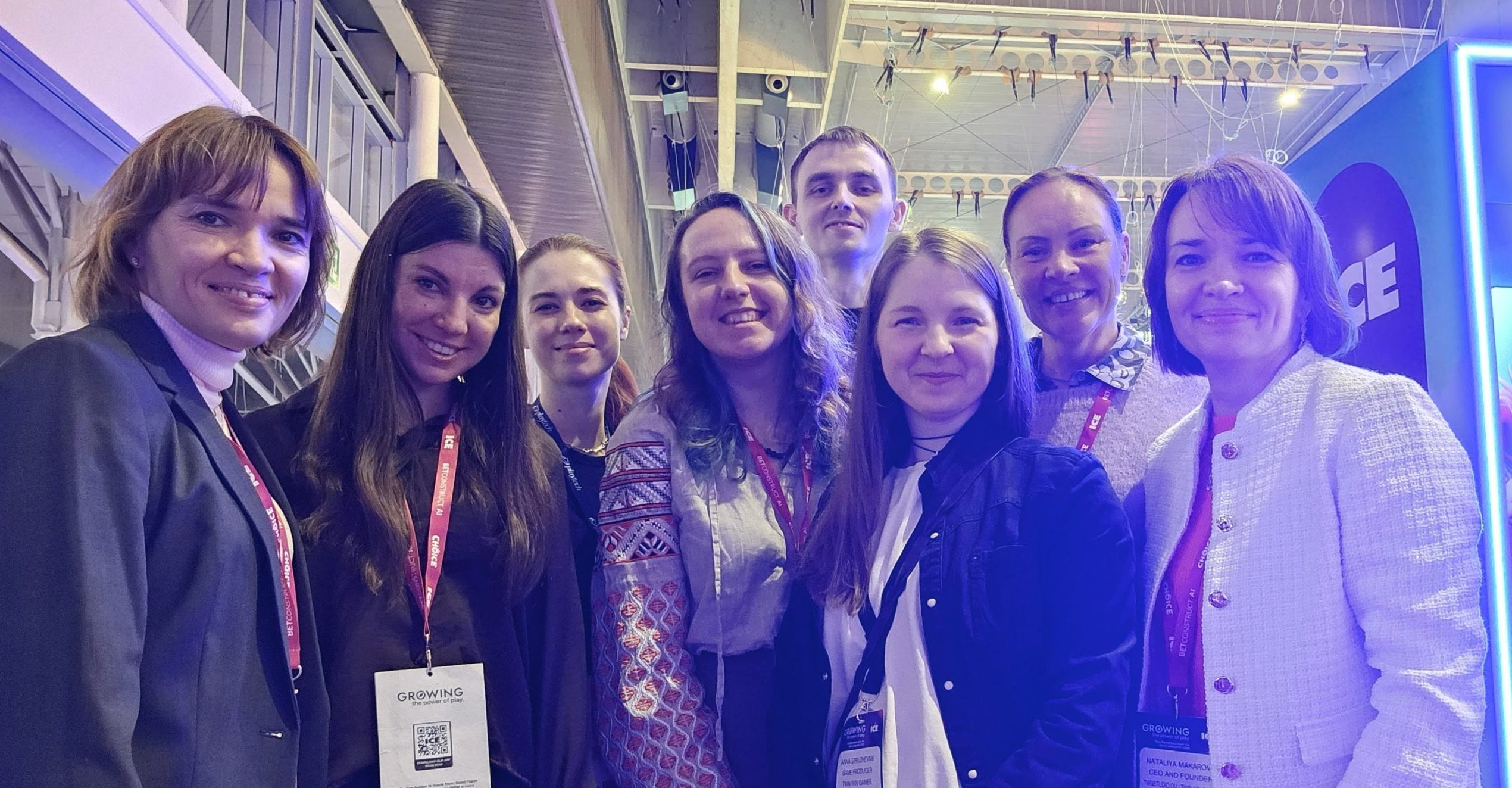
Our team spent ICE talking with casino game studios, operators, aggregators, and platform providers. Below are the patterns that came up most often.
These are not stage trends. These are buyer questions.
If you’re building new content for 2026, scaling production, or rethinking delivery models, this is the reality check you want. We work with studios and operators on full-cycle delivery, from concept to release, across art, development, backend, and live operations.
Learn more about our full-cycle approach here: casino game development.
The signal behind all trends: uncertainty is the real enemy
Before the trends, one observation matters more than everything else.
Studios are not afraid of complexity. They already ship complex products. They are afraid of uncertainty.
Unclear ownership, unstable teams, weak planning, and vendors who disappear when the project gets hard.
Natalia Makarova, CEO of Twin Win Games, put it clearly:

“What clients truly value is comprehensive expertise, experience across markets, jurisdictions, compliance, and operational realities, not isolated AI experts or surface-level knowledge.
As AI accelerates access to tools and information, real differentiation comes from teams with lived product experience who can reduce ambiguity from concept to live operations.
This is where the Twin Win Games Product-as-a-Service model becomes critical, stable teams, shared accountability, predictable delivery, and the ability to commit to budgets while communicating clearly when expectations don’t match reality.
In practice, studios are prioritizing partnership, trust, and long-term ownership. Choosing partners who think in products, not deliverables, and are committed to long-term outcomes.”
This quote is the best summary of what ICE 2026 felt like in real meetings.
Now, the 8 trends.
1. Cross-platform is no longer a feature, it is a growth strategy
Comment from the floor
Dmytro Derevianchenko, Partner and Head of Solutions:

“One clear trend in iGaming after ICE: the best land-based mechanics are moving online, and online ideas are making their way back to the casino floor.
Studios that can design for both ecosystems are gaining a real edge. Bluberi is a good example of that shift.
In just a few years, they’ve grown from a niche Class II supplier into a serious U.S. contender, 12,000+ installs across North America, 194 licenses, and 4× revenue growth in three years.
They’re not just releasing more games. They’re porting proven land-based hits into digital formats and building products that work cross-platform from day one.
Their 2025 partnership with Design Works Gaming combines LuckyTap online mechanics with strong retail performers like Devil’s Lock. Shared DNA products instead of simple ports.
Add a Nevada license, new hardware, 14+ planned releases per year, and 2026 looks less like expansion and more like acceleration.
Smart bet: build once, win in both worlds.”
What this means in practice
Cross-platform used to be a “nice bonus.” In 2026, it is becoming a competitive moat.
Studios that can move mechanics, IP, and design logic across ecosystems gain:
- faster iteration cycles
- longer lifespan of successful concepts
- more licensing and distribution options
- stronger negotiating power with partners and platforms
Practical checklist for decision-makers
If you are building for both ecosystems, you need answers to these questions:
- What part of the game logic is reusable across channels?
- How do you handle different certification requirements?
- What parts of the art pipeline must be adapted for cabinet-scale screens?
- Do you have production workflows that support both formats without doubling cost?
The line between land-based and online is becoming thinner. Proven land-based mechanics are moving into digital formats, and online interaction patterns are influencing retail experiences. If you want to build for both ecosystems, the key is reusability and modular architecture. This is where a scalable game engine solution becomes critical.
2. “Partner” beats “vendor” as the main buying filter
Comment from the floor
Hanna Hryhorenko, Account Manager:

“Clients don’t want just an executor anymore. They want a partner who is involved in their business. They want a team that understands context, market, and constraints, not a team that works strictly by a task list.
Transparency matters. Honest timelines, realistic estimates, and open dialogue are more valuable than trying to look faster and cheaper at the start.
The most common pain point is misalignment between initial expectations and the real complexity of the project.
Clients also mention communication issues, lack of transparency in project status, unclear decision-making, and sensitivity to changes without revisiting agreements.
What matters most is how the team behaves when something goes off plan. Presentations stop mattering if there is no clear feedback and no willingness to take responsibility.”
What changed compared to 2024–2025
Studios are not selecting “best service.” They are selecting “lowest delivery risk.”
This is a big shift.
Many buyers already have scars from:
- missed timelines
- hidden scope creep
- teams that change mid-project
- unclear responsibility between departments
- rework caused by weak onboarding
Practical advice for studios and operators
When selecting a development partner, ask for:
- escalation process examples
- what happens when milestones slip
- how decisions are documented
- who owns approvals on both sides
- what the weekly communication format looks like
If a vendor cannot answer this clearly, you are buying uncertainty.
3. AI conversations became specific, and buyers got stricter
Comment from the floor
Oksana Zakharchuk, iGaming Partnerships Strategist:

“AI was the main theme. If earlier AI was discussed more abstractly, this year there were concrete use cases: AI for safer gambling, CRM automation, real-time bonus personalization.
RenderWolf and SlotGPT had booths focused on AI game creation.
Web3 as a separate niche felt overrated. Blockchain is now mostly treated as another payment method, not a unique player value.
What impressed me was marketing. Companies tried to stand out in every way possible. Giant screens, hosts, cockroaches, a horror room, a dragon, a slot machine on wheels. Novomatic had a photo booth I actually enjoyed.
There is also a trend of promoting new releases during the conference noise.”
What this means in practice
AI is no longer a “topic.” It is a tool. Buyers now ask:
- where it saves time
- where it breaks quality
- where it creates compliance risks
- who controls the final output
The companies that sound credible are the ones who say:
“We use AI in specific production stages, with human control.”
The companies that lose trust are the ones who imply:
“AI replaces the team.”
4. Game design questions were not about mechanics, they were about consistency
Comment from the floor
Ann Spruzhevnik, Game Producer:

“I wouldn’t say there were many game design questions in meetings. Most companies already have a clear design vision or portfolio.
They were more interested in whether we could reproduce their style in new projects, and maintain quality.
Land-based showed a good trend of moving beyond classic themes like Asia, Egypt, leprechauns.
That space was more valuable for design, focus on detail, high art quality, complex animations on large screens.
Online conversations were less about retention math and more about workflow. How do you handle iterations? What happens when results fall short? Can you incorporate feedback without blowing up timelines?
The biggest tension is speed and quality. Everything shines and animates, but it must run smoothly on devices too.”
What this means in practice
Studios already know what they want.
They struggle with delivering it repeatedly across multiple releases.
That is why the real questions are:
- Can you match our quality bar every time?
- Can you handle feedback without chaos?
- Can you keep the pipeline stable across a year of releases?
Practical advice
If you want to scale content production, stop treating quality as “taste.” Treat it as a system:
- art style bible
- animation rules
- performance requirements
- review gates
- asset naming and structure
- consistent pipeline ownership
5. Planning is the difference between teams that ship and teams that slip
Comment from the floor
Anna Vasylkivska, Head of Production:

“There is a clear trend: everyone is chasing shorter time to market and tools for fast idea testing and faster execution.
Attitudes toward AI vary a lot. Some companies still say ‘no way.’ Others are ready for anything.
What separates teams that actually launch games? Planning. Teams with clear expectations, timelines, and roadmaps deliver more often.
As Benjamin Franklin said, if you fail to plan, you are planning to fail.
And if you choose reliable partners who consistently deliver high quality products, you reduce risk.”
What this means in practice
Time-to-market is not solved by motivation.
It is solved by:
- stable production planning
- clear milestone definitions
- controlled iteration loops
- predictable review cycles
- risk management
Practical checklist
If your team wants faster releases, audit these:
- Are milestones tied to measurable outputs?
- Is the feedback process time-boxed?
- Is there a documented “definition of done”?
- Are approvals centralized or scattered across stakeholders?
- Do you have a risk register for each release?
6. Efficiency without cutting corners became the main strategic priority
Comment from the floor
Tatiana Makarova, COO:

“The industry continues to grow. There are many new companies, especially in online. But the dominant players remain the same.
There are also many payment and marketing companies. The main challenge is fighting for the player and their attention.
Companies need new content that is interesting, high quality, not too expensive, and produced quickly.
AI-driven studios will soon create strong competition for teams that refuse to use AI.
This did not change our strategy. The market needs companies who build quality content and know how to deliver the product from A to Z.
We will continue implementing AI tools across departments to reduce development time without losing quality.
The market is crowded with studios offering similar services. Especially in art and animation. We need to move toward Product-as-a-Service mindset faster to stay competitive.”
What this means in practice
2026 is about making more content, with fewer risks, and with a stable quality bar.
Studios that win will be the ones who can scale production without:
- breaking the pipeline
- losing art consistency
- increasing bugs
- extending timelines
7. Trust became the real product, and expertise became a partnership
This insight was not a headline at ICE. But it surfaced in meeting after meeting.
Studios are not afraid of hard projects. They are afraid of projects where nobody owns the outcome.
They are tired of fragmented vendor setups where:
- art is outsourced to one team
- development is done by another
- backend is handled elsewhere
- integration is “someone’s responsibility”
- certification is pushed to the end
That structure creates delivery chaos.
The shift we saw at ICE is simple.
Buyers are moving toward partners who can own full-cycle delivery, reduce ambiguity, and provide predictable execution.
This is where structured models like Product-as-a-Service become practical, not theoretical.
8. Hybrid products and multi-ecosystem thinking will be a key differentiator in 2026–2027
Comment from the floor
Maria Yudaeva Moiseeva, BDM, Web3 Solutions Gaming Innovation Partner:

“Beyond the trends already mentioned, ICE 2026 highlighted another important shift: the growing importance of hybrid products and multi-ecosystem strategies that go beyond a simple online and land-based mindset.
The industry is increasingly looking for ways to combine the strengths of both worlds through adaptable mechanics, shared player insights, and deeper integration between physical and digital touchpoints.
This was visible not only in panel discussions, but also in how companies presented themselves on the show floor. Many were no longer showcasing individual games, but rather systems designed to operate across environments with a unified understanding of players and performance metrics.
In my view, this trend will become even more pronounced in 2026–2027 and may serve as a key differentiator for teams ready to think of products more holistically than just another online slot or another cabinet on the casino floor.
Compared to ICE 2025, ICE 2026 also felt larger in scale and different in quality. There was a clear increase in the number of top-management attendees and fewer casual visitors. Conversations were more focused, pragmatic, and commercially grounded. There was a tangible sense of capital moving through the industry.”
What this means in practice
This is the “next layer” after cross-platform.
Cross-platform is about delivery across environments.
Hybrid strategy is about product systems that connect environments.
This includes:
- shared player data logic
- unified performance measurement
- mechanics designed to travel across ecosystems
- product thinking beyond individual releases
Practical takeaway
If your roadmap is built around isolated games only, you will be competing in the most crowded layer of the market.
The more defensible direction is building systems:
- reusable mechanics frameworks
- cross-environment content strategies
- scalable pipelines
- stable partner ecosystems
What decision-makers were actually testing at ICE 2026
Across meetings, the most serious buyers were testing three things.
1) Delivery realism
Not your portfolio. Your process.
They want to know:
- can you estimate correctly
- can you hit deadlines
- can you communicate delays early
2) Team stability
They want to know who is actually building.
Not a pitch team. Not a deck.
A real production team.
3) Ownership under pressure
They want to know what happens when:
- integration breaks
- certification delays appear
- a game needs iteration
- scope changes mid-production
What Twin Win Games focuses on in 2026
ICE Barcelona 2026 reinforced our direction.
Studios need partners who can:
- deliver full-cycle development
- scale production without losing quality
- reduce uncertainty through stable teams and clear processes
- integrate modern tooling, including AI, without sacrificing control
That is the logic behind our Product-as-a-Service — turnkey casino game development model.
If you want to discuss delivery models, cross-platform strategy, or predictable production for 2026 releases, feel free to reach out.
You can also explore our core capabilities in casino game development, slot game development, backend game development, and game engine solution.
Want to see how we work?
If you want to discuss full-cycle game development, scalable production pipelines, or certification-ready delivery, reach out.
📧 info@twinwingames.com
🔗 twinwingames.com