
An in-house game team makes sense when you have three things: time to build it, budget to sustain it and a long-term product vision that justifies the investment. If one of them is missing, a game development studio can help you reach that point faster. Many teams end up using both.
Below, Natalia Makarova, CEO and Co-founder of Twin Win Games, answers six questions on this decision.
In the video:
- What do studios ask first?
- What can a studio give you that is hard to build internally?
- Where does an in-house team have the advantage?
- Can a studio work with a team that already exists?
- What changes after several projects?
- What should you prepare before talking to a studio?
What do studios ask first? Whether we have solved this before
The question we hear most from studios and operators is about experience. They want to know what we have built, who we have worked with and whether we have solved challenges similar to theirs. That is a fair question. Choosing a development partner is a big decision, and before timelines or budgets come up, clients want confidence that the team knows what to do.
The best answer is the work itself. See our portfolio and our slot art case study.
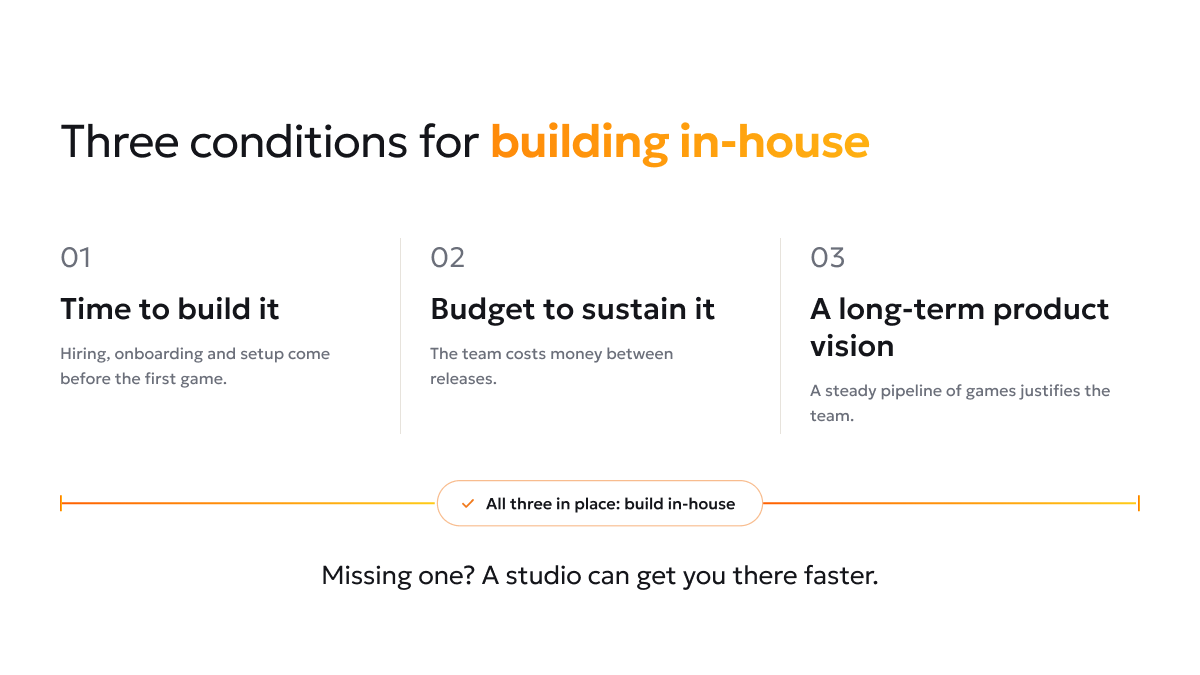
Three conditions for building in-house
An internal team is a strong investment when all three of these are true.
- Time to build it. Hiring, onboarding and setting up processes all happen before the first game ships.
- Budget to sustain it. The team stays on the payroll between releases, and the budget has to cover that time too.
- A long-term product vision. The investment pays off when there is a steady pipeline of games for the team to work on.
An in-house team also gives you complete ownership over your technology, your creative direction and your know-how.
“For some companies, that’s absolutely the right choice.” Natalia Makarova, CEO and Co-founder of Twin Win Games
What a studio gives you from day one
A studio fits when speed, range of skills or accumulated experience matter. Three things stand out.
- Speed to start. The team, the tools and the process are already running.
- Depth across disciplines. Art, animation, math, development and QA sit in one place. Building the same range internally means a separate hiring track for each discipline.
- Accumulated production knowledge. At Twin Win Games, the experience from 1,000+ games released is built into the production processes, the quality standards and the framework. A new team develops those practices over time.
Studios and in-house teams often work together
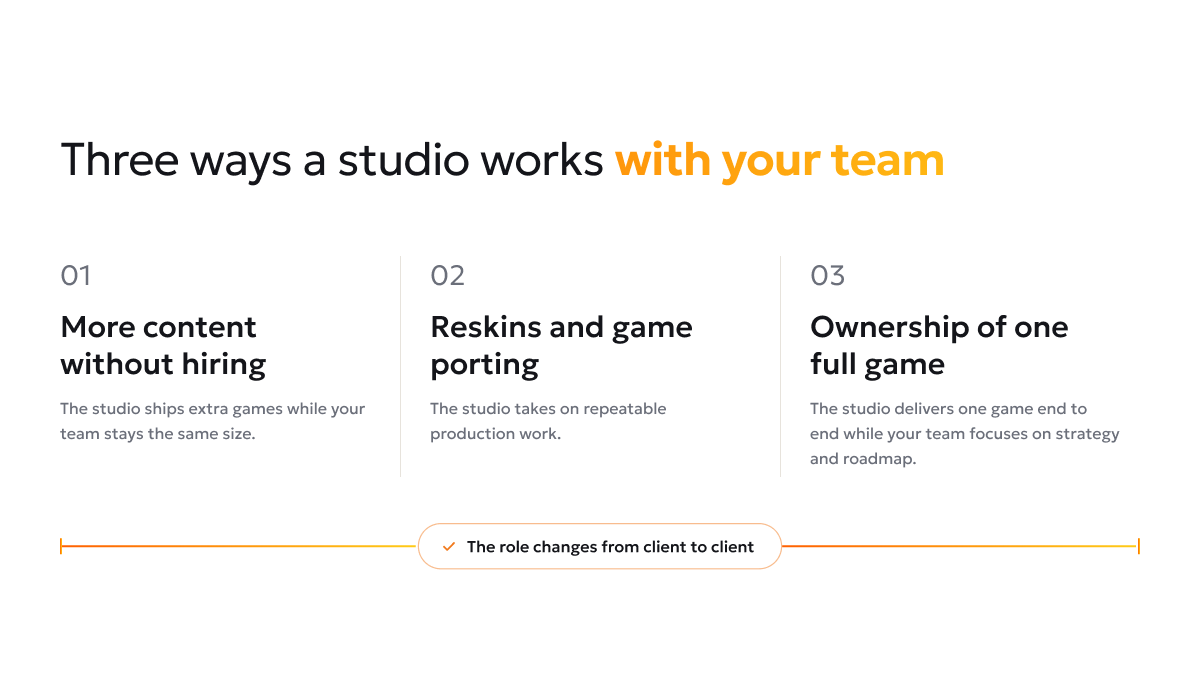
In our experience, most studios keep their internal team and bring in a partner to fill the gaps. The role of the studio takes one of three forms.
- More content without hiring. The studio ships additional games while the internal team stays the same size. See how studios ship 10+ games a year.
- Reskins and game porting. The studio takes on repeatable production work such as reskins. Our guide to new slots, reskins and ready-made games compares the options.
- Ownership of an entire game. The studio delivers one game end to end, for example through slot game development, while the internal team focuses on strategy and roadmap.
The role changes from client to client. A good studio adapts to the structure the client already has.
What changes after several projects
The biggest change is trust. After a few projects, both sides know what to expect. The studio understands the client’s processes, standards and goals. The client knows how the studio works.
In practice that means fewer approvals, fewer explanations and fewer second guesses. Communication gets faster and decisions get easier. Clients who trust the team are also more open to new ideas and give the studio more freedom to contribute.
How to decide: a quick check
This is our summary of the points above.
| Question | In-house fits when | A studio fits when |
| Time | You can wait while the team is hired and set up | You need production to start soon |
| Budget | You can fund the team between releases | You prefer to add production capacity for the games you are building now |
| Vision | You plan to release games continuously for years | You are testing a new product or format |
| Skills | Your team covers every discipline you need | You are missing one or two disciplines, such as math or QA |
You can also combine both. Many teams do.
What to prepare before talking to a studio
You do not need a finished specification. Start with your goals.
- Do you want to launch faster?
- Do you want to increase production capacity?
- Do you want to build a completely new product?
Once the goal is clear, a studio can help define the best way to reach it. Sometimes that means building everything together. Sometimes it means supporting your existing team. Sometimes it means solving one specific production challenge.
The best conversations start with the problem and move to the solution after that.
Frequently asked questions
When should a studio build an in-house game team?
When it has time to build the team, budget to sustain it and a long-term product vision that justifies the investment. With all three in place, an internal team gives full ownership of technology, creative direction and know-how.
Can a game studio work alongside an in-house team?
Yes. A studio can add content without hiring, handle reskins and game porting, or take ownership of an entire game while the internal team focuses on strategy and roadmap.
What does a game development studio offer that takes time to build internally?
A team, tools and process that already run. Art, animation, math, development and QA in one place. Production knowledge built over 1,000+ games.
Do I need a full specification before contacting a studio?
No. Start with your goals: launch faster, increase production capacity or build a new product. The studio can help define the approach from there.
What changes after several projects with the same studio?
Trust grows. Both sides know the standards and expectations, so there are fewer approvals, fewer explanations and fewer second guesses.
What do studios ask first when choosing a development partner?
Experience. They want to know what the team has built, who it has worked with and whether it has solved similar challenges. They ask before timelines and budgets come up. Our portfolio shows the work.
Is working with a game studio the same as outsourcing?
Not always. Outsourcing usually means handing a defined task to an outside vendor. A studio can also co-develop alongside your team, take on repeatable production such as reskins and porting, or own a whole game. The role depends on what your team already covers.
Start a conversation
Have a game project in mind? Bring your brief, your deadline and your challenges. We will tell you what we can build and how fast.
Twin Win Games is a full-cycle game development studio. Art, animation, math, development, back-end and QA are handled by one in-house team. 13+ years, 1,000+ games released, 198+ clients, 110+ specialists.