
| QUICK ANSWER There are 8 main types of gamers: Achievers, Explorers, Socializers, Competitors, Casual Gamers, Hardcore Gamers, Mobile-First Gamers, and Streamer/Content Creator Gamers. Each type has distinct motivations, session behaviors, and game mechanics they respond to. Understanding these types before development begins is the single most impactful product decision a game studio can make. |
Every game studio eventually faces the same question: who are we actually building this for? The answer shapes everything from feature priority and monetization model to art direction and UI complexity. Studios that define their player type before writing a single line of code consistently ship products that retain players longer and monetize more efficiently than those that treat audience definition as a post-launch problem.
This guide breaks down the 8 primary gamer types, what motivates each, and what that means for game design and development decisions. It applies equally to casual mobile games, online casino titles, and mid-core PC or console products.
Why Gamer Typology Matters for Developers
Gamer typology is not a marketing exercise. It is a product design tool. The mechanics that keep an Achiever engaged for 90-day retention are fundamentally different from the mechanics that work for a Casual Gamer. Building for both simultaneously without a clear primary audience produces a product that serves neither well.
According to GlobalWebIndex gaming persona research, six distinct gamer segments exist even within a single platform. Each differs in session length, social behavior, content consumption, and purchase intent. Studios that map their game design decisions to a defined primary persona see measurably higher day-7 and day-30 retention compared to those that use generalized audience assumptions.
The typology below draws on Bartle’s foundational framework (1996) and extends it with current behavioral data from mobile, casino, and mid-core gaming contexts.
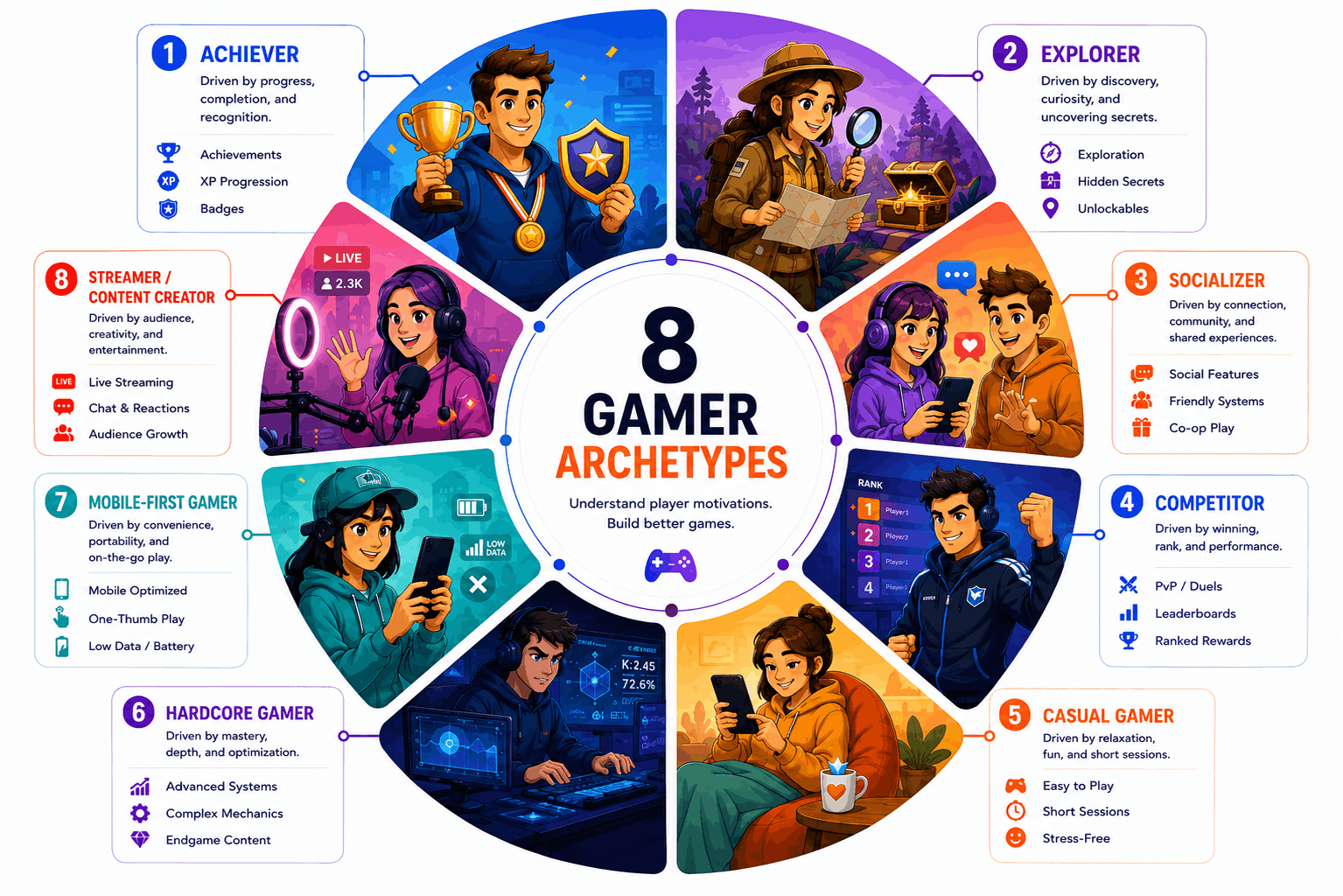
The 8 Main Types of Gamers
The same game mechanic that retains one player type will drive another away. A leaderboard motivates a Competitor and means nothing to a Casual Gamer. A complex progression system delights a Hardcore Gamer and kills retention for a Mobile-First player at onboarding. These eight types are not demographics. They are behavioral profiles that determine what a player needs from a game to stay.
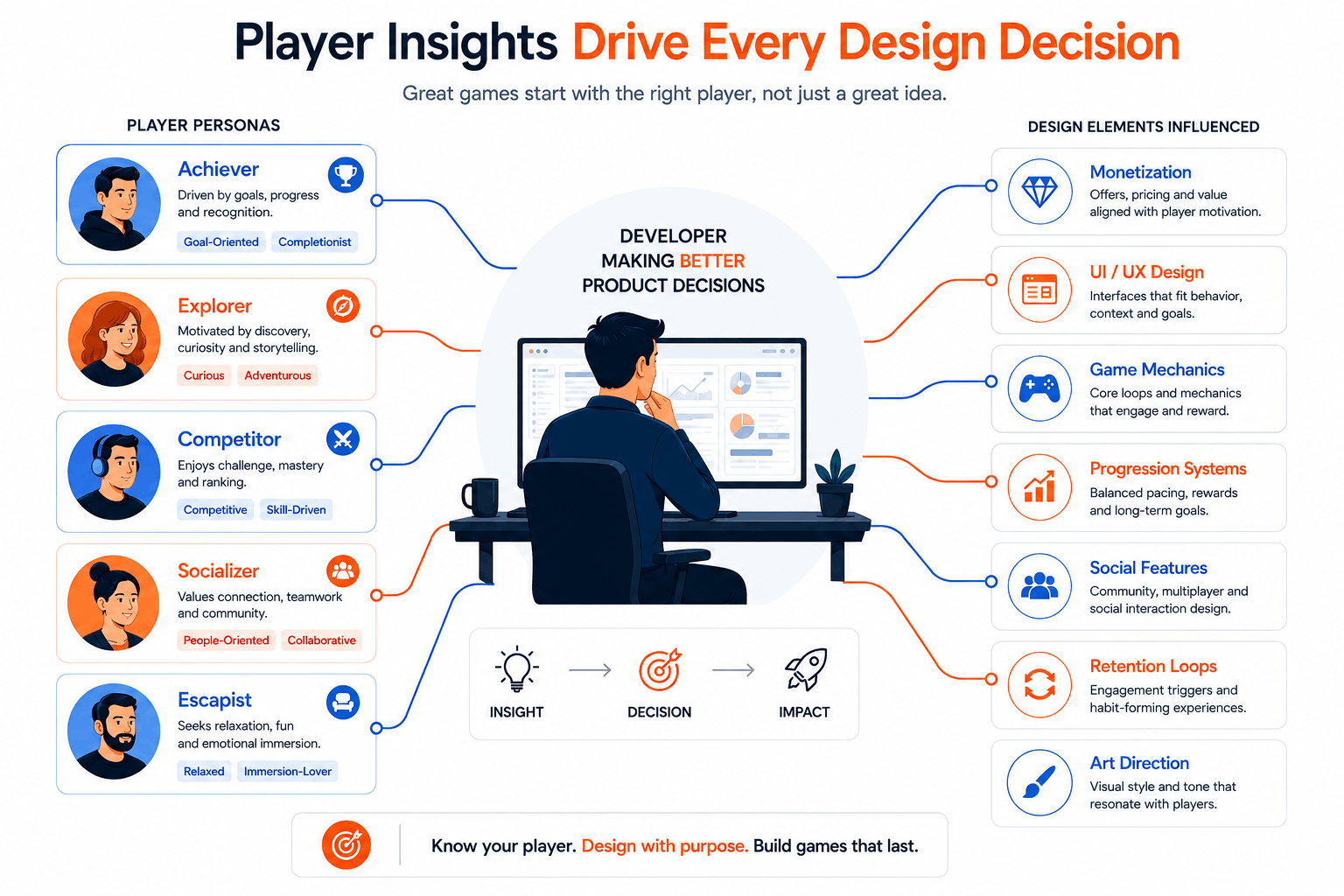
1. The Achiever
Key mechanics: progression systems, achievement badges, level caps, XP bars, leaderboards with ranked tiers, collectible sets.
Achievers are motivated by progress, completion, and visible status. They collect trophies, complete every side quest, and track statistics. In casino games, they are the players who pursue jackpot milestones and fill loyalty card meters. In mobile games, they grind daily missions and fill achievement libraries.
Design implication: Every session must offer measurable progress toward a visible goal. If a session ends with no visible advancement, Achievers disengage.
2. The Explorer
Explorers are motivated by discovery. They want to find hidden content, test system edges, and understand how everything works. In slot games, they are the players who test every bet level to understand the math. In open-world games, they map every area before advancing the story.
Key mechanics: hidden bonuses, unlockable content, easter eggs, diverse game modes, varied feature sets with non-obvious trigger conditions.
Design implication: Depth over breadth. Explorers need content that rewards curiosity. A game that reveals everything in the first session loses them permanently.
3. The Socializer
Socializers play primarily for the relational experience. They are less interested in winning than in sharing the experience of play. In casino contexts, they are the group visit players and the live chat participants. In mobile, they play async multiplayer games with friends and share results on social platforms.
Key mechanics: multiplayer modes, async social features, leaderboards with friend visibility, gifting systems, shared win celebrations, tournament formats.
Design implication: Shareability must be built in, not added later. Win screens, milestone moments, and tournament results need to be screenshot-ready and shareable by design.
4. The Competitor
Competitors are motivated by winning against other players. They track their rank, study opponent behavior, and optimize for performance. In casino games, they engage heavily with tournament formats and live leaderboards. In mid-core and mobile games, they are the players in the top tier of PvP modes.
Key mechanics: PvP modes, ranked ladders, real-time leaderboards, seasonal competition resets, tournament brackets, win rate tracking.
Design implication: Perceived fairness is non-negotiable. Competitors will abandon a product if they perceive that matchmaking is manipulated or that pay-to-win mechanics undermine skill expression.
5. The Casual Gamer
Casual Gamers represent the largest segment by volume and the most diverse by demographic. They play in short sessions, often on mobile, as a form of relaxation or time-filling. They do not identify strongly as gamers. Female mobile players aged 25 to 45 represent the largest sub-group within this type.
Key mechanics: simple onboarding, satisfying tactile feedback, low skill floor, session lengths of 3 to 10 minutes, forgiving failure states, clear daily rewards.
Design implication: Complexity kills casual retention. Every additional mechanic requires justification against the risk of losing the player at onboarding.
6. The Hardcore Gamer
Hardcore Gamers play for mastery. They invest hundreds of hours per title, consume strategy content, and participate in communities built around the game. They expect depth, challenge, and developer responsiveness to the meta-game community.
Key mechanics: deep systems, skill expression through decision-making, regular content updates, competitive modes, community tools, mod support or builder modes.
Design implication: Launch is not the finish line for Hardcore Gamers. They expect an evolving game. Studios without a post-launch content roadmap will not retain this segment past the first month.
7. The Mobile-First Gamer
Mobile-First Gamers play exclusively or primarily on smartphones. They are not a subset of Casual Gamers but a platform-defined type that spans from casual puzzle players to high-engagement RPG players who have never owned a console. 90% to 95% of Gen Z and Gen Alpha identify as gamers, and the majority of that identification is through mobile.
Key mechanics: portrait-mode primary design, one-thumb interaction, offline support, session resume without penalty, push notification re-engagement, minimal data usage.
Design implication: Mobile-first is not a port from desktop. Games designed desktop-first and compressed for mobile consistently underperform in session length and retention against native mobile designs.
8. The Streamer / Content Creator Gamer
This type plays games partly or primarily as content for an audience. They need games that create watchable moments: dramatic near-misses, unexpected outcomes, social reactions, and shareable highlights. Crash casino games and high-volatility slots perform exceptionally well for this type because the shared tension of watching a multiplier climb is inherently watchable content.
Key mechanics: spectator modes, highlight-worthy peak moments, real-time tension mechanics, big-win sequences with dramatic visual payoff, shareable clips.
Design implication: Games that generate organic streaming content receive earned marketing at zero cost. Building streamability into the core loop is a distribution strategy, not just a design choice.
Gamer Types at a Glance
A few patterns stand out across these types. Session length and spending behavior don’t always move together. Casual Gamers have the shortest sessions but represent the largest aggregate revenue pool in mobile gaming simply because of volume. Competitors and Hardcore Gamers play longer but monetize through progression depth and competitive content rather than convenience purchases. The Streamer type generates disproportionate acquisition value relative to their count. One streamer with 50,000 viewers drives more new player acquisition than thousands of paid impressions.
| Type | Primary Motivation | Key Mechanics | Avg Session Length |
| Achiever | Progress and completion | XP, badges, milestones | 30 to 60 min |
| Explorer | Discovery and depth | Hidden content, varied systems | 45 to 90 min |
| Socializer | Connection and sharing | Multiplayer, async social | 20 to 45 min |
| Competitor | Winning against others | PvP, ranked ladders | 45 to 120 min |
| Casual Gamer | Relaxation and time-fill | Simple loops, daily rewards | 3 to 10 min |
| Hardcore Gamer | Mastery and optimization | Deep systems, meta-game | 60 to 180 min |
| Mobile-First | Convenience and portability | Portrait UX, offline mode | 5 to 20 min |
| Streamer | Content creation | Peak moments, spectator | Varied |
The most common mistake in early product definition is designing for the founder’s own gamer type. Knowing which type you are building for and deliberately designing for their behavior rather than your own is one of the few decisions that cannot be corrected cheaply after launch.
How Gamer Type Defines Product Decisions
Defining the primary gamer type before development begins answers product questions that would otherwise require expensive iteration:
1. Volatility and pacing in casino games maps directly to whether the primary player is a Thrill Seeker (high volatility, big-win mechanics) or a Session Player (medium volatility, frequent smaller rewards).
2. Monetization model depends on gamer type. Achievers convert on cosmetic progression. Competitors convert on competitive advantages and ranked content. Casual Gamers respond to convenience purchases and time-limited offers.
3. Art direction and UI complexity are determined by audience. Hardcore Gamers expect information density. Casual Gamers need minimal cognitive load. Mobile-First Gamers need thumb-friendly interaction geometry.
4. Session design, including how long a session lasts and how it ends, must match the type. Casual sessions need a clean 5-minute loop. Competitor sessions need a ranked match format with a clear outcome.
| Related reading: 👉 Types of Casino Players | Demographics, Mechanics, and Market Data |
FAQ
What are the main types of gamers?
The 8 main gamer types are: Achievers (motivated by progress), Explorers (motivated by discovery), Socializers (motivated by connection), Competitors (motivated by winning), Casual Gamers (motivated by relaxation), Hardcore Gamers (motivated by mastery), Mobile-First Gamers (platform-defined), and Streamer Gamers (content-motivated). Each type requires different mechanics, session structures, and monetization approaches.
How do different types of gamers affect game design?
Gamer type determines every major product decision: feature priority, difficulty curve, session length, monetization model, UI complexity, and social mechanics. A game designed for Achievers without understanding that audience will lack the progression depth that retains them. A game designed for Casual Gamers without understanding their 5-minute session expectation will lose them at onboarding.
Is it possible to design a game for multiple gamer types?
Yes, but it requires a clearly defined primary type and deliberately scoped secondary types. Games that attempt to serve all types equally typically serve none well. The successful approach is to design core systems for the primary type and add secondary mechanics that do not conflict with the primary experience. Twin Win Games advises on audience definition during the pre-production scoping phase of every development engagement.
How has mobile changed gamer typology?
Mobile has fundamentally expanded what counts as a gamer. Before mobile, gamer typology was defined primarily by console and PC behavior. Mobile introduced two new primary types: the Mobile-First Gamer (who has never played on another platform) and the Casual Gamer in their current form (predominantly female, 25 to 45, playing for relaxation). According to IAB data, 90 to 95% of Gen Z identify as gamers, and the majority of that identification is through mobile gaming.
What types of gamers spend the most money in games?
Achievers and Competitors are historically the highest-spending gamer types in games with progression and competitive monetization. Hardcore Gamers spend significantly on content expansions and cosmetics tied to status. In casino games, Thrill Seekers (high-volatility players) and High Rollers generate disproportionate revenue relative to their count. Casual Gamers spend at lower individual levels but at very high volume due to the size of the segment.
Ready to Build a Game for Your Target Audience?
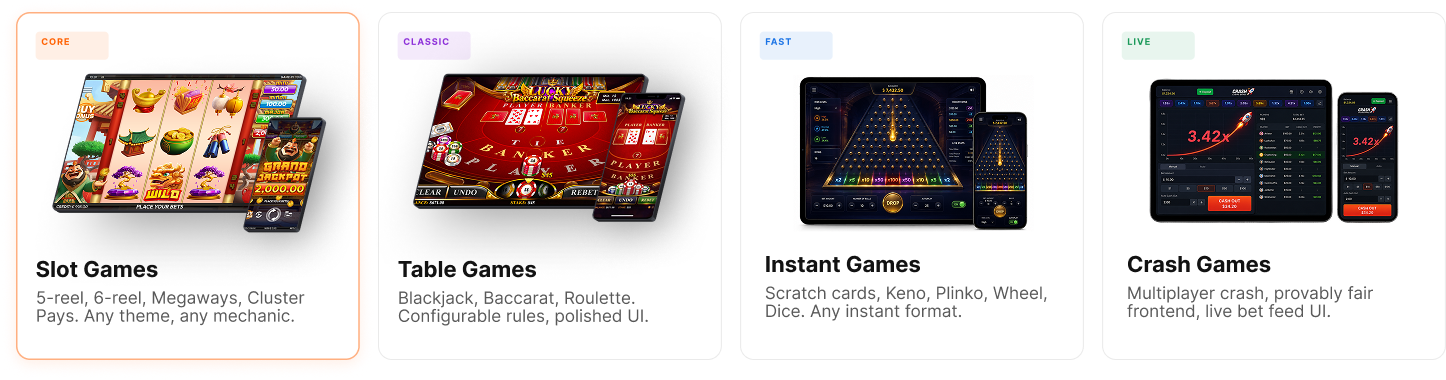
Twin Win Games develops slot games, table games, instant games, and crash games for operators and studios worldwide. We work with audience definition from day one. Gamer type shapes math model, mechanics, art direction, and session design before a line of code is written.
👉 twinwingames.com/casino-game-development/
📨 info@twinwingames.com