
A slot can keep the same math, RTP, RNG, and mechanics and still lose player attention.
The reason is simple. The technical foundation of a game and the way players perceive it do not age at the same rate. A mechanic may remain perfectly usable while its theme, artwork, animation, UI, or overall presentation starts to feel dated next to newer releases.
For operators, that creates an important question: should you retire the game, rebuild it, or refresh the old slot game while preserving what already works?
The answer depends on what is actually causing the decline.
Signs a Slot Is Losing Player Engagement
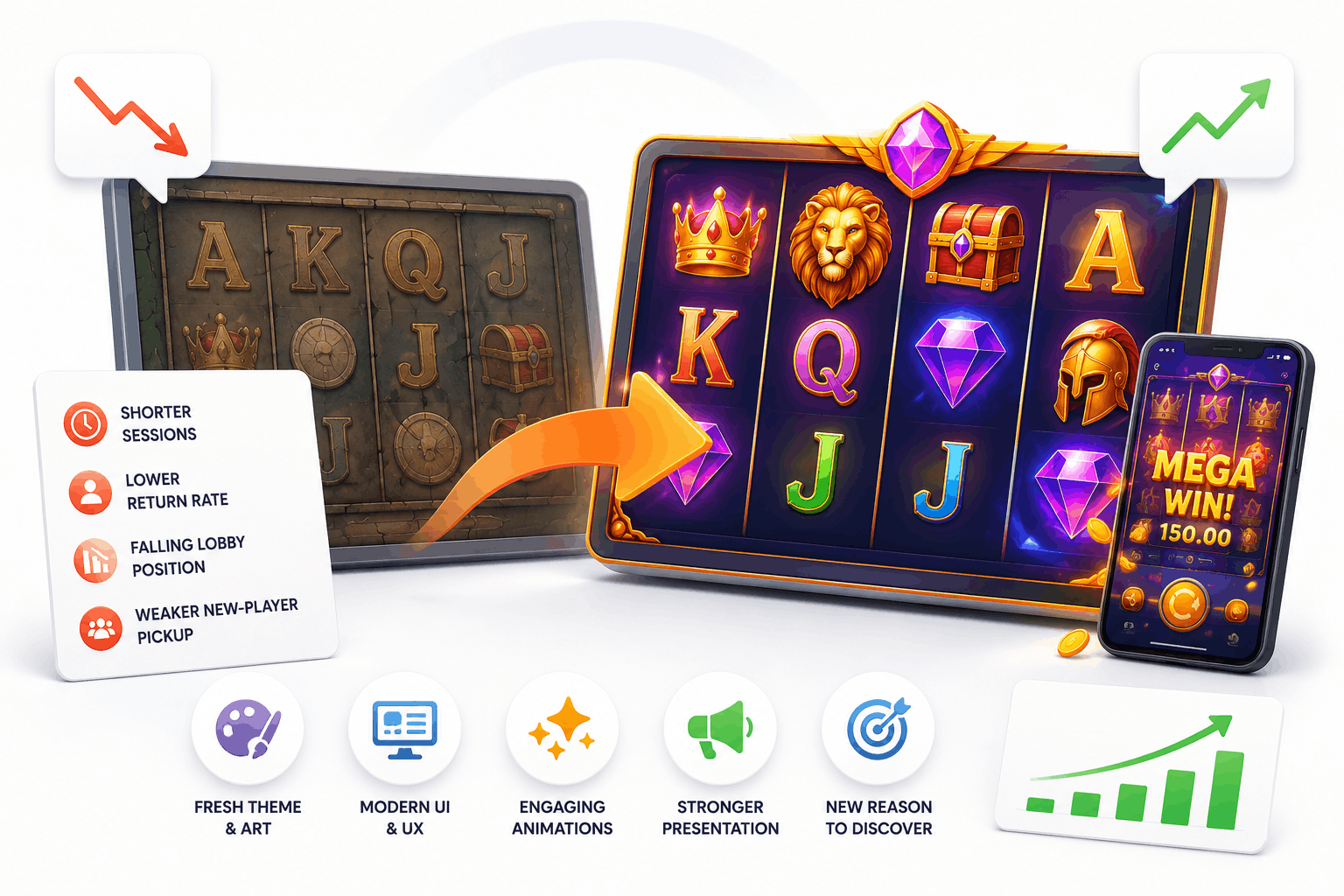
A declining title rarely announces the problem through a single metric. Operators should look for patterns across several indicators.
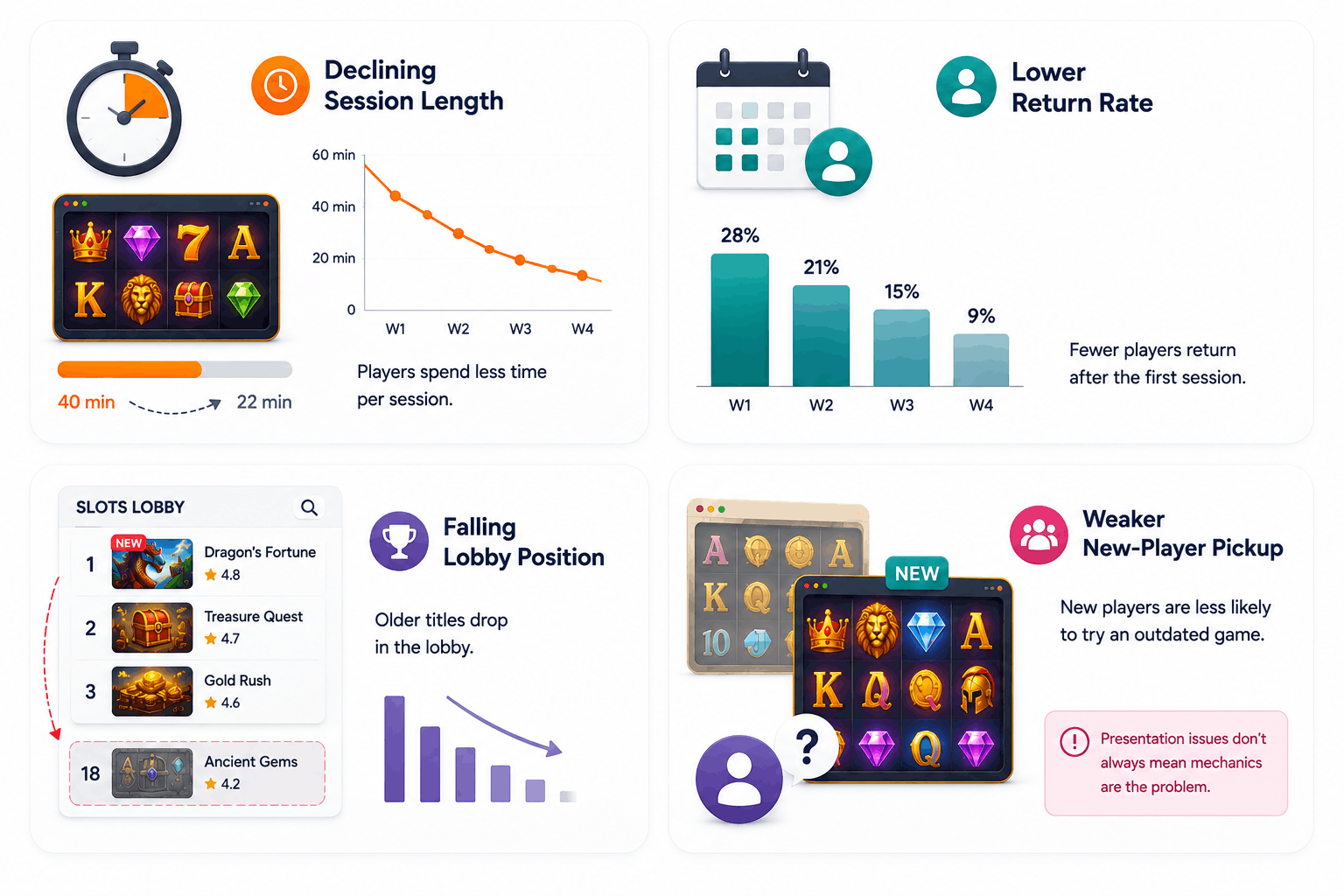
Declining Session Length
If players who open the game spend less time with it than they previously did, something may have changed in how the experience competes for attention.
That does not automatically mean the math is the problem. Presentation, usability, positioning, and competing titles can all influence the player’s decision to continue or leave.
Lower Return Rate
A slot may still attract initial plays but struggle to bring players back.
This can be particularly revealing for an established title. If the underlying gameplay has not changed but repeat activity weakens, the issue may sit outside the core mechanics.
Falling Lobby Position
Casino lobbies are competitive environments.
New releases continually enter the catalogue, promotional priorities change, and older games can gradually lose visibility. Once a title moves away from prominent positions, discovery can weaken further.
The result can become cyclical. Lower visibility means fewer opportunities to play, which can make an older title even easier to overlook.
Weaker New-Player Pickup
Existing players may remember a game from its stronger period, while new players encounter it alongside more recent titles.
If the artwork, UI, animation, or theme looks noticeably older than neighboring games, a new player may make a decision before experiencing the mechanic at all.
This distinction matters. A presentation problem should not automatically be treated as a gameplay problem.
Why Slot Engagement Declines Over Time
There is rarely one universal cause of slot engagement decline. Several factors can overlap.
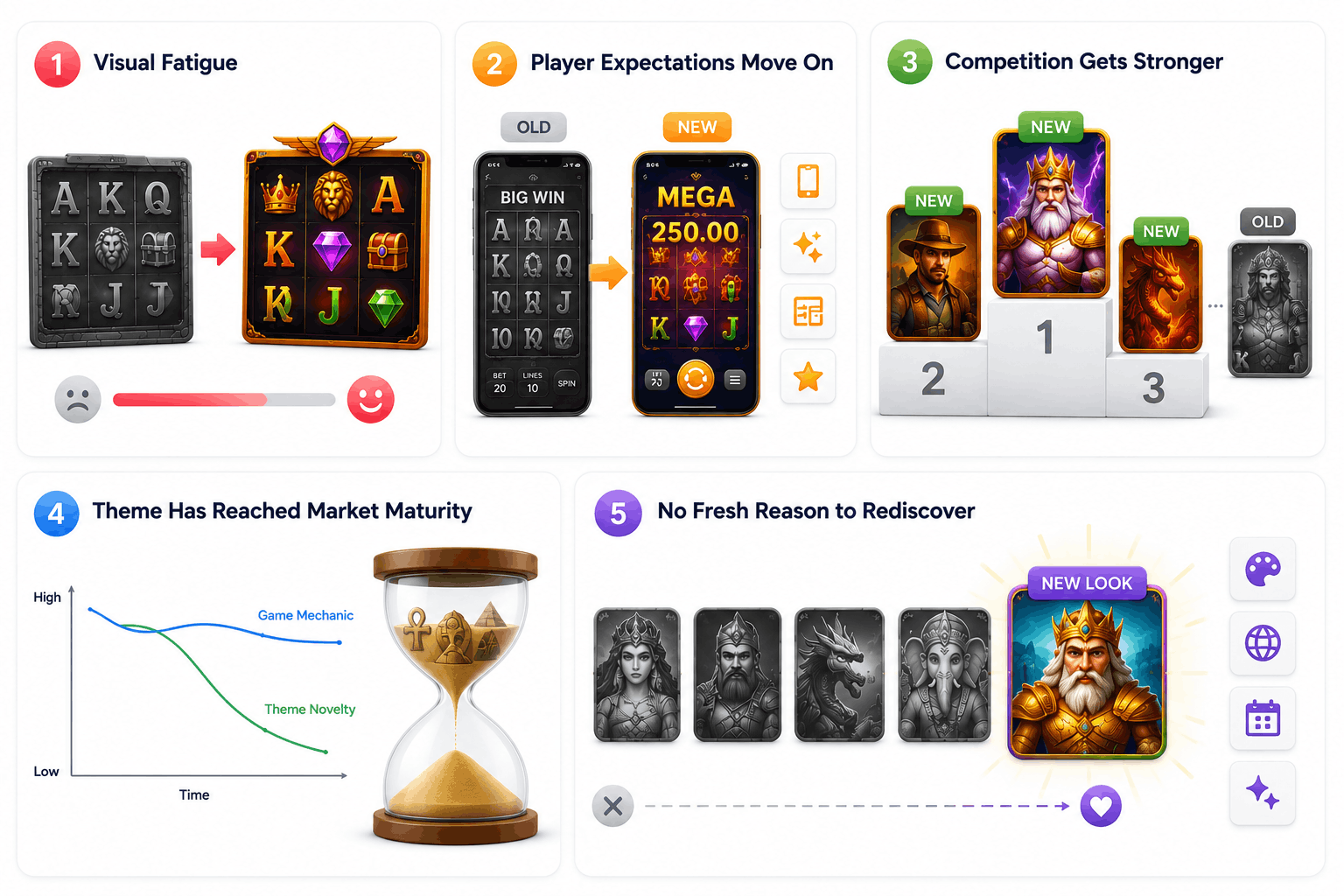
Visual Fatigue
Players can become familiar with a game’s symbols, characters, backgrounds, effects, and overall theme.
Familiarity is not inherently negative. Recognizable games can retain value for a long time. The problem starts when familiarity becomes visual fatigue and there is little left in the presentation to rediscover.
This can happen even when the underlying gameplay remains sound.
Player Expectations Move On
Casino game presentation changes over time.
Newer titles can introduce more polished interfaces, stronger animation, clearer mobile layouts, improved visual hierarchy, and different approaches to feature presentation.
An older slot does not need to imitate every new design trend. Constantly chasing trends can create its own problems.
But there is a difference between having an established visual identity and looking technically or visually dated.
UI is particularly important here. A game designed around older screen formats or interaction patterns may feel less comfortable on the devices players use today.
This matters more every year. According to Market Research Future, mobile and tablet devices generated 61.1% of online gambling revenue in 2025, and in markets like the US that share already exceeds 80%. A slot built around older screen formats is competing for attention on the exact devices where it performs worst.
Updating slot game art and visual production can therefore involve more than replacing illustrations. Symbols, animation, UI, effects, and mobile presentation need to work together.
Competition Gets Stronger
Sometimes nothing is “wrong” with the old game.
The competitive environment simply improves around it.
A slot that once stood out in a smaller portfolio may later compete with dozens or hundreds of newer titles for the same lobby space and player attention.
The environment keeps expanding. Statista projects the online gambling market to grow from around $107.7 billion in 2025 to $133 billion by 2029. For an established slot, that means competing against a steadily growing catalogue of newer titles for the same lobby space.
That changes the benchmark. The relevant question is no longer whether the old game still functions. It is whether it remains competitive against what players can choose today.
The Theme Has Reached Market Maturity
Themes have life cycles too.
A visual concept can perform well when it feels relevant or distinctive, then gradually lose novelty as similar themes enter the market or player tastes shift.
This creates an interesting situation for operators. The theme may have aged while the mechanic underneath it has not.
That is one of the strongest reasons to evaluate a refresh rather than immediately retire the complete game.
There Is No Fresh Reason to Rediscover the Game
An established title can become invisible through familiarity.
Players recognize the thumbnail, know the theme, and assume they already know what the game offers. Even if they previously enjoyed it, there may be little reason to select it instead of something new.
A refreshed visual identity, market-specific theme, seasonal version, or stronger presentation can give an existing mechanic a new discovery opportunity.
It should not be treated as a guarantee of renewed performance. It is a way to address a presentation and positioning problem when those are the actual causes.
Retire, Rebuild, or Refresh?
When a slot is losing players, operators generally have three broad options.
| Option | Best When | Main Trade-Off |
| Retire | The game no longer supports the portfolio or business goal | Existing investment stops producing new content value |
| Rebuild | Math, mechanics, features, or game logic need fundamental changes | Higher cost, longer development, broader certification scope |
| Refresh / Reskin | The technical foundation remains useful but presentation needs a new direction | Works only when the underlying game is worth preserving |
Retire the Game
Retirement is sometimes the right decision.
If neither the mechanic nor the presentation supports the current portfolio, investing more resources in the title may not make commercial sense.
The same applies when the technical foundation creates limitations that would make modernization inefficient.
Not every old game deserves another production cycle.
Build a New Slot
A rebuild makes sense when the problem goes deeper than presentation.
If you need different math, new mechanics, substantially different features, or a fundamentally new player experience, replacing artwork will not solve the problem.
That is new game development.
The investment is larger, but that investment is justified when the product needs a new foundation.
Our detailed reskin vs building a new slot comparison looks at this decision across cost, timeline, risk, and certification.
Refresh the Existing Slot
The third option sits between retirement and rebuilding.
If the math and mechanics remain worth keeping, you can modernize an old slot game by changing the presentation around that foundation.
Depending on scope, this can include:
- a new theme and art direction;
- redesigned symbols and characters;
- updated backgrounds;
- new animation and effects;
- refreshed UI;
- new sound and music;
- mobile-oriented visual improvements;
- localization for another market;
- new promotional assets.
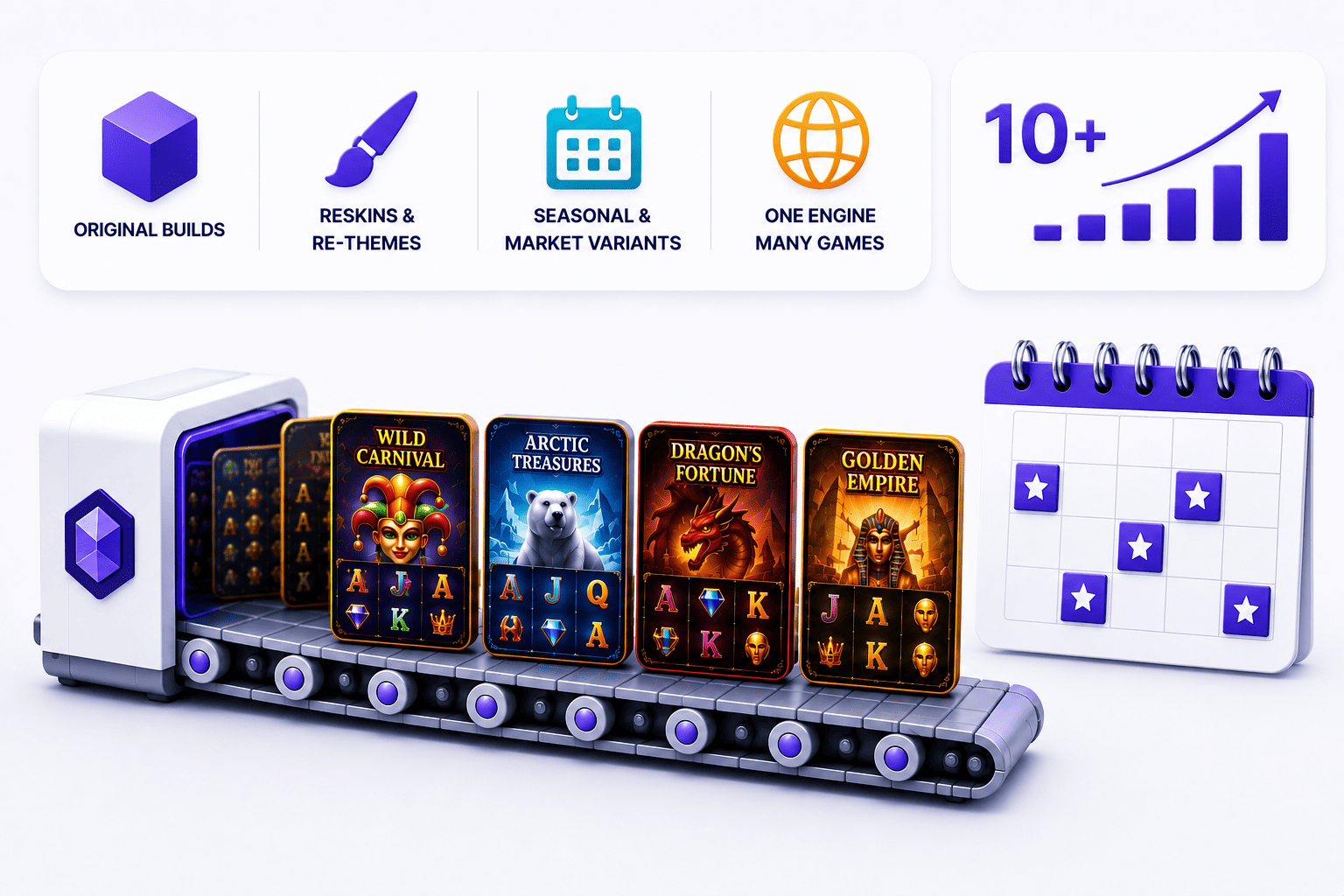
This is where a reskin becomes commercially interesting. You spend the production budget on the layer that needs changing instead of automatically rebuilding the layers that still work.
How a Slot Reskin Can Re-Engage a Proven Game
A reskin gives an existing game a new visual identity while retaining the technical foundation where the project allows it.
For a visual-only reskin, the math model, RNG, RTP, paytable, and core game logic remain unchanged. The production work focuses on presentation.
That creates several practical advantages.
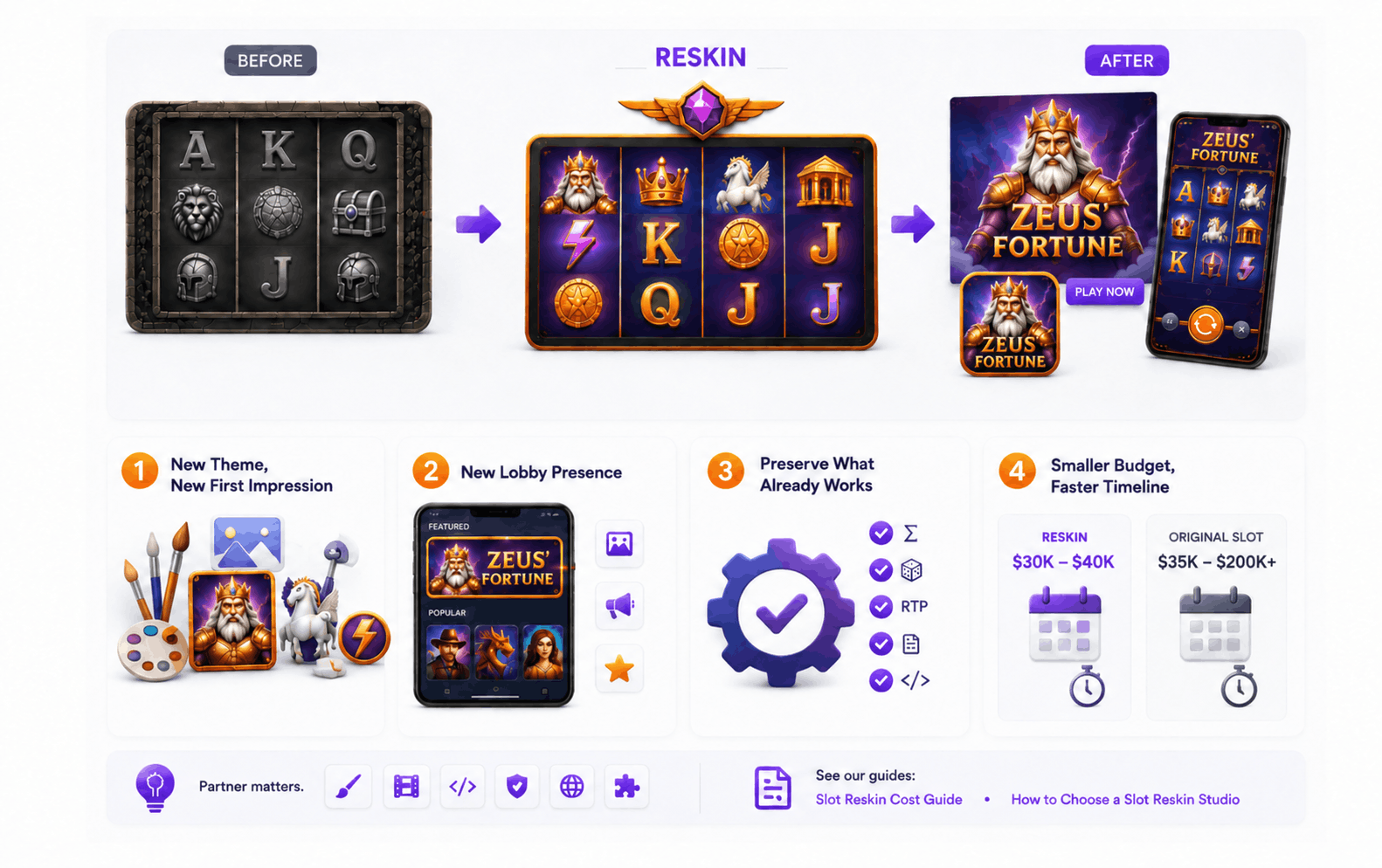
A New Theme Changes the First Impression
Players encounter the presentation before they experience the math.
New symbols, characters, environments, UI, animation, and audio can change how an established mechanic appears in a casino lobby and during the first game session.
The goal should not be to disguise an old game with different colors. A strong reskin creates a coherent new visual identity at the quality expected from a new release.
The Game Gets a New Lobby Presence
A new theme also creates new lobby assets, thumbnails, promotional artwork, and positioning opportunities.
This can give an existing technical product another chance to compete for discovery rather than relying on an identity players have already seen many times.
You Preserve What Already Works
This is the central economic argument for a reskin.
If the mechanic remains valuable, replacing it simply because the art has aged can mean paying twice for the same type of foundation.
With slot game reskin services, the objective is to identify what should change and what should stay intact.
A visual-only project that preserves the math, RNG, RTP, paytable, and game logic will also typically follow a lighter compliance path than a completely new game. The exact requirements still depend on the testing lab, jurisdiction, existing certification, and scope of changes.
The Budget and Timeline Can Be Smaller
For budgeting purposes, a typical slot reskin can fall around $30,000–$40,000, while an original slot build may range from roughly $35,000 to $200,000+, depending on complexity.
Reskin projects are also commonly measured in weeks rather than the months associated with full original development.
These are planning ranges, not fixed project prices. Asset count, art complexity, animation, UI work, localization, audio, integration, and other requirements affect the final scope.
Our slot game reskin cost guide explains these budget drivers in more detail.
The production partner matters as much as the reskin scope. A strong studio should understand slot-specific art, animation, game logic boundaries, certification, source ownership, localization, and integration. If you are comparing vendors, our guide on how to choose a slot reskin studio covers seven practical questions to ask before starting a project.
Have an older title with mechanics you still want to keep?
Refresh a proven slot with Twin Win Games. We can review the existing game and determine what actually needs to change before defining the scope.
When to Refresh a Slot and When to Retire It
Before investing in an older game, separate the performance of the foundation from the performance of the presentation.
Use these questions as a quick decision guide:
Does the core mechanic still fit your portfolio?
If yes, there may be value worth preserving. If no, a new game or retirement may make more sense.
Is the main weakness visual rather than mechanical?
Dated art, UI, animation, or theme are strong refresh candidates. Weak core gameplay is not.
Would the same mechanic make sense with a different theme or market positioning?
If yes, a reskin can be worth evaluating.
Do you need to change math, RTP structure, game logic, or core features?
If yes, the project is moving beyond a visual refresh and toward new development.
Is there still a commercial reason for this game to exist?
This is the most important question. A lower-cost refresh is still an unnecessary investment if the title no longer serves the portfolio.
A useful final test is simple:
“If the current artwork disappeared, would you still want the game underneath it?”
If yes, consider refreshing it.
If no, changing the theme is unlikely to solve the underlying problem.
FAQ
Why do slots lose players over time?
Slots can lose player attention because of visual fatigue, changing UX expectations, stronger competition, declining lobby visibility, theme maturity, or a lack of fresh reasons to rediscover the game. Declining engagement does not automatically mean the underlying math or mechanics are the problem.
Can I refresh a slot without rebuilding it?
Yes. If the existing technical foundation remains suitable, a reskin can update the theme, symbols, characters, UI, animation, audio, and other presentation assets without rebuilding the complete game. The exact scope depends on the existing product and the changes required.
Does refreshing the art change the gameplay?
A visual-only refresh does not need to change the underlying gameplay. Math, RNG, RTP, paytable, and core game logic can remain intact while the presentation layer is redesigned. If those technical components also need modification, the project goes beyond a standard visual reskin.
Is a reskin cheaper than a rebuild?
Typically, yes. For budgeting, reskins commonly fall around $30,000–$40,000, while original slot development can range from approximately $35,000 to $200,000+ depending on complexity. The difference exists because a reskin can reuse a suitable technical foundation rather than creating every component again.
Give a Proven Slot a New Reason to Be Seen
A decline in player engagement does not automatically mean a slot has reached the end of its useful life.
First identify what has aged.
If the math, mechanics, and technical foundation remain valuable but the theme and presentation no longer compete effectively, a reskin can be a practical way to refresh an old slot game without paying to rebuild what already works.
If the foundation itself is the problem, build new or retire the title. The right decision starts with diagnosing the game rather than assuming every engagement problem has the same solution.
Twin Win Games has 13+ years of game development experience, 1,000+ released games, 198+ clients worldwide, and 100+ in-house specialists across game production disciplines.
If you have a title that is losing momentum, Get a Reskin Quote. We can review the existing game, desired visual direction, target markets, and production requirements before defining the right path.