
| QUICK ANSWER There are 6 primary types of casino players: The Thrill Seeker, The Session Player, The Bonus Hunter, The Social Player, The Casual Visitor, and The High Roller. Each type responds to different volatility profiles, feature mechanics, and RTP configurations. Designing or selecting casino games without mapping them to a target player type is the most common cause of underperforming titles on operator platforms. |
Most conversations about casino game design focus on math models, RTP ranges, and feature mechanics. Far fewer start with the foundational question: which player type is this game for? That question determines every technical specification that follows, from volatility setting and hit frequency to bonus trigger rate, max win, and session length design.
This guide breaks down the 6 primary casino player types, their demographic data, and what each type requires from a game design and development perspective. It is intended for casino operators selecting titles for their lobby and for game studios defining the specification for a new development project.
The Global Casino Player: Key Statistics for 2026
Understanding who plays casino games today, and where they play, is the foundation for any product or market entry decision. The data below reflects 2025 and 2026 research across regulated markets.
Demographics: Age and Gender
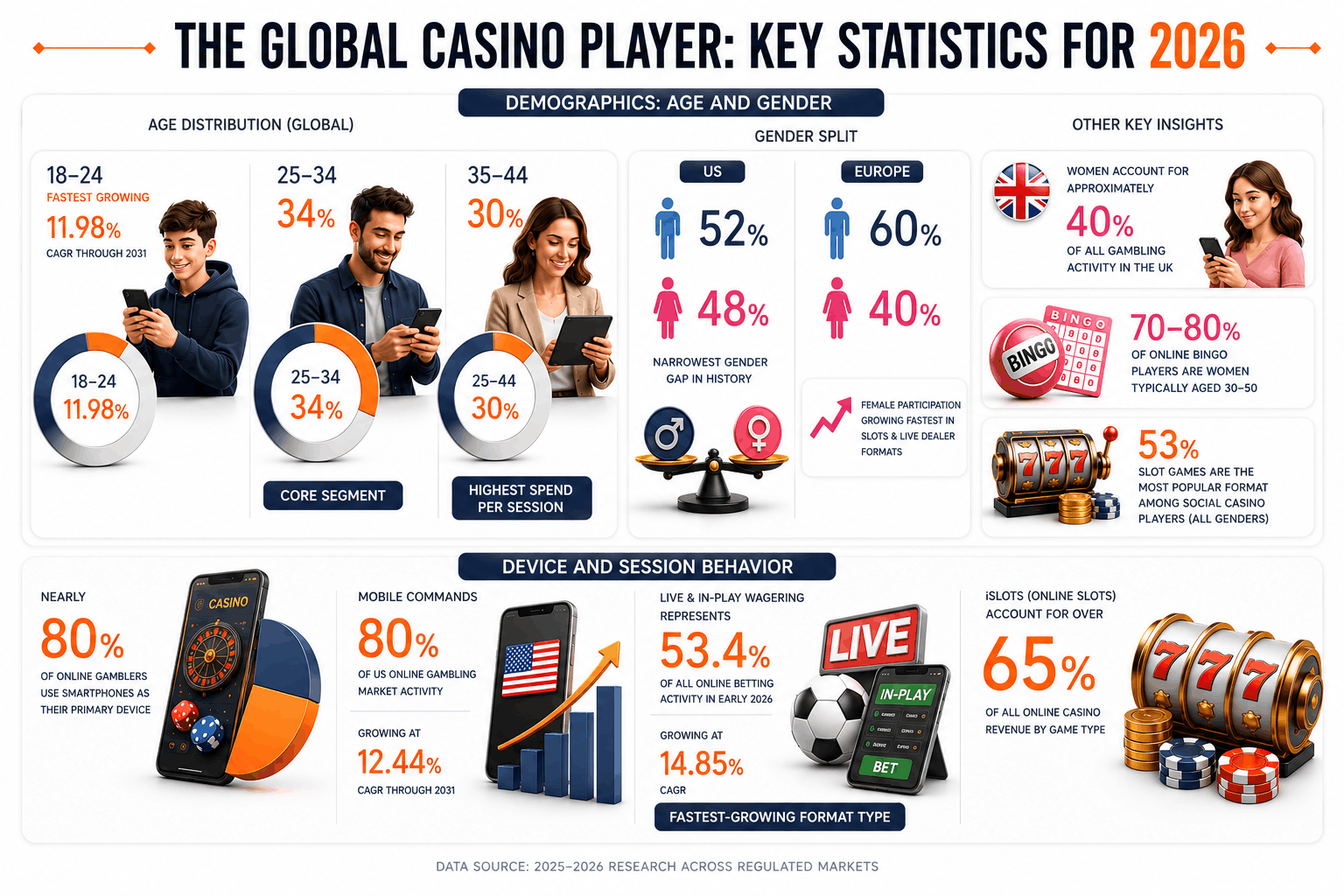
The core online casino player base globally is concentrated in the 25 to 44 age range. Players aged 25 to 34 represent 34% of the global online gambling customer base (Mordor Intelligence, 2026).
The 35 to 44 segment accounts for 30% of global players and delivers the highest average spend per session, making it the primary revenue segment for most operators.
The 18 to 24 cohort is the fastest-growing segment, projected at 11.98% CAGR through 2031, driven by mobile-first habits and social betting formats.
Gender: online casino players in the US are 52% male and 48% female, the narrowest gender gap in the market’s history. In Europe, the split is approximately 60% male, 40% female, with female participation growing fastest in slots and live dealer formats (PlayLogiQ, 2025).
Women account for approximately 40% of all gambling activity in the UK. 70 to 80% of online bingo players are women, typically aged 30 to 50.
Slot games are the most popular format among social casino players, played by 53% of that audience regardless of gender.
Device and Session Behavior
- Nearly 80% of online gamblers use smartphones as their primary device (DemandSage, 2026).
- Mobile commands 80% of US online gambling market activity and is growing at 12.44% CAGR through 2031 (Mordor Intelligence, 2026).
- Live and in-play wagering represents 53.4% of all online betting activity in early 2026, growing at 14.85% CAGR. It is the fastest-growing format type.
- iSlots (online slots) account for over 65% of all online casino revenue by game type (Grand View Research, 2026).
Why Casino Player Types Matter for Game Development
Casino operators serve multiple player types simultaneously. A lobby that only contains high-volatility, big-win-focused titles will lose Session Players and Casual Visitors within the first week. A lobby heavy with low-volatility grinding titles will fail to retain Thrill Seekers and High Rollers.
For game developers, player type mapping during pre-production determines the math specification before a single asset is produced. Getting this right at the specification stage is significantly cheaper than correcting it post-launch through math adjustments and feature redesign.
| Related: For a broader overview of gamer types across all genres → https://twinwingames.com/types-of-gamers/ |
The 6 Types of Casino Players
Six distinct player types, each requiring a different math configuration, feature set, and art direction. Know your primary type before development begins.
1. The Thrill Seeker
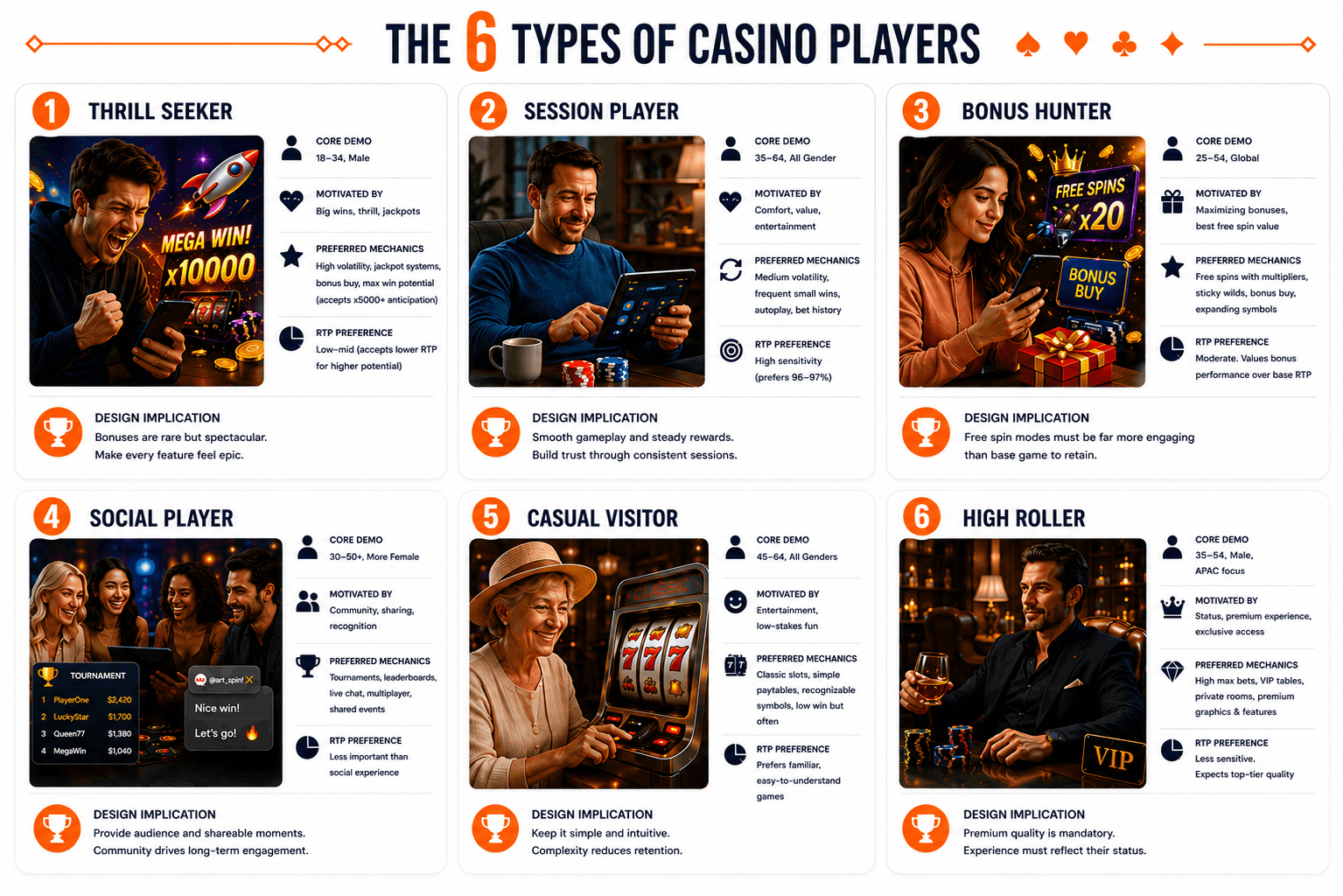
Thrill Seekers play for the possibility of a life-changing win. They accept frequent losses as the price of access to high-multiplier outcomes. They are drawn to high-volatility titles with low hit frequency but large maximum exposure, typically x2000 to x10000 or higher.
Core demographic: Over-represented in the 25 to 34 male segment. Highest concentration in regulated European markets and LatAm. The fastest-growing age group (18 to 24) skews heavily toward this type due to mobile crash and high-volatility slot formats.
Motivations: the emotional peak of a big win, the tension of near-miss mechanics, the possibility of hitting a jackpot.
Preferred mechanics: high-volatility math, jackpot systems, bonus buy features, max exposure above x5000, anticipation spin mechanics, grand win celebration sequences.
RTP preference: Less sensitive to base RTP than to max win potential. Will accept 94% RTP on a game with x10000 max exposure.
Design implication: Bonus frequency can be low, but the visual and emotional payoff of a bonus trigger must be significant. The Thrill Seeker needs to feel that the wait was worth it every time a feature lands. This is the type that drives demand for crash game development, where the entire mechanic is built around the tension of the multiplier climb.
2. The Session Player
Session Players budget time and money for a defined gaming session and want that session to last as long as possible. They are the backbone of online casino revenue: consistent, predictable, and retention-focused. They respond poorly to high variance and will leave a game that drains their balance quickly even with occasional big wins.
Core demographic: Strongest representation in the 35 to 44 age group, which accounts for 30% of the global player base and delivers the highest average session spend. Split roughly evenly by gender in mature European markets.
Motivations: entertainment value per session, balance management, the feeling of control over their gambling experience.
Preferred mechanics: medium volatility, high hit frequency on small wins, frequent bonus triggers with moderate payouts, autoplay features, clear bet history.
RTP preference: Highly sensitive. Prefers titles at 96% to 97% RTP. Will actively compare RTPs between similar titles.
Design implication: Small wins must land frequently enough to maintain balance without triggering the loss threshold that ends the session. Hit frequency optimization is more important for this type than max win ceiling.
3. The Bonus Hunter
Bonus Hunters play primarily through operator promotions: free spin offers, welcome bonuses, and reload packages. They are sophisticated about game selection, understanding which titles have the most valuable free spin mechanics and highest hit frequency during bonus rounds. They represent a significant acquisition channel but lower long-term lifetime value without strong game stickiness.
Core demographic: Concentrated in the 25 to 34 segment. Disproportionately represented in markets with highly competitive operator landscapes: UK, Germany, and the Nordics, where welcome bonus offers are the primary acquisition channel.
Motivations: maximizing value from promotional mechanics, finding games with the best free spin payoff profiles.
Preferred mechanics: free spin features with multipliers, bonus buy features, sticky wilds during free spins, expanding symbols, high pay during bonus vs base game.
Design implication: Free spin mode performance must be tuned to be significantly more engaging than the base game. A flat free spin mode does not retain Bonus Hunters beyond the promotion period.
4. The Social Player
Social Players use casino gaming as a social activity. They play in groups at land-based casinos, participate in live dealer chat, and engage with online tournament features. They are less motivated by individual wins than by shared experience and community status. This type has grown significantly as live dealer game usage increased 52% in 2025 (Business Research Insights, 2026).
Core demographic: Over-represented among female players aged 30 to 50 and in the 45 to 64 segment at land-based venues. The social casino market, which primarily serves this type, reached $10.11 billion in 2026 and is projected to hit $14.23 billion by 2030 (Research and Markets, 2026).
Motivations: shared experience, community recognition, group participation, the social ritual of gambling.
Preferred mechanics: tournament modes, live leaderboards, multiplayer formats, shared bonus events, chat features in live dealer games, group play mechanics.
Design implication: Social Players need an audience for their wins. Win screens, milestone celebrations, and tournament positions need to be shareable and visible to a community.
5. The Casual Visitor
Casual Visitors play infrequently, typically during travel, social occasions, or as occasional entertainment. They have a low skill floor expectation and a low tolerance for complex mechanics. This is the largest demographic at land-based casinos by volume and a significant segment of the social casino and free-to-play online market.
Core demographic: Strongest representation in the 45 to 64 age group according to UK Gambling Commission data (2025). Average casino visitor age in the US has dropped to 41.9 years in 2025 from 49.6 in 2019, reflecting the migration of older casual players to digital formats.
Motivations: entertainment, novelty, the social atmosphere of a casino environment, low-stakes fun.
Preferred mechanics: classic slot formats (3×3 or 5×3), simple paytables, recognizable symbols, low minimum bets, intuitive onboarding with no tutorial required.
Design implication: Every additional mechanic is a retention risk with Casual Visitors. The ideal game for this type is immediately understandable without reading instructions. Classic fruit machine aesthetics and simple bonus mechanics outperform complex feature sets with this segment.
6. The High Roller
High Rollers play at maximum bet levels and expect premium treatment both at land-based properties and online. They are the smallest segment by count but generate disproportionate revenue. They expect VIP mechanics, premium visual quality, and games that reflect their status. Online, they cluster around live dealer high-limit tables and high-stakes slot formats.
Core demographic: Predominantly male, aged 35 to 54. Strong representation in Asia-Pacific markets: Macau generated $22.8 billion in GGR in 2023 primarily from VIP and premium mass segments. Wynn’s $5.1 billion Ras Al Khaimah resort opening in 2026 signals continued operator investment in this segment globally.
Motivations: status, the quality of the experience, access to limits unavailable to standard players, personalized treatment.
Preferred mechanics: high maximum bet configurations, VIP table access, private room formats, premium art and animation quality, dedicated account management integrations.
Design implication: Production quality is non-negotiable. High Rollers will not engage with titles that feel low-budget. Art quality, animation smoothness, and sound design need to reflect a premium positioning.
Casino Player Types by Geography: What Operators Need to Know
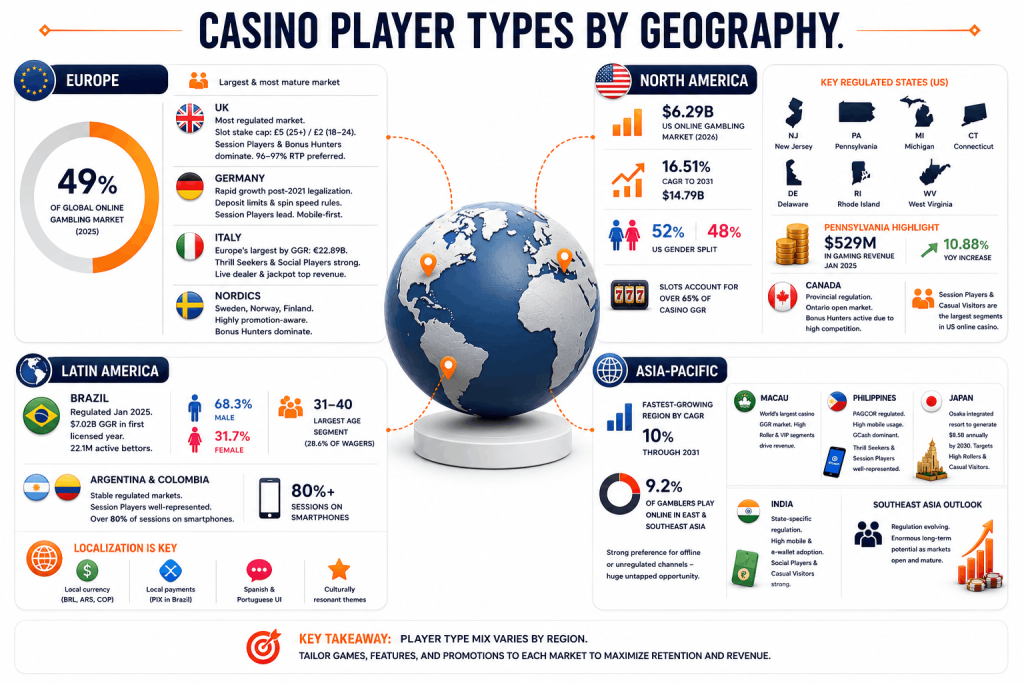
Player type distribution shifts significantly by region. The same game that retains players in Germany will underperform in Brazil if the player type mix is different and the product spec does not reflect it. The geo data below is drawn from 2025 and 2026 market research and regulatory reporting.
Europe: The Largest and Most Mature Market
Europe accounts for approximately 49% of the global online gambling market in 2025, making it the dominant region for any studio or operator building online casino games (Grand View Research, 2026).
UK: The most regulated and competitive market. Online gambling accounts for 56% of total UK gambling revenue. Since April 2025, online slot stakes are capped at £5 for adults 25+ and £2 for ages 18 to 24, per UK Gambling Commission regulation. Session Players and Bonus Hunters dominate. Titles with 96 to 97% RTP and transparent paytables perform best.
Germany: Rapidly growing following the GlüNeuRStV legalization in 2021. Strict deposit limits and spin speed restrictions shape the player experience. Session Players are the primary type. Mobile-first delivery is mandatory.
Italy: Europe’s largest gambling market by GGR at €22.89 billion. Strong mix of Thrill Seekers and Social Players. Live dealer and jackpot formats are the highest-revenue categories.
Nordics: High-value market with sophisticated Bonus Hunter behavior. Players in Sweden, Norway, and Finland are among the most promotion-aware in the world and demand high-quality free spin mechanics.
North America: High Growth, State-by-State Regulation
The US online gambling market reached $6.29 billion in 2026 and is projected to grow at 16.51% CAGR to $14.79 billion by 2031 (Mordor Intelligence, 2026). Online casino is legal in 7 states, with additional states under active legislation.
US online casino: Gender split is 52% male, 48% female, the most balanced of any major market. The 25 to 40 age segment accounts for 53% of US online gambling activity. Slot formats account for over 65% of casino GGR.
Key regulated states: New Jersey, Pennsylvania, Michigan, Connecticut, Delaware, Rhode Island, West Virginia. Pennsylvania generated $529 million in gaming revenue in January 2025 alone, a 10.88% YoY increase.
Player type dominance: Session Players and Casual Visitors are the largest segments in US online casino. Thrill Seekers are concentrated in the 18 to 34 male demographic.
Canada: Progressive provincial regulation. Ontario’s open market model has attracted major international operators. Bonus Hunters are particularly active due to high operator competition and aggressive promotional spend.
Latin America: The Fastest-Growing Emerging Market
Latin America is the most strategically significant emerging region for online casino development in 2026. Brazil’s regulated market reached $7.02 billion GGR in its first licensed year (2025), with 22.1 million active bettors.
Brazil: Regulated from January 2025. 79 licensed operators as of January 2026. Player gender breakdown: 68.3% male, 31.7% female. Largest age segment: 31 to 40 at 28.6% of wagers. The Thrill Seeker type dominates given the market’s early stage and high appetite for high-multiplier formats.
Argentina and Colombia: Stable regulated markets with predictable returns. Session Players are well-represented. Mobile penetration is high, with over 80% of sessions on smartphones.
Game localization requirements: Local currency (BRL, ARS, COP), local payment methods (PIX in Brazil), Spanish and Portuguese UI, and culturally resonant themes are table stakes for market entry.
Asia-Pacific: High Volume, Complex Regulation
Asia-Pacific is the fastest-growing online gambling region by CAGR, projected at 10% through 2031 (Polaris Market Research, 2026). However, regulatory fragmentation makes it the most complex market for cross-border operators.
Macau: The world’s largest casino GGR market. High Roller and VIP segments generate a disproportionate share of revenue. Mass-market GGR is projected to be 15 to 20% above pre-pandemic levels in 2025.
Philippines (PAGCOR): Significant player base for online casino formats. Mobile penetration is high. GCash is the dominant payment method. Thrill Seeker and Session Player types both well-represented.
Japan: First integrated casino resort in Osaka expected to generate $8.5 billion annually by 2030. Primarily targets High Rollers and tourism-driven Casual Visitors.
India: State-specific regulation swings between leniency and restriction. High mobile engagement and e-wallet adoption make it a long-term market with significant Social Player and Casual Visitor population.
In East and Southeast Asia, only 9.2% of gamblers report playing online, indicating a strong preference for offline or unregulated channels, but this represents a significant untapped addressable market as regulation evolves.
| Region | Market Size 2026 | Dominant Player Types | Key Design Requirements | Growth Outlook |
| Europe | $48B+ (49% global share) | Session Player, Bonus Hunter | 96-97% RTP, mobile-first, transparent paytable | Stable, 9% CAGR |
| North America | $6.9B (US only) | Session Player, Casual Visitor | 65%+ slots, 52/48 gender balance | High, 16.5% CAGR |
| Latin America | $7B+ (Brazil alone) | Thrill Seeker, Social Player | Local payments, PT/ES UI | Very high, emerging |
| Asia-Pacific | Macau $22.8B GGR | High Roller, Thrill Seeker | VIP mechanics, premium quality | Highest CAGR, complex reg |
How Player Type Drives Technical Specification
Every player type maps to a specific set of technical decisions that must be resolved before development begins.
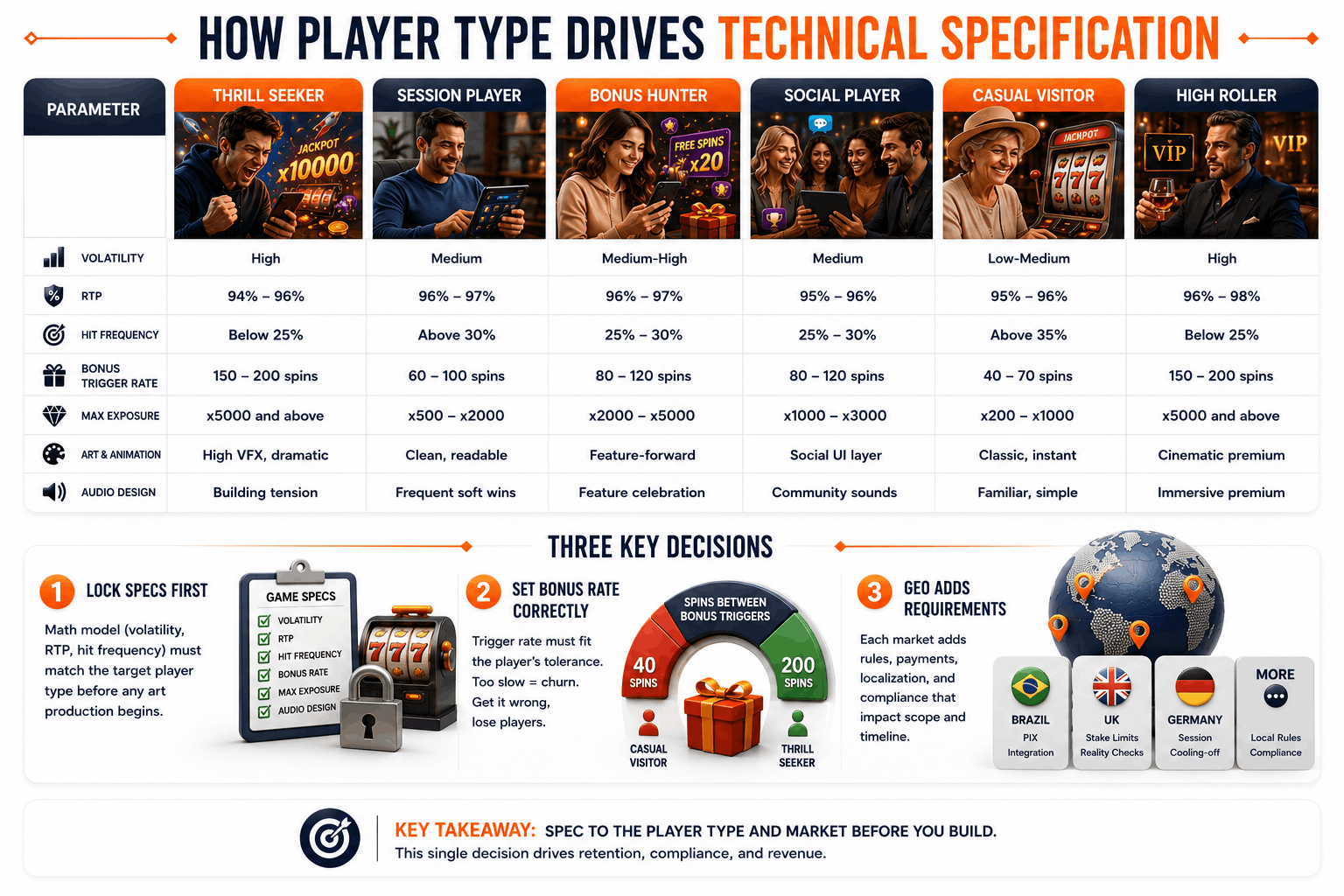
The seven parameters below are the ones most directly determined by the target player type. Getting any one of them wrong for the audience produces measurable retention loss regardless of how well the other six are executed.
| Parameter | Thrill Seeker | Session Player | Bonus Hunter | Social Player | Casual Visitor | High Roller |
| Volatility | High | Medium | Medium-High | Medium | Low-Medium | High |
| RTP | 94% to 96% | 96% to 97% | 96% to 97% | 95% to 96% | 95% to 96% | 96% to 98% |
| Hit frequency | Below 25% | Above 30% | 25% to 30% | 25% to 30% | Above 35% | Below 25% |
| Bonus trigger rate | 150 to 200 spins | 60 to 100 spins | 80 to 120 spins | 80 to 120 spins | 40 to 70 spins | 150 to 200 spins |
| Max exposure | x5000 and above | x500 to x2000 | x2000 to x5000 | x1000 to x3000 | x200 to x1000 | x5000 and above |
| Art and animation | High VFX, dramatic | Clean, readable | Feature-forward | Social UI layer | Classic, instant | Cinematic premium |
| Audio design | Building tension | Frequent soft wins | Feature celebration | Community sounds | Familiar, simple | Immersive premium |
Three decisions this table changes before development starts
Spec sequence. Math model parameters must be locked to the target player type before art production begins. Adjusting volatility or hit frequency post-production requires rebuilding bonus trigger logic, rebalancing the base game economy, and in regulated markets, resubmitting for certification. Studios that start with art and add math later consistently miss their target player type.
Bonus trigger rate tolerance is the single most commonly mis-specified parameter. A Thrill Seeker will tolerate 150 to 200 spins between bonus triggers because the eventual payoff justifies the wait. A Casual Visitor who goes 150 spins without a bonus trigger will leave the game before it fires. Specifying trigger rate correctly for the target type requires knowing the type before the math model is designed.
Geo adds a seventh parameter. Each target market adds RTP regulatory floor, currency and payment method integration, language and localization scope, and responsible gambling feature requirements to the specification. These are pre-production scope items that determine the engineering and compliance timeline. Brazil requires PIX integration. UK requires stake limits and reality checks. Germany requires mandatory session cooling-off. Every geo adds scope that must be estimated before the first line of code is written.
| Related: Traditional vs Online Slots: What’s the Real Difference? → https://twinwingames.com/traditional-vs-online-slots/ |
| Related: Slot Game Development Services → https://twinwingames.com/slot-game-development/ |
FAQ
What are the main types of casino players?
The 6 main types of casino players are: The Thrill Seeker (high volatility, big win focused), The Session Player (medium volatility, retention focused), The Bonus Hunter (promotion and free spin focused), The Social Player (community and tournament focused), The Casual Visitor (simple mechanics, infrequent play), and The High Roller (premium experience, maximum stakes). Each requires a different math configuration and feature set.
How do player types affect slot game math?
Player type directly determines volatility setting, hit frequency, maximum exposure, and RTP configuration. A game designed for Session Players needs medium volatility with hit frequency above 30% on small wins. A game designed for Thrill Seekers needs high volatility with hit frequency below 25% and max exposure above x5000. Getting the math wrong for the target player type produces poor retention regardless of visual quality.
Which type of casino player spends the most?
High Rollers generate the highest revenue per player, but represent the smallest segment. Session Players, concentrated in the 35 to 44 age group, generate the most total revenue by volume due to their consistent play patterns and long lifetime value. Thrill Seekers generate high revenue in peaks but have more volatile lifetime value curves due to their sensitivity to big-win outcomes.
How should operators balance their game lobby across player types?
A well-balanced operator lobby contains representation across all 6 types. High-volatility jackpot titles for Thrill Seekers and High Rollers, medium-volatility session titles for the core revenue base, tournament and social formats for Social Players, and classic simple formats for Casual Visitors. Twin Win Games advises clients on lobby architecture and game specification as part of the development engagement.
Does player type differ between land-based and online casino players?
Yes, significantly. Land-based environments over-index on Social Players and Casual Visitors due to the group visit dynamic and the accessibility of the physical casino format. Online environments over-index on Session Players and Bonus Hunters because the digital format attracts players who research titles and use promotional mechanics deliberately. High Rollers split more evenly, with strong representation in both live dealer online formats and land-based VIP rooms.
Which geographic markets have the highest-value casino players?
Europe produces the highest average revenue per user among regulated online casino markets, with the UK, Germany, Italy, and the Nordics delivering the most commercially valuable Session Player and Bonus Hunter segments. Asia-Pacific, specifically Macau, Philippines, and emerging Japanese and Indian markets, produces the highest High Roller revenue. Latin America, led by Brazil, is the fastest-growing market with a Thrill Seeker-dominant player base and rapidly scaling mobile infrastructure.
| Twin Win Games develops slot and casino games from math specification through certified delivery across regulated markets worldwide. If you are defining a new title, entering a new geo, or expanding your game library, we start every project with player type and market definition.https://twinwingames.com/casino-game-development/ |
Build a Casino Game That Fits Your Players
Six player types. Four game formats. One development partner.

Twin Win Games starts every project with player type definition: because the math model, art direction, feature set, and session design all follow from knowing exactly who you are building for. We have shipped 1,000+ titles across 138+ clients in regulated markets worldwide.
👉 twinwingames.com/casino-game-development/