

Quick answer: Slot RTP versions are several configurations of one game, each with its own return to player (RTP). Each version is separately built, tested and documented. The theme, features and rules of play stay the same. The theoretical return changes, and with it the house edge. Operators choose which version to run in each market or brand, because regulation, tax and competition differ from market to market. For a studio, every version needs its own simulation, documentation and certification, and the RTP shown in the game must match the version that is live.
What are slot RTP versions?
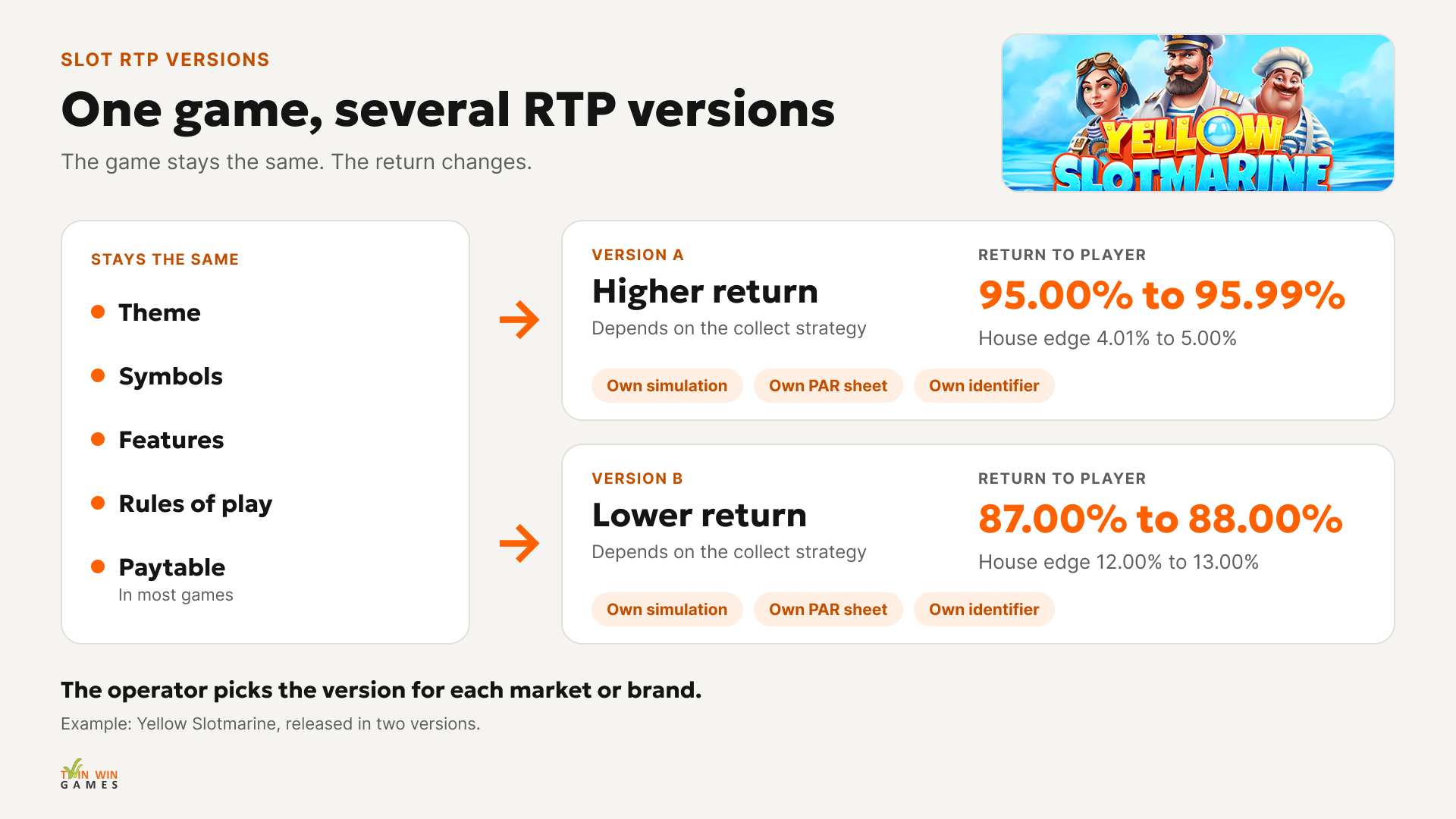
RTP, or return to player, is the share of all wagers a game is designed to return over the long run. Slot RTP versions, also called RTP variants, are releases of the same game with different RTP. The symbols, features and rules do not change. The return does.
Each version is built, simulated and documented on its own, and it carries its own identifier so that everyone can tell which configuration is live. Yellow Slotmarine shows how this looks in practice. It ships in two versions, at 95.00% to 95.99% and at 87.00% to 88.00%. Its return depends on the player’s collect strategy, so each version states the strategy behind its figure.
Why does one slot need several RTP versions?
Markets differ in what the law allows, what operators can afford and how they compete. One version cannot fit all of them.
Regulation
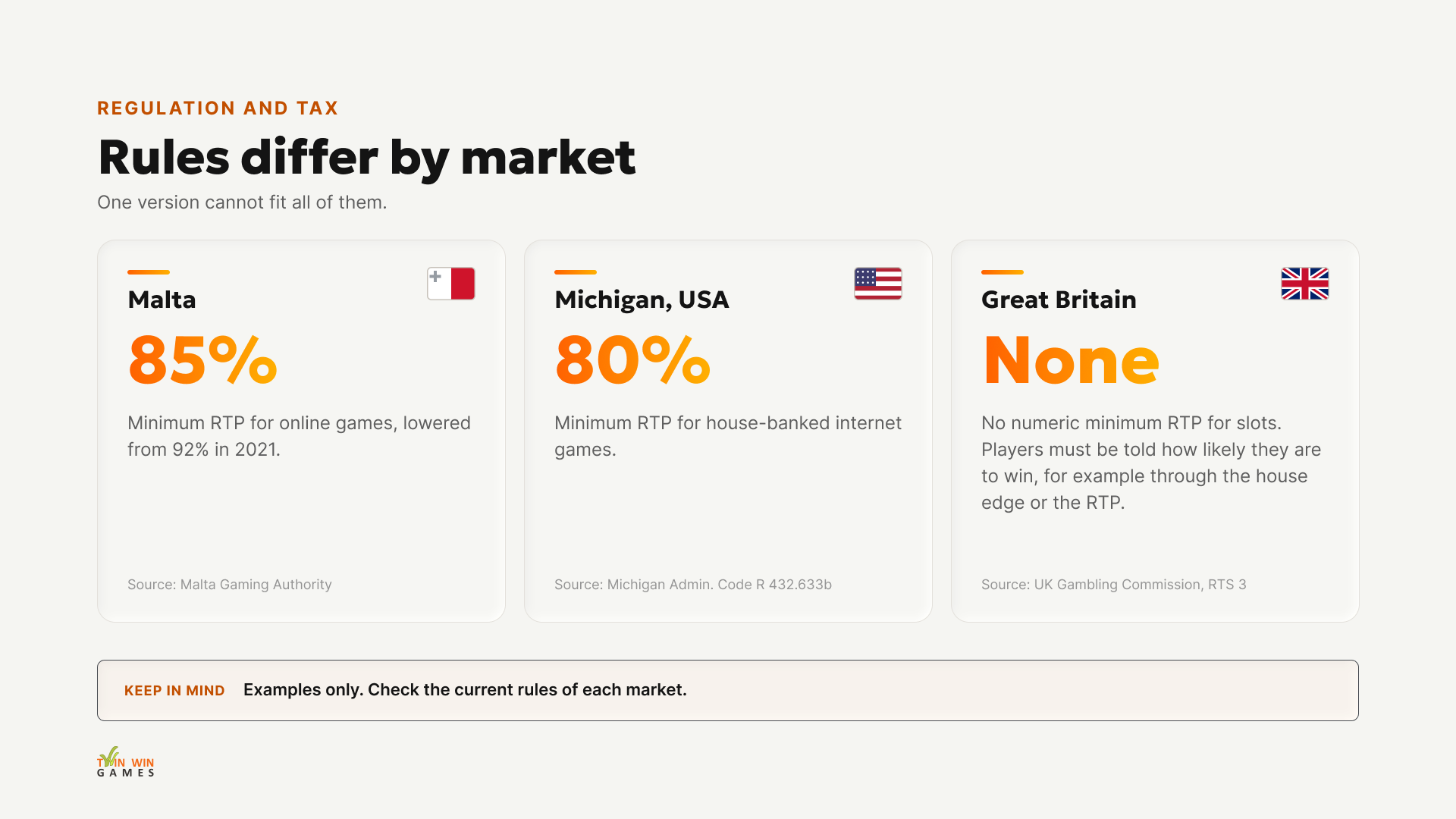
Some regulators set a numeric minimum. Malta lowered the minimum RTP for online games from 92% to 85% in 2021. Michigan requires an RTP of at least 80% for house-banked internet games, unless the board authorizes otherwise. Great Britain sets no numeric minimum for slots, but the Gambling Commission’s remote technical standards require information that tells players how likely they are to win, for example the house edge or the RTP percentage.
A studio that sells into several markets has to know which versions are certified for which market.
Tax and operating costs
Taxes change the economics of a game. The UK government raised Remote Gaming Duty from 21% to 40% from 1 April 2026. The Office for Budget Responsibility estimated that operators will seek to pass through around 90% of the increase by raising prices or reducing payouts. For a slot, one way to reduce payouts is to run a lower RTP version.
As a game provider, we build the range. The operator chooses the version it runs, within what each market allows.
Brand and competition
Operators also use RTP to position their brands. One that competes on value may run the highest version. Another may run a lower one. A studio that offers a range lets each operator make that choice.
How are slot RTP versions built?
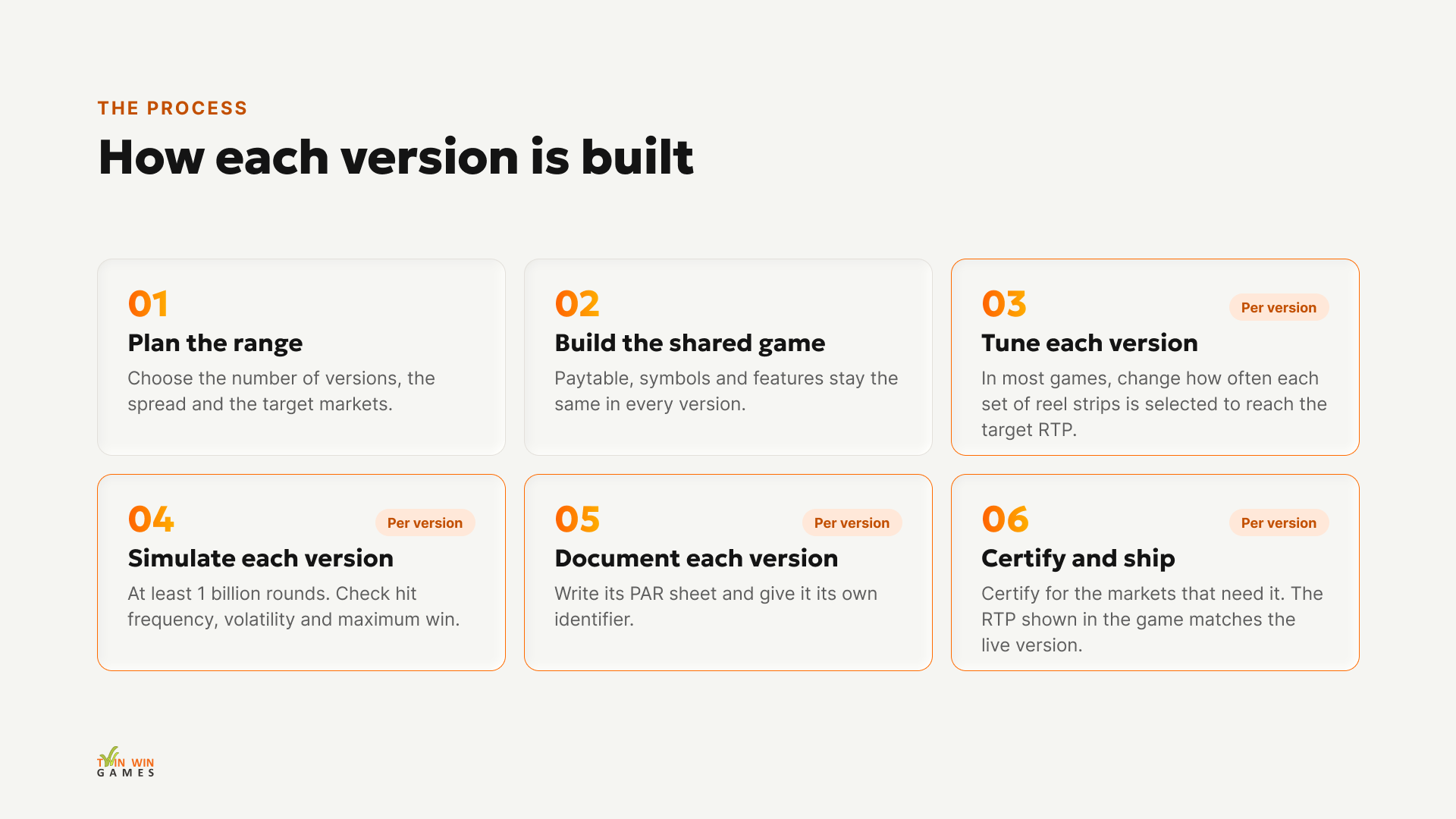
In full-cycle slot game development, the math team plans the range before the game is designed. How many versions, how far apart and for which markets are decisions made at the start of the math model. Our guide to how a slot math model is built explains that process.
In most games, the versions share the same paytable. What changes is how often the game selects each of its sets of reel strips. That shifts the probabilities and so the return, while the symbols, features and paytable stay as they are.
Every version then goes through the full process on its own. We simulate each RTP version across at least 1 billion rounds, check hit frequency, volatility and maximum win, and write its documentation, including its own PAR sheet. Our guide to what a PAR sheet is explains that document.
Games where players make decisions need one more step. The documentation for each version names the strategy behind its figure.
Versions also carry over to new themes. A slot reskin keeps the math of the original game, so the versions built for the original can be reused in the new one. The reskinned game is still released as a new game and is documented and certified under its own identity.
How far apart should the versions be?
There is no fixed number of versions or fixed spread. Public examples run from two versions to five or more. The right range depends on the markets you target and on the game itself.
A lower RTP at the same volatility means fewer or smaller wins over a session. A very low version can make a game feel flat, so we test the lowest version for how it plays as well as for its figures.
What does the difference mean in numbers?
The house edge is 100% minus the RTP. The table shows the long-run effect on wagers of 1,000,000.
| RTP | House edge | Expected return per 1,000,000 wagered | Expected gross gaming revenue |
|---|---|---|---|
| 96.00% | 4.00% | 960,000 | 40,000 |
| 94.00% | 6.00% | 940,000 | 60,000 |
| 88.00% | 12.00% | 880,000 | 120,000 |
A move from 96% to 94% RTP raises the house edge from 4% to 6%, which is 50% more expected gross revenue on the same wagers. These are long-run averages across very many bets and say nothing about a single session.
The bonus buy needs attention in each version. Its price sets the return of that mode, so it has to be checked against every version. Some platforms add limits of their own. Engine, formerly Stake Engine, requires every mode in a game to fall within 0.5% RTP of the base game.
What does certification need for each version?
Each version is its own configuration with its own documentation. Independent test laboratories verify a game against that documentation. How a laboratory handles several versions of one game depends on the laboratory and the market, so we confirm it at the start of a project. Our slot certification guide covers the process.
One mismatch causes real problems: the RTP shown in the game does not match the version that is live. The game rules must state the RTP of the active version. The version identifier should also appear in the configuration and the logs, so that a regulator, an operator or a studio can tell which version produced a result.
We recommend a version table for every game. For each version it lists the identifier, the RTP, the volatility, the hit frequency, the maximum win and the markets where the version is certified.
What should a studio decide before building a range?
- Which markets will the game launch in, and what does each one require?
- How many versions does that call for?
- What are the highest and lowest RTP, and does the lowest one still play well?
- Does the volatility stay consistent across versions?
- How does the bonus buy behave in each version?
- How will versions be identified in the game, the configuration and the documentation?
- Which versions need certification, and for which markets?
- Who can switch a live game between certified versions, and how is the change recorded?
How do players see slot RTP versions?
Players can check the active RTP in the game’s rules or info screen. The same slot can therefore show different figures at two casinos, and both can be correct. That is why the displayed RTP has to match the live version every time. For studios and operators alike, the displayed figure is a commitment.
Need a game with several RTP versions?
Twin Win Games builds games for operators and publishers, from slot game development to other casino games. Our in-house mathematicians design the range, simulate every version across at least 1 billion rounds and prepare certification-ready documentation. Our own slots are certified for the UK, Malta, Latvia and Portugal. See our slot game math service.
Frequently asked questions
What is a multi-RTP slot?
It is one slot released in several RTP versions. The theme, features and rules stay the same, and each version has a different theoretical return.
Why do casinos run different RTPs for the same slot?
Regulation, tax and competition differ by market and by brand. Studios release a range of versions, and each operator chooses the one it runs within what its market allows.
Does a lower RTP version change the features of the game?
No. The symbols, features and rules stay the same. The return changes, and with it the house edge and the pattern of wins over a session.
Does each RTP version need its own certification?
Each version has its own documentation. How laboratories and regulators handle several versions of one game depends on the laboratory and the market, so confirm it early in the project.
How many RTP versions should a slot have?
There is no fixed number. Public examples run from two versions to five or more. The right range depends on the markets you target.
How can I see which RTP a slot is running?
Open the game’s rules or info screen. It must state the RTP of the version that is live.
Is it legal to run a lower RTP version?
Where a market sets a minimum, the version must meet it. Malta and Michigan, for example, set numeric minimums. Great Britain sets none but requires information about the likelihood of winning. Always check the rules of each market and run only versions certified for it.
How much does RTP change operator revenue?
Over the long run, the house edge is 100% minus the RTP. At 96% RTP, an operator keeps 4% of wagers as gross gaming revenue. At 94% it keeps 6%, which is 50% more. These are long-run averages across very many bets and say nothing about a single session.