
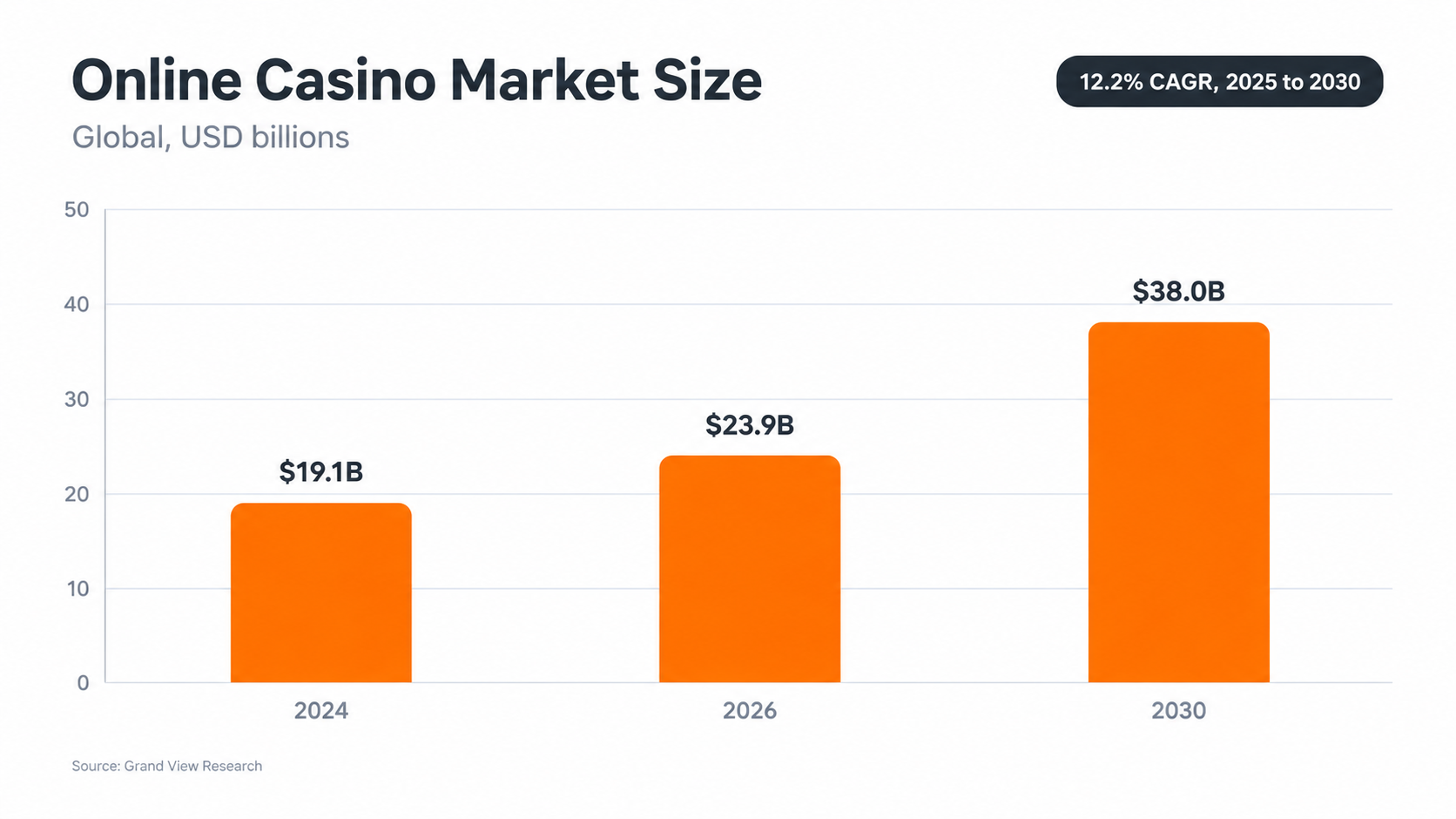
Online casino games are a large and growing market, and every game in it produces data. Grand View Research valued the global online casino market at $19.1 billion in 2024 and projects it to grow from $23.9 billion in 2026 to $38.0 billion by 2030, a CAGR of 12.2%. Europe is the largest region, with a 48.0% share in 2024.
Grand View attributes the growth mainly to smartphone penetration and faster internet, which have brought online casino platforms within reach of far more players. More players on more devices means more data, and more reason to use it well.
In a market this competitive, intuition is a poor guide. Analytics tells an operator which games hold players, which promotions pay back, and which players are at risk. This guide covers the metrics that matter, how to act on them responsibly, and what game developers build to make that data useful in the first place.
Why Game Analytics Matter for Casino Platforms
Analytics answers the questions every casino operator faces:
- Why do players leave after their first session?
- Which games drive the most revenue?
- Which players show early signs of harmful play?
The third question matters as much as the first two. In regulated markets it is an obligation, and the same behavioral data answers all three.
Used well, analytics helps operators improve retention, understand how each game performs, personalize the player experience, and meet their player protection responsibilities.
Key Metrics That Drive Strategic Growth
These are the numbers that separate a casino platform that reacts from one that plans.
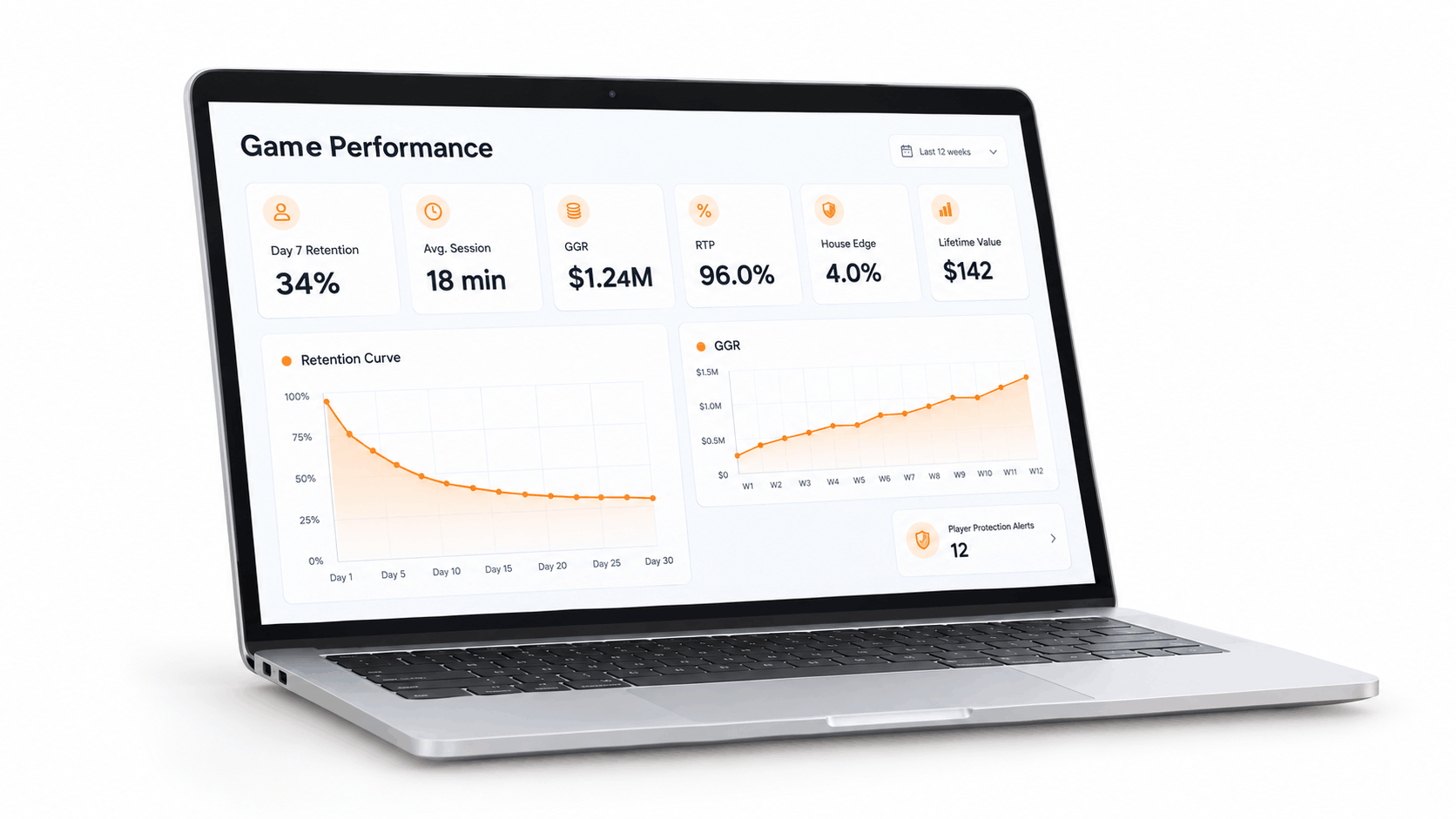
1. Player Retention Rate
What it is: the percentage of players who return after a set period, typically Day 1, Day 7, and Day 30.
Why it matters: retention is the clearest indicator of a game’s long-term value. Strong retention means players find the experience worth coming back to.
How to use it:
- Segment the data. Compare retention across new and returning players, and across stake levels, to see which groups are slipping away.
- Read the shape of the curve. Weak Day 1 retention usually points to onboarding or the first-session experience. Strong Day 1 with a sharp Day 7 drop usually means players liked the game but found no reason to return.
- Give players a reason to come back. Weekly challenges, loyalty programs, and fresh seasonal content support Day 7 and Day 30 retention.
2. Average Session Duration
What it is: how long a player stays in a game during a single session.
Why it matters: session length is a useful engagement signal, and it has two readings. Healthy session lengths suggest compelling content. Unusually long sessions, particularly late at night, can also be a marker of harmful play, which is why session data belongs in responsible gambling monitoring too.
How to use it:
- Find the friction. Short sessions often trace back to a confusing UI, slow loading, or gameplay that turns repetitive. Analytics shows where players drop off.
- Fix performance first. Lag, long load times, and crashes cut sessions short more reliably than any content issue.
- Watch the outliers. Treat very long sessions as a signal to review, alongside the engagement they may represent.
3. Gross Gaming Revenue (GGR)
What it is: the core revenue measure in casino gaming: the total amount players wager, minus the winnings paid back to them.
Why it matters: GGR is how a casino game’s commercial performance is actually measured. It is the figure that operators, suppliers, and regulators all work from.
How to use it:
- Track it per game and per market. A title can perform very differently from one jurisdiction to the next.
- Read it alongside retention. High GGR from a small group of players tells a different story than steady GGR across a broad base.
4. Return to Player (RTP)
What it is: the percentage of all money wagered that a game is expected to return to players over the long run. A 96% RTP game is designed to return $96 of every $100 wagered, across a very large number of plays.
Why it matters: RTP is central to both fairness and compliance, and regulators require it to be accurate and disclosed.
How to use it:
- Treat RTP and volatility as separate levers. RTP sets the long-term return. Volatility sets how that return is distributed, whether through frequent small wins or rare large ones. Two games can share an identical RTP and feel completely different to play. Our Bank Wagon Heist slot, for example, runs at 94.01% RTP with high volatility: the math fixes the long-term return, and the high volatility means that return arrives through rarer, larger wins. Our guide to what volatility means in slots covers the distinction in depth.
- Choose the right configuration. Many games ship with several pre-certified RTP settings, which lets an operator match a game to a market. Designing and validating those configurations is the work of slot game math.
- Disclose it clearly. Showing players the RTP builds trust and is required in most regulated markets.
5. House Edge
What it is: the theoretical advantage the casino holds over the long run, and the inverse of RTP. A game with a 96% RTP has a 4% house edge.
Why it matters: the house edge is the operator’s long-term margin on a game. Balancing it against an experience players enjoy is what keeps a portfolio both sustainable and competitive.
How to use it:
- Monitor it across the portfolio to confirm each game performs in line with its design.
- Understand the mathematics behind it. Our breakdown of casino math explains how probability, house edge, and expected value fit together.
6. Lifetime Value (LTV)
What it is: a forecast of the total revenue a player will generate across their whole relationship with the platform.
Why it matters: LTV shapes acquisition spend, marketing priorities, and which games deserve investment.
How to use it:
- Study your highest-value segments to understand what keeps them engaged.
- Keep LTV honest. A forecast inflated by a small number of heavy players can hide weakness across the wider base, and those same players warrant the closest responsible gambling attention.
How to Use Data for Practical Improvements
Tracking the right metrics is the first step. Acting on them well is the part that pays off.
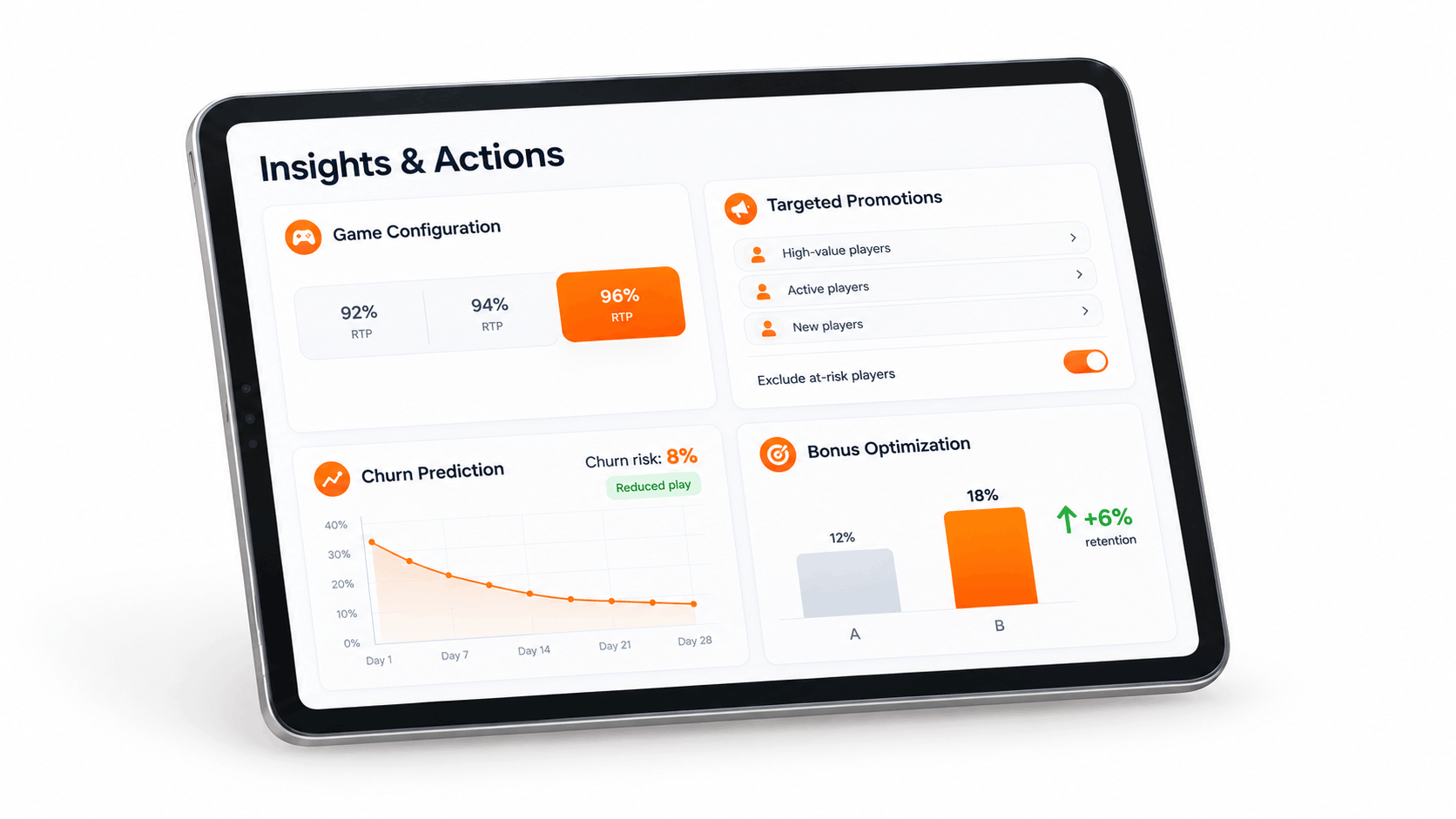
1. Game Configuration
Problem: a game’s payout profile does not suit a particular market or player base.
Solution: where a game offers more than one RTP setting, select the one that suits the market. In regulated markets the RNG itself cannot be adjusted: it is certified to produce outcomes that are random and independent of player behavior. What an operator can change is which certified version of a game it runs.
Some games ship with several RTP settings, each tested and certified before release, so an operator can offer the right one for each market. That advance certification is what keeps the choice compliant.
2. Targeted Promotions
Problem: certain player segments are less engaged than expected.
Solution:
- Use behavioral data to tailor offers to each segment.
- Build in guardrails from the start: exclude self-excluded players, and players showing markers of harm, from promotional targeting.
3. Churn Prediction Models
Problem: players leave the platform after only a few sessions.
Solution:
- Build models that identify players likely to churn, based on changes in activity patterns.
- Separate disengagement from self-management. A player who is reducing their play may be doing so deliberately, and a re-engagement offer should respect that.
4. Bonus Optimization
Problem: current bonuses are not driving the engagement they should.
Solution:
- Run A/B tests on bonus structures, such as daily rewards against welcome offers.
- Measure each promotion on retention and GGR over time, beyond the initial response.
Using Analytics for Responsible Gambling
The behavioral data operators use for retention is the same data regulators expect them to use for player protection. A mature analytics program treats both as core functions.
Detecting markers of harm. Analytics can surface patterns associated with harmful play: rapid increases in stake size, chasing losses, very long or late-night sessions, and repeated failed deposits.
Triggering interventions. Those signals can prompt reality checks, deposit limit suggestions, cooling-off options, or direct contact from a trained team.
Meeting regulatory obligations. Regulated markets, the UK among them, expect operators to monitor player behavior and act on signs of harm.
The model that flags a player about to churn can also flag a player at risk. The operators that run their analytics well use it for both.
What Game Developers Contribute to Casino Analytics
Most casino analytics runs on the operator’s platform. What the game studio builds decides how good that data can be.
- Event instrumentation. Games built to emit clean, detailed events, such as spins, wins, feature triggers, and stake changes, that operators can analyze reliably.
- Reporting and APIs. Backend systems that pass game-level performance into the operator’s platform in a usable form.
- Certified multi-RTP configurations. The compliant way to give operators control over a game’s payout profile.
- Math that performs as modelled. Simulation-backed models that behave in live play the way they were designed to, so the numbers operators see match the numbers that were certified.
When these are built into a game from the start, the operator gets data it can act on. When they are missing, even the best analytics platform has little to work with.
Frequently Asked Questions
What is game analytics in the context of casino platforms?
Game analytics is the process of collecting and analyzing player data to improve games, the player experience, and commercial performance. For casino operators it covers player behavior, session patterns, wagering, and game-level revenue, and it also supports responsible gambling monitoring.
Why is game analytics important for online casinos?
It shows operators which games hold players, which promotions pay back, and where players may be at risk. That lets them improve retention, manage their portfolio, personalize the experience, and meet player protection obligations.
What are the key metrics used in casino game analytics?
The core metrics are player retention rate, average session duration, gross gaming revenue (GGR), return to player (RTP), house edge, and lifetime value (LTV). Together they describe how engaged players are, how each game performs, and how much each player is worth over time.
How can analytics help improve player retention in online casinos?
Retention data shows where players drop off and why. Operators can use it to fix onboarding problems, give players reasons to return through loyalty programs and fresh content, and tailor offers to each segment, while excluding players who show markers of harm.
What is churn prediction, and how does it help casino platforms?
Churn prediction uses changes in player activity to identify players likely to leave. It lets operators respond before they go. Good models also distinguish a player who is disengaging from one who is deliberately reducing their play, so interventions respect player choice.
How does win/loss ratio analysis impact player satisfaction?
Players who feel a game never pays out tend to leave, so operators watch win frequency closely. In regulated markets, though, the RNG cannot be adjusted to change outcomes: it is certified to produce random results independent of player behavior. Win frequency comes from the game’s math, specifically its volatility and hit frequency. Operators influence it by choosing between pre-certified RTP configurations, or by selecting games whose volatility suits their players.
How can analytics help optimize casino bonuses and promotions?
A/B testing and behavioral data show which bonuses actually drive lasting engagement. Operators can adjust promotion structures, tailor offers to each segment, and measure results on retention and GGR over time.
How does analytics support responsible gambling?
The same behavioral data used for retention can detect markers of harmful play, such as rapid stake increases, chasing losses, and very long sessions. Operators use those signals to trigger interventions like reality checks and deposit limits, and to meet the player protection requirements of regulated markets.
Building Casino Games Operators Can Measure
Twin Win Games builds casino games with the analytics foundation operators need: clean event tracking, reporting integration, certified multi-RTP configurations, and math that performs as modelled in live play. With 13+ years in game development, 1,000+ released titles, and 198+ clients worldwide, we build games that hold up in regulated markets.