Every online game runs on more than its graphics and gameplay. Behind the scenes, the backend manages player accounts, stores progress, runs the logic that has to be trusted, and keeps multiplayer sessions stable.
Single-player games can run without one. Multiplayer, live-service, and mobile games with online features depend on it completely. The backend decides how many players a game can support, how quickly it responds, how safe its data is, and how easily it can grow.
This guide covers what a game backend does, the six main architectures and when to use each, the types of servers involved, and the mistakes that cause the most trouble later.
What a Game Backend Does
The backend connects the game client, the part running on the player’s device, with the servers and data behind it. It typically handles:
- Accounts and identity. Registration, login, and session management.
- Persistence. Saving progress, inventories, and player history.
- Trusted logic. Anything that must not be left to the client, such as match results, rewards, and in-game currency.
- Real-time sessions. Keeping players in a multiplayer match in sync.
- Live operations. Events, content updates, and configuration changes after launch.
Core Concepts in Game Backend Development
Scalability. The backend has to handle a few hundred players on a quiet day and many times that during a launch or an event, adding capacity as demand rises and releasing it afterward.
Latency. Every action a player takes has to travel to the server and back. For turn-based games a delay is barely noticed. For real-time games it decides whether the game feels responsive or broken.
Persistence. Player progress has to survive crashes, device changes, and server restarts. Losing a player’s progress is one of the fastest ways to lose the player.
Security. The backend protects accounts and data, and it enforces the rules the client cannot be trusted with.
The Six Main Game Backend Architectures
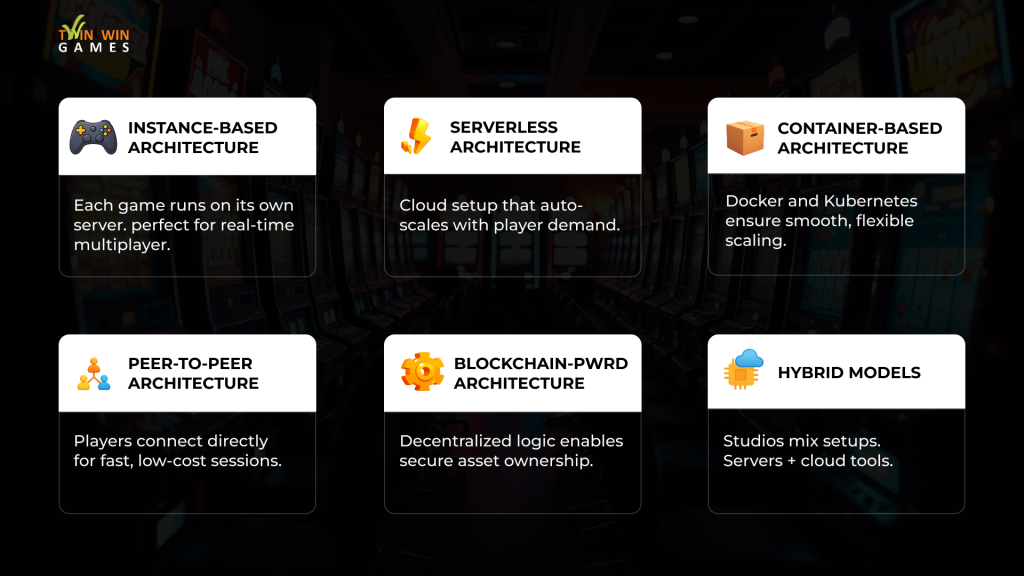
Instance-based architecture. Each game session runs on its own dedicated server instance. It is common in competitive shooters and large online games, where the server needs full authority over the match.
Serverless architecture. Backend functions run on cloud services that scale automatically and charge only for use. It suits mobile games with uneven traffic and games that do not need a constant real-time connection.
Container-based architecture. Backend services are packaged with tools such as Docker and managed with an orchestrator such as Kubernetes. It offers portability and reliable scaling across many services.
Peer-to-peer architecture. Players connect directly to one another, with no central game server. It is cheap to run, but it gives the developer little control over cheating or connection quality.
Blockchain-powered architecture. Ownership of assets and accounts is recorded on a distributed ledger. It adds transparency, and brings real challenges in speed, cost, and complexity.
Hybrid architecture. Many studios combine approaches, for example dedicated servers for live matches alongside serverless functions for analytics and account services.
Game backend architectures compared
| Architecture | Best for | Main strength | Main trade-off |
|---|---|---|---|
| Instance-based | Competitive real-time multiplayer | Full server authority, strong anti-cheat | Higher running and operating cost |
| Serverless | Mobile and turn-based games | Scales automatically, pay per use | Unsuited to constant real-time connections |
| Container-based | Live-service games with many services | Portable, reliable scaling | Operational complexity |
| Peer-to-peer | Small co-op and casual multiplayer | Very low cost | Weak control over cheating and stability |
| Blockchain-powered | Games built around owned digital assets | Transparent ownership | Slower, costlier, more complex |
| Hybrid | Larger and more complex projects | Right tool for each job | More moving parts to manage |
Choosing a Backend by Game Type
Turn-based and asynchronous mobile games. Puzzle, card, and strategy games where players take turns tolerate a short delay. A serverless or lightweight API backend is usually enough, and it keeps costs low while traffic is small.
Real-time multiplayer games. Shooters, racing games, and arena games need low latency and an authoritative server. Instance-based dedicated servers, deployed in several regions close to players, are the standard choice.
Live-service games. Games built around ongoing events, seasons, and in-game economies need backends that can change without a new client release. Container-based services with strong live operations tooling suit them best.
Casual games with light online features. A game that is mostly single-player, with leaderboards or cloud saves, needs only a minimal backend. A backend-as-a-service platform often covers it without custom infrastructure.
Types of Servers in Game Development
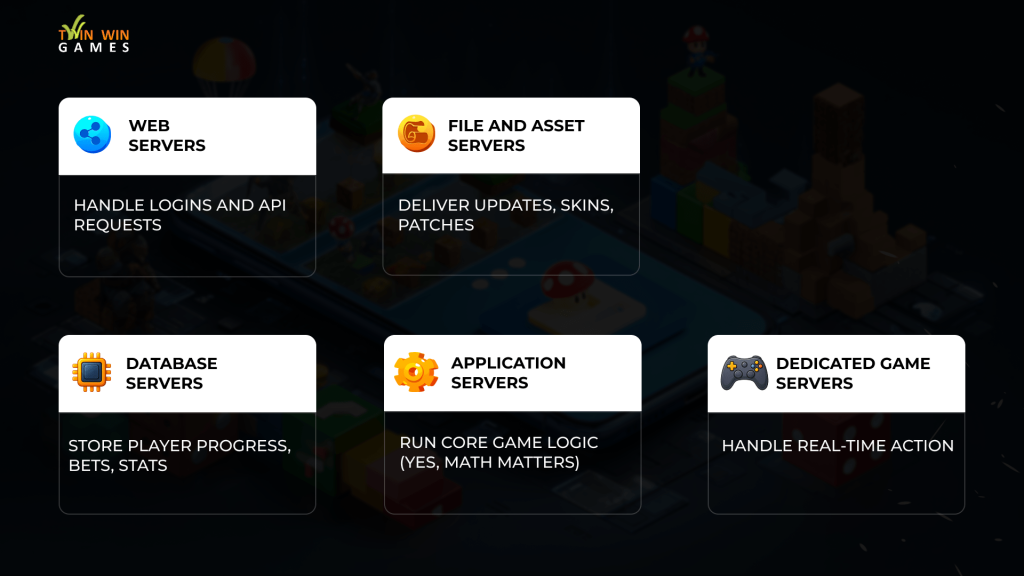
Web servers handle requests from game clients and browsers, including login, session validation, and API calls.
Application servers run the core game logic: game rules, matchmaking, and state transitions. They sit between the client-facing layer and the data layer.
File and asset servers store and deliver large content, such as patches, downloadable content, and updates, usually through a content delivery network.
Database servers hold persistent data: accounts, progress, inventories, match history, and leaderboards.
Dedicated game servers run real-time multiplayer sessions and keep every connected player in sync.
Essential Features of a Robust Game Backend
Authentication and authorization. Secure login and identity management keep accounts safe, often with multi-factor authentication.
In-game economy and purchases. The backend integrates with app store billing and payment providers, and manages in-game currencies, purchases, and refunds. Every balance and purchase has to be validated on the server.
Leaderboards, achievements, and social features. Rankings, challenges, and achievements all depend on the backend to store and verify results.
Live operations. Events, limited-time content, and configuration changes let a game stay fresh after launch without shipping a new client each time. This is where much of a live game’s long-term revenue comes from, as covered in our guide to mobile game development stages.
Analytics and monitoring. Studios track retention, revenue, and player behavior, while monitoring keeps the infrastructure healthy during peak traffic.
Common Game Backend Mistakes
Trusting the client. Any value the client can send, the player can alter. Match results, rewards, and currency balances must be decided and checked on the server.
Building for launch-day scale on day one. Over-engineering for traffic that has not arrived wastes money. Design so the backend can scale, then deploy at the size you actually need.
Adding monitoring after the first outage. Without visibility into performance and errors, problems are found by players first. Monitoring belongs in the first release.
Leaving data rules until late. Privacy regulations such as GDPR, and rules on where player data can be stored, shape the architecture. Retrofitting them is far harder than planning for them.
“Backend decides how far a game can grow. You need to plan for latency, concurrency, and fault tolerance from the start. If you miss one of these, scaling later will cost more time and money. Many projects fail because they treat backend as secondary. It should be the first layer of design.”
Pavlo Ratushnyi, Head of Development at Twin Win Games
Backend for Casino Games
Real-money casino games use a different backend model. The game logic and a certified RNG run on a remote game server, or RGS, which connects to the operator’s player platform and wallet. The player’s money stays with the operator throughout, and every outcome is decided on the server.
Our guide to iGaming server infrastructure explains each layer, from the operator’s platform to the RGS and the game client.
How Twin Win Games Builds Game Backends
We build backends for casual, mobile, live-service, and casino projects, designed alongside the game itself. That covers game logic and state management, scalable cloud deployment, secure authentication, and integrations with platforms, payment providers, and analytics tools.
Because our backend, game engine, and HTML5 game clients are built by the same team, they are designed to work together from the start. For casino titles, we run our own remote game server, with certified games live in regulated markets.
Frequently Asked Questions
What is game backend development?
Game backend development is building the server-side systems behind a game: accounts, data storage, trusted game logic, multiplayer sessions, and live operations. It connects the game on the player’s device with everything that has to be stored, synchronized, or protected.
Do all games need a backend?
No. A purely single-player game can run without one. Any game with accounts, multiplayer, leaderboards, cloud saves, purchases, or live events needs a backend.
Which backend architecture is best for multiplayer games?
For real-time multiplayer, instance-based dedicated servers are the standard choice, because they give the server full authority over the match and keep latency low. Turn-based multiplayer games can often use a lighter serverless backend.
How does game backend development differ from web backend development?
Game backends have to support real-time interaction, very low latency, and large numbers of simultaneous players, while keeping game state consistent. Web backends are usually built around requests and transactions, with far less need for real-time synchronization.
What types of servers are used in game development?
The main types are web servers for requests and login, application servers for game logic, file and asset servers for content, database servers for persistent data, and dedicated game servers for real-time multiplayer.
Can blockchain be used for game backend development?
Yes. Blockchain can record ownership of digital assets and support player-to-player trading. It also adds cost, complexity, and performance limits, so most studios use it only where verifiable ownership is central to the game.
How are casino game backends different?
Real-money casino games run on a remote game server that holds the game logic and a certified RNG, and connects to the operator’s platform and wallet. The player’s balance stays with the operator, and every outcome is decided on the server.
Planning a Game Backend?
Twin Win Games designs and builds game backends for casual, mobile, live-service, and casino projects. With 13+ years in game development, 1,000+ released titles, and 198+ clients worldwide, we build backends that scale with your players and stay stable after launch.