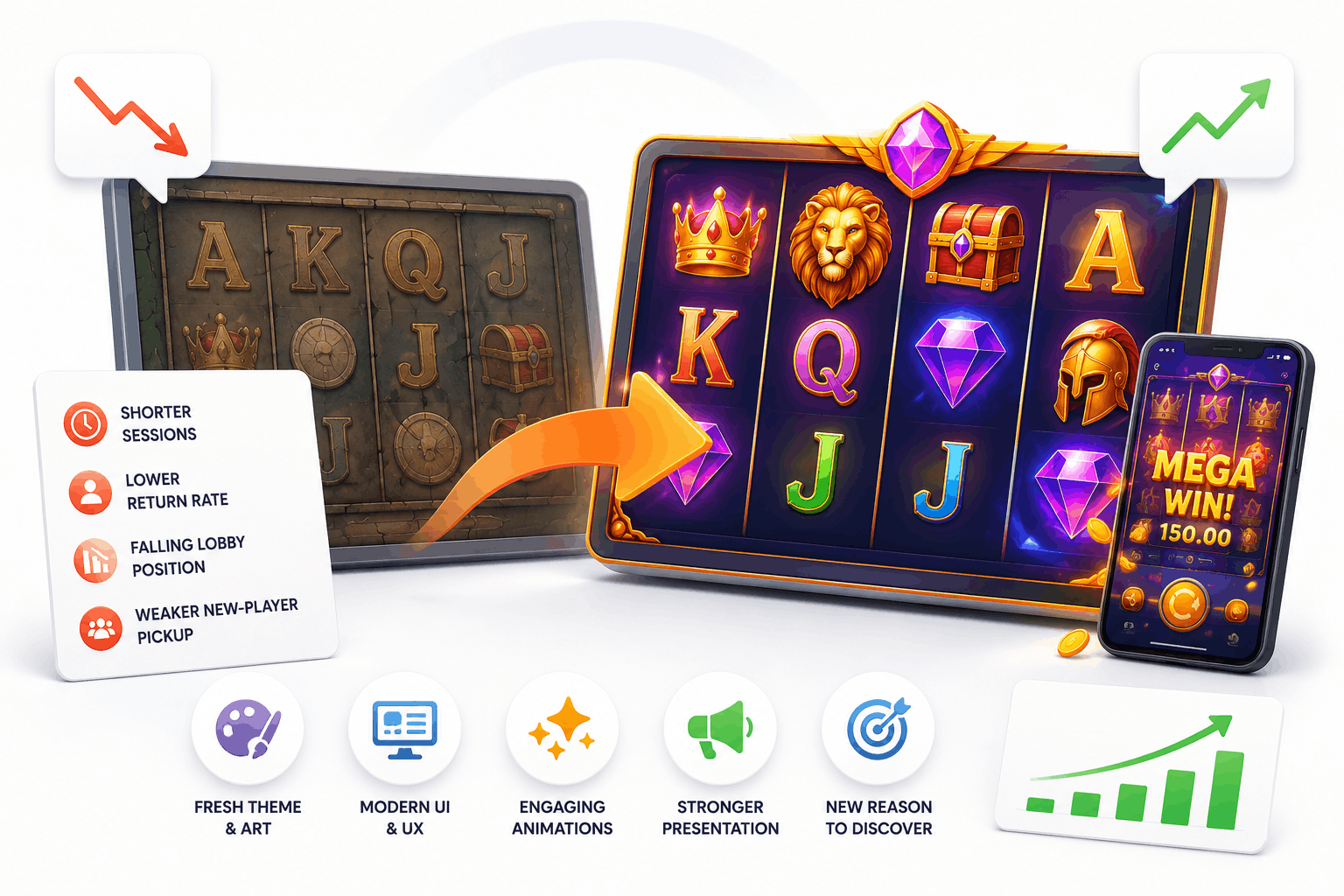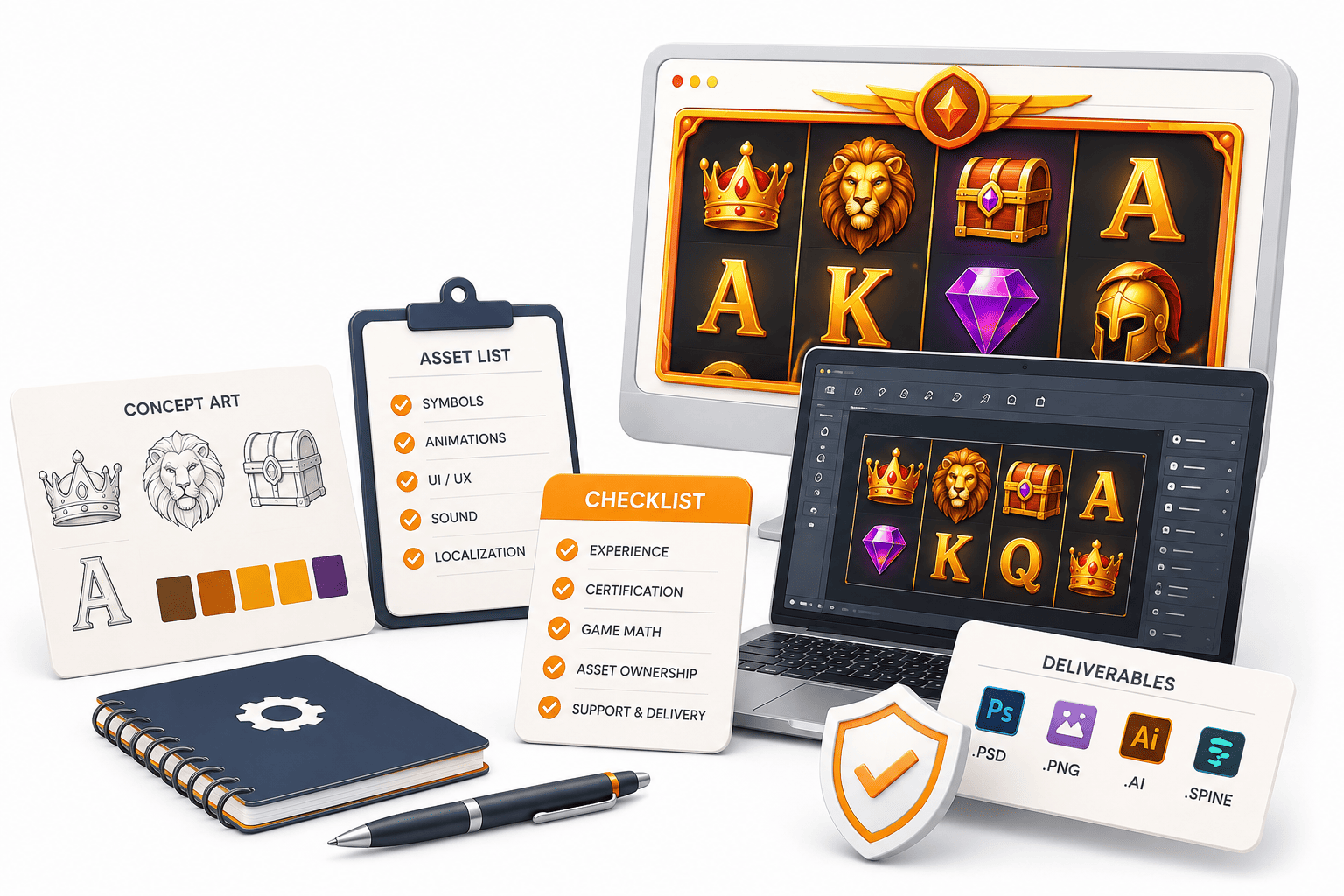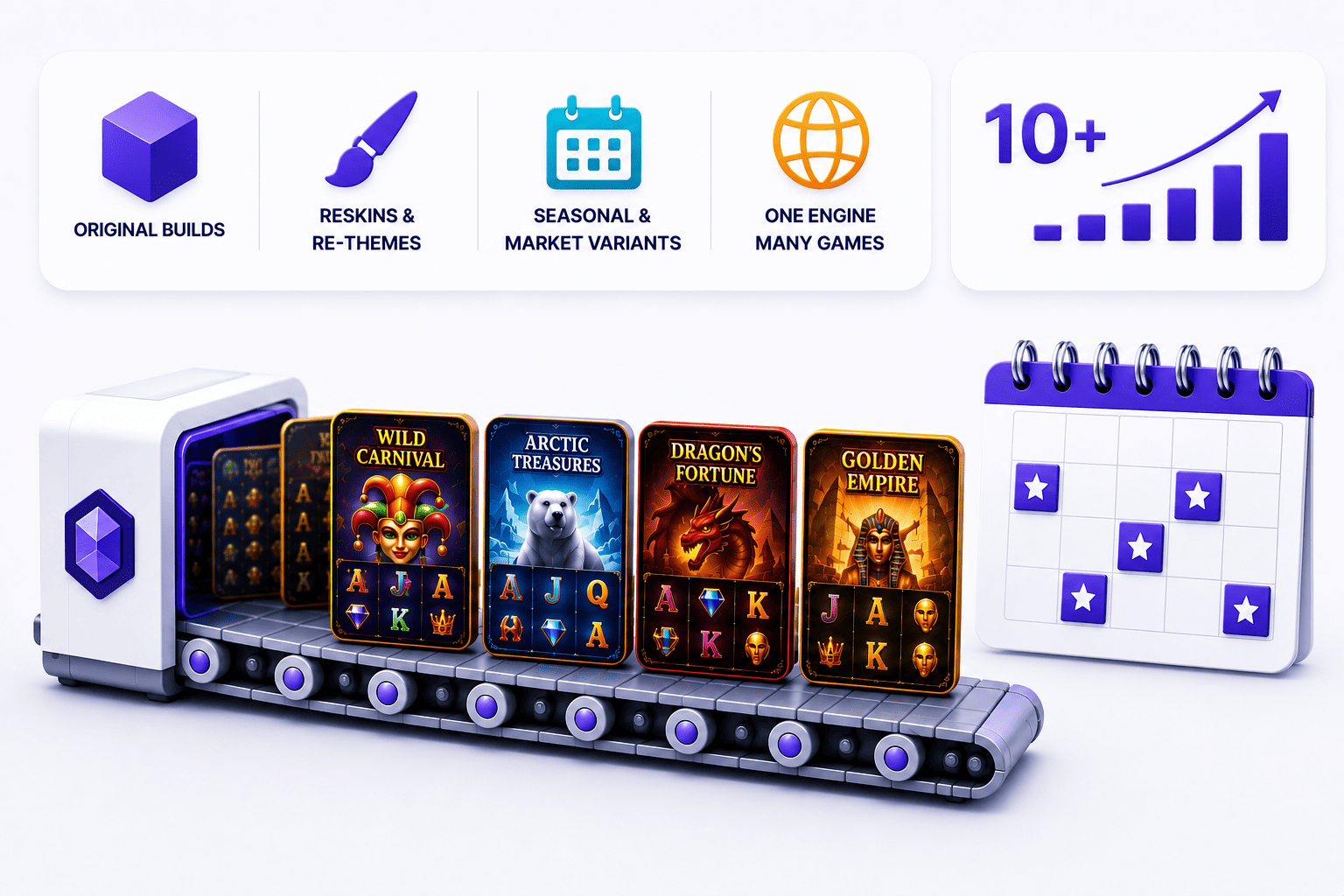

Shipping one casino game is a production project. Shipping 10, 20, or more titles a year requires a production system.
Studios that consistently scale a casino game portfolio rarely treat every release as a completely independent build. They decide where originality creates value and where existing technology, mechanics, art pipelines, and production frameworks can be reused.
The result is a portfolio mix. Original games create new foundations. Reskins and re-themes extend proven ones. Seasonal and regional variants fill specific calendar opportunities. A reusable engine reduces repeated engineering work.
The goal is not to make every game faster. It is to stop rebuilding the same foundation when there is no product reason to do so.
Why Casino Content Velocity Matters
A casino lobby is a constantly changing content environment.
The scale is easy to underestimate. According to industry database SlotCatalog, the market now spans more than 50,000 slot titles from over 1,000 providers, with new games launching every week. An established title is not competing against a handful of rivals. It is competing for lobby space and player attention against an enormous, constantly growing catalogue.
New releases give operators fresh titles to feature, new assets for campaigns, and additional opportunities to address different player segments and markets. For studios, a predictable release cadence also makes portfolio planning less dependent on one or two large launches.

The broader direction of the industry reinforces this pressure. New technology, changing player expectations, mobile-first experiences, and evolving game formats continue to shape the future of slot machines. Studios therefore need a production model that can respond to change without restarting the entire development process for every release.
But casino content velocity should not mean releasing games simply to increase the title count.
Every release still needs a reason to exist.
One title may introduce a new mechanic. Another may adapt a proven game for a different market. A seasonal release may support a fixed promotional window. A reskin may give an established technical foundation a new visual identity.
A scalable casino content strategy therefore asks two questions:
How many games do we want to release?
And more importantly:
How many of those games actually need to be built from zero?
The second question changes the economics of the entire roadmap.
Why Building Every Game From Scratch Does Not Scale
Original development gives a studio maximum control.
You can create new math, mechanics, features, game logic, art, animation, audio, and technical architecture around a new concept.
That flexibility has a cost.
For budgeting, a full original slot can typically range from around $35,000 to $200,000+, depending on complexity. Development is generally measured in months rather than weeks.
Now multiply that process across 10 or 20 releases.
The problem is not only budget. Each original title creates work across game design, math, engineering, art, animation, UI, QA, integration, and certification.
If every release begins at the same starting line, production capacity has to increase almost directly with release targets.
That is difficult to scale efficiently.
This does not mean studios should stop making original games. It means original development should be used where originality creates enough value to justify the additional production scope.
Twin Win Games provides full-cycle slot game development for titles that genuinely need new mechanics, math, features, or a new technical foundation. For a deeper look at the stages involved in creating a game from scratch, see our guide to slot machine game development.
For the rest of the roadmap, reuse becomes a strategic tool.
Mix Original Builds, Reskins, and Variants
A scalable portfolio does not need one production model.
A more practical approach combines several.
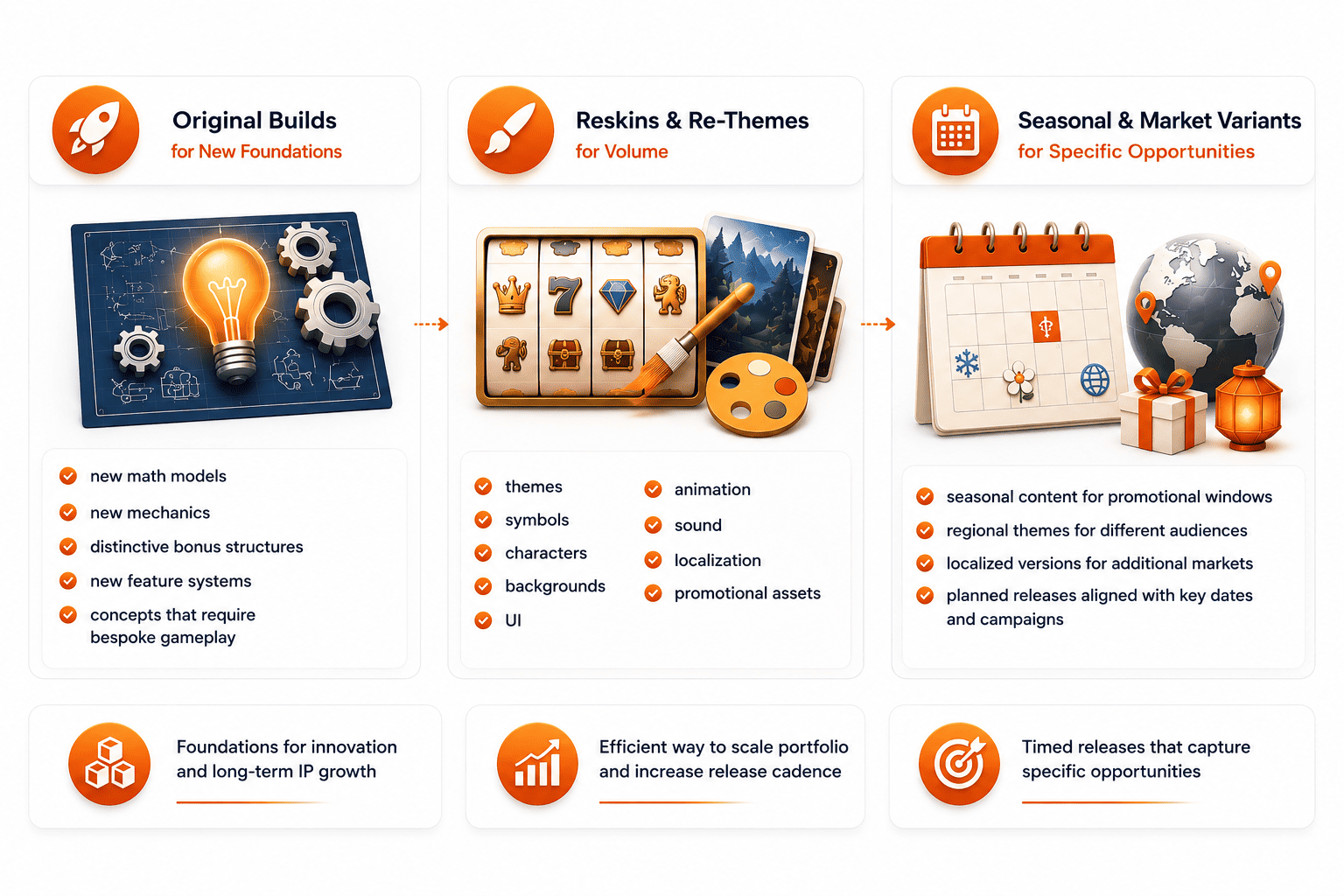
Original Builds for New Foundations
Original games should carry the ideas that cannot be delivered effectively through an existing foundation.
That may include:
- new math models;
- new mechanics;
- distinctive bonus structures;
- new feature systems;
- concepts that require bespoke gameplay;
- strategic titles intended to establish a new game family.
Think of these releases as foundations.
If the mechanic proves useful, that foundation may later support additional themes or market versions.
Math decisions also matter at this stage. For example, volatility influences how wins are distributed and how the game feels over a session. Our guide to what volatility means in slots explains why this mathematical characteristic needs to be considered as part of the underlying game design rather than its visual presentation.
Reskins and Re-Themes for Volume
A reskin starts from a different question:
What if the game underneath the artwork already does what we need?
If the math, RNG, RTP, paytable, mechanics, and game logic remain suitable, the studio can concentrate production on the presentation layer.
Depending on scope, that can include new:
- themes;
- symbols;
- characters;
- backgrounds;
- UI;
- animation;
- sound;
- localization;
- promotional assets.
This turns reskinning into a portfolio tool rather than simply a way to make an old game look different.
The economics are also different. A standard reskin can typically fall around $10,000–$30,000 for budgeting purposes, with production often measured in weeks.
Our reskin vs building a new slot comparison goes deeper into when each production model makes sense across cost, time, risk, and certification.
Seasonal and Market Variants for Specific Opportunities
Not every release needs to remain equally prominent throughout the year.
Seasonal content can support specific promotional windows. Regional themes can adapt a suitable game foundation for another audience. Localized versions can extend a product into additional markets.
These releases work best when they are planned rather than added to the roadmap at the last minute.
A December launch has a fixed deadline. So does content planned around a major regional event or campaign.
The production calendar needs to work backwards from those dates.
How Reskins Multiply Portfolio Output
Reskins change the relationship between game foundations and game releases.
Without reuse, ten releases may require ten independent technical foundations.
With a portfolio model, one successful foundation can potentially support multiple presentations where the mechanic remains appropriate.
For example:
Original Game → New Theme → Regional Version → Seasonal Version
These should not become automatic clones.
Each release still needs a commercial purpose, appropriate art direction, QA, and the necessary compliance review. A mechanic that works with one theme may not fit another, and excessive reuse can make a portfolio feel repetitive.
Art quality is particularly important when the same technical foundation supports multiple titles. A new theme needs more than a palette swap. Symbols, characters, UI, backgrounds, animation, and effects need a coherent visual direction. Our slot game art services cover this production layer, while our overview of slot game art companies explains what to evaluate when selecting an external art partner.
When the fit is real, however, the production advantage can be significant.
The team does not need to recreate math, RNG, paytable logic, and core mechanics solely because it wants another visual concept.
That is the core principle behind planned slot reskins.
Reskins Also Reduce Some Production Uncertainty
A new game asks several questions simultaneously.
Will the mechanic work as intended? Can the engineering support it? Does the math behave correctly? How will the feature interact with the rest of the game? What needs to happen during certification?
A reskin starts with more known components.
For a visual-only project, the math, RNG, RTP, paytable, and core game logic can remain unchanged. This typically creates a lighter compliance path than certifying a completely new title, although the exact requirements still depend on the testing lab, jurisdiction, existing certification, and scope of changes.
Certification still needs to be included in production planning. Our slot certification guide explains the process and the technical and regulatory considerations studios need to account for before release.
This allows teams to concentrate more of the reskin production cycle on creative execution, implementation, and market fit.
Reuse Your Technology, Keep Each Game Unique
Reskinning is only one form of reuse.
The larger velocity advantage comes from designing the entire development pipeline around reusable components.
Studios repeatedly need systems for reels, game states, UI behavior, animations, audio handling, feature logic, localization, device adaptation, integration, and other common requirements.
Rebuilding every shared component for every title creates unnecessary engineering work.
A modular framework allows teams to reuse proven technical components while changing the parts that make the individual game distinct.
The important distinction is that technical reuse should not become creative sameness.
Players do not care that two games share infrastructure behind the scenes. They do care if every game looks, sounds, and feels identical.
A scalable studio therefore standardizes what players do not need to experience as unique while investing creative resources in the areas where differentiation matters.
That can include game mechanics for original releases, themes, characters, feature presentation, animation, audio, and UI identity.
Run Production in Parallel
Technology alone does not create release velocity.
The workflow matters too.
If every department waits for the previous department to finish completely, even a reusable technical foundation can become trapped in a slow production process.
High-output pipelines identify which tasks can safely move in parallel.
For example, after the concept, scope, and technical boundaries are approved, teams may be able to progress simultaneously on:
- symbol and character production;
- UI design;
- animation planning;
- audio;
- localization preparation;
- technical implementation;
- marketing assets.
This requires clear ownership and stable specifications.
Parallel production without coordination creates rework. Parallel production with a defined asset list, approved art direction, technical constraints, and review checkpoints can shorten the overall calendar.
Team structure matters here.
Twin Win Games has 100+ in-house specialists across production disciplines. Keeping game design, art, animation, UI, development, and related capabilities within a coordinated workflow allows multiple projects and production stages to move at the same time.
When external capacity is required, the same principle applies to vendor selection. A production partner needs to understand not only visual delivery but also slot-specific technical boundaries, source ownership, localization, integration, and compliance. Our guide on how to choose a slot reskin studio provides seven practical questions for evaluating potential partners.
This is one of the practical differences between completing individual projects and operating a content pipeline.
Plan the Content Calendar Backwards
A high-output roadmap should start with release objectives, not a queue of game ideas.
Begin with the year.
Identify the markets, promotional periods, strategic launches, and portfolio gaps that matter. Then assign the appropriate production model to each opportunity.
A simple planning sequence looks like this:
1. Map fixed release windows.
Mark seasonal campaigns, market launches, partner commitments, and other dates that cannot move easily.
2. Place original builds first.
They typically require the longest lead times and carry the most production uncertainty.
3. Add reskins around proven foundations.
Use shorter production cycles to expand themes, markets, or portfolio coverage.
4. Reserve capacity for localization and seasonal variants.
Do not assume these are zero-effort extensions.
5. Build in QA and compliance time.
A finished art package is not the same as a launch-ready game.
6. Leave production capacity for change.
A calendar operating at 100% theoretical capacity has no room for approvals, revisions, integration issues, or shifting commercial priorities.
The objective is a predictable release cadence, not a calendar that works only when nothing goes wrong.
Looking at how established slot game companies structure their products and capabilities can also help teams benchmark where their own portfolio needs original innovation and where production efficiency matters more.
A Practical 10+ Game Portfolio Mix
There is no universal ratio of originals to reskins.
A studio focused on experimental mechanics may need more original development. An operator expanding quickly across several markets may get more value from reusable foundations and localized variants.
Still, a hypothetical annual mix shows how the model works.
| Production Type | Example Annual Mix | Strategic Role |
| Original builds | 3 | Create new mechanics and foundations |
| Full thematic reskins | 4 | Extend proven games into new concepts |
| Regional variants | 2 | Adapt suitable titles for target markets |
| Seasonal versions | 2 | Support fixed promotional opportunities |
| Total releases | 11 | Mixed production portfolio |
This is an example framework, not a recommended quota.
The important point is that 11 releases do not necessarily require 11 completely new games.
Three original games can create technical and mechanical foundations. Selected foundations can then support additional releases when there is a genuine theme, market, or promotional reason to reuse them.
The result is a portfolio that directs the largest development investment toward projects that actually require it.
Twin Win Games produces 100+ slots a year. At that scale, reusable technology, structured pipelines, and parallel production are operational requirements rather than optional optimizations.
FAQ
How do studios release 10+ casino games a year?
Studios increase output by combining original development with reusable technology, established production frameworks, reskins, regional variants, and parallel workflows. The key is deciding which releases genuinely need a new technical foundation and which can reuse proven components without compromising the product.
Do reskins help scale a casino game portfolio?
Yes, when an existing mechanic is suitable for another theme, market, or release opportunity. A reskin can preserve the math, RNG, RTP, paytable, and core game logic while replacing the presentation layer. This reduces the amount of new production required for each additional title.
Is it cheaper to reskin or build new when producing games at volume?
Typically, reskinning costs less when a suitable technical foundation already exists. For budgeting, a standard reskin can fall around $10,000–$30,000, compared with approximately $35,000–$200,000+ for an original slot build depending on complexity.
Our slot game reskin cost breakdown explains the main factors behind those ranges, including art complexity, animation, UI, localization, and integration.
How long does a slot reskin take?
A slot reskin is typically measured in weeks rather than the months associated with original development. The actual schedule depends on art complexity, asset volume, animation, UI, audio, localization, integration, approvals, QA, and compliance requirements.
Scale the Portfolio Without Rebuilding Everything
To scale a casino game portfolio, do not start by asking how your team can build 10 completely original games faster.
Start by deciding which of those 10 games actually need to be original.
Invest in new development where new math, mechanics, or gameplay create meaningful product value. Use reskins when a proven foundation deserves another theme or market opportunity. Reuse technical frameworks where players gain nothing from rebuilding them. Plan seasonal and regional releases around the calendar rather than treating them as last-minute additions.
That combination turns content velocity into a production strategy instead of a race against deadlines.
Twin Win Games has 13+ years in game development, 1,000+ games released, 198+ clients worldwide, 100+ in-house specialists, and production capacity of 100+ slots a year.
If you want to increase release cadence using existing game foundations, discuss planned reskins with Twin Win Games. We can review your portfolio, identify suitable reskin candidates, and define a production scope around your release roadmap.