Quick answer: AI in slot game development speeds up how games are made, mainly in art and code, while people stay in charge of every decision. At Twin Win Games, AI-led art levels save up to 65 to 75% of image production time compared with fully manual art, and AI-assisted front-end development is up to 2.5 times faster. AI never touches a game’s math, RNG, or outcomes, which stay certified.
What Is AI in Slot Game Development?
AI slot game development is the use of artificial intelligence in producing slot games: generative AI for concepts and rendering, and AI coding assistants for tests, refactoring, and feature code. It speeds up production. It does not change how a certified slot pays, since outcomes still come from a certified RNG and a validated math model.
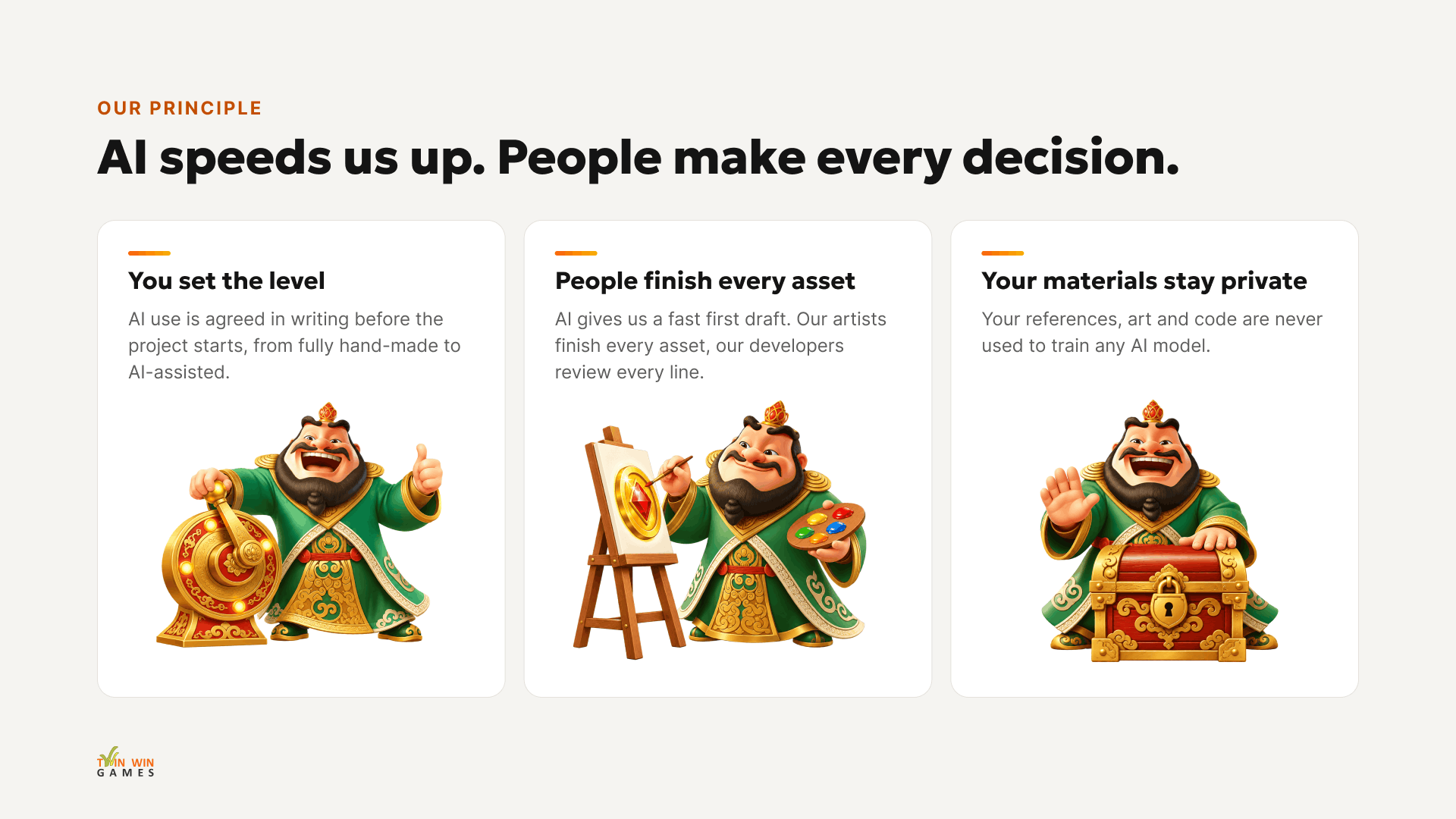
In a regulated real-money product, the useful question is where AI belongs, who stays in charge, and where AI has no place at all. Our answer starts with one principle: AI speeds us up. People make every decision.
Our Principle in Three Commitments
You set the level. How much AI goes into your project is agreed in writing before work starts, from fully manual production to AI-assisted.
People finish every asset. AI gives us a fast first draft. Our artists finish every asset, and our developers review every line of code.
Your materials stay private. Your references, art, and code are never used to train any AI model.
Where Does AI Speed Up Slot Production?
We use AI in two parts of slot production:
- Art, across six levels, from fully manual production to AI-led. Every final asset is checked by our artists.
- Code, with Claude as an engineering assistant, across five levels, from research only to full co-pilot. Every change is reviewed and tested by our developers.
The levels for art and code are chosen separately, so a project can combine AI-led art with hand-written code, or the other way round.
How Is AI Used in Slot Art?
Our slot game art pipeline offers six levels of AI involvement. They differ in who handles each stage: the concept, where the design and visual direction are found and approved; the render, which works out forms, materials, light, and detail; and finalization, the final polish and the removal of defects.
| Level | Approach |
|---|---|
| 0 | Fully Manual Production |
| 1 | Artist Concepts and Manual Polish |
| 2 | AI Concepts and Manual Production |
| 3 | Artist Concepts and AI Production |
| 4 | AI with Manual Polish |
| 5 | AI with Technical Retouching |
The savings grow as AI takes on more of the work: from around 20% of image production time at Level 1 to 65 to 75% at Level 5, compared with fully manual art of the same scope and complexity. They apply primarily to image creation. Technical work is scoped separately, and we confirm timelines after reviewing your brief.
Our team leads at every level. Our art director sets the direction, selects the strongest options, and makes sure the limits of your chosen level are followed. AI never decides on its own. The level defines how the art is produced, and the final look is agreed separately on a test asset.
AI-led levels can still have a distinctive style. Art direction, carefully chosen references, iterations, and a consistent asset set make that possible. Generative AI works best on classic themes with a clear market reference, such as myths and legends or Egypt, while original or mixed styles are better served by the levels where artists lead.
How the fastest levels work
At Levels 4 and 5, production runs in three steps:
- Brief and reference. Our art director writes the brief from a market reference, covering style, theme, and sizes.
- Mockup in 24 hours. Concepts for every asset arrive within a day, followed by art director feedback on the whole mockup.
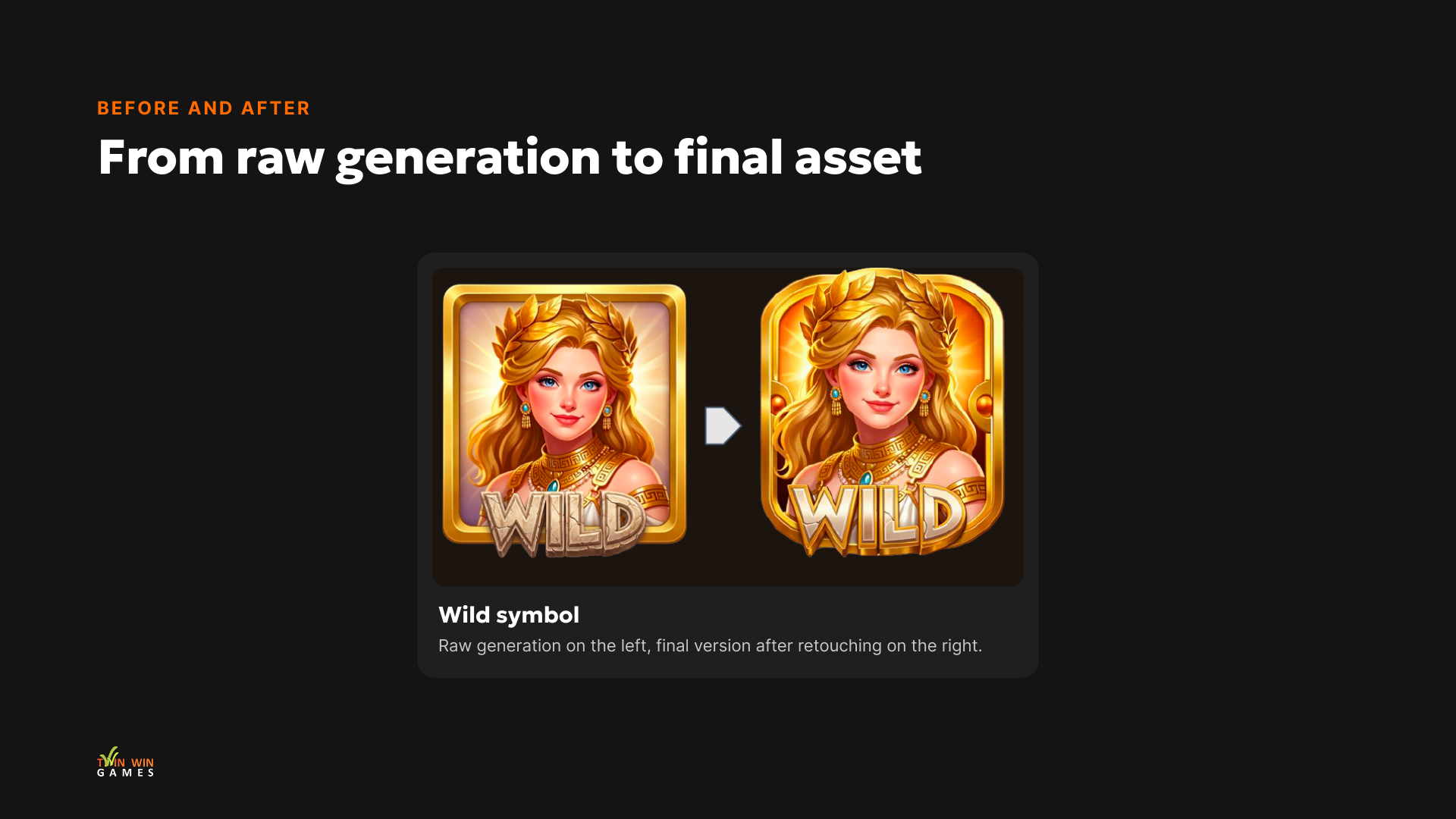
- Retouching and upscaling. Our artists fix defects, correct color, unify frames, and upscale every asset.
The result is a full concept set for your theme within 24 hours, one consistent style across the whole game from the first delivery, and an earlier release. We have tested this pipeline on three commercial projects and on our own internal asset packs.
How Is AI Used in Slot Game Code?
On the code side, clients choose one of five levels:
- Level 0, No AI. All code is written by hand.
- Level 1, Research only. Claude advises on patterns and logic, and no AI-generated code enters your repository.
- Level 2, Snippets. Small, isolated helpers, reviewed and integrated by hand.
- Level 3, Components. Automated testing, refactoring, debugging, and isolated modules.
- Level 4, Co-pilot. Claude works with full project context, for the fastest delivery, if your policy allows it.
At every level, our developers review, test, and own every line that goes into your project.
The biggest gains come from combining AI with our proprietary game engine. The engine already provides the foundation almost every slot needs, from spin flow and win presentation to recovery and the build pipeline, so AI works on top of a ready structure. Together, they make front-end development up to 2.5 times faster.
What Stays Human?
Art direction. On every level, our art director sets the direction and checks every result.
Finished assets. AI produces drafts. Depending on the level, our artists retouch or hand-polish every asset before it is delivered.
Architecture and code ownership. Our developers design the architecture, and review, test, and own every line of AI-assisted code.
Game logic, math, and RNG. The math model is designed by our mathematicians and validated across a minimum of one billion simulated rounds for every RTP version. The logic that applies it stays entirely in human hands.
Can AI Change Slot Outcomes or RTP?
No. In a real-money slot, the outcome of every round is decided by a certified random number generator on the remote game server, using probabilities the math model defines. Testing laboratories certify exactly that.
AI plays no part in deciding outcomes. It does not adjust odds, tailor results to a player, or change how a game pays. A game’s RTP comes from the certified version the operator runs in its market, and any change to that version is a configuration decision governed by the market’s rules, made outside any AI model. A system that changed odds for individual players would break the certification the game depends on, and the trust players place in it.
How Is AI Used in Slot Games After Launch?
Once a slot is live, AI is mostly the operator’s tool, and it works on the operator’s platform around the game. Operators use machine learning for game recommendations, the timing of promotions, fraud and bonus abuse detection, and responsible gambling monitoring that spots risky play early.
All of this shapes what a player is shown and how the platform responds. None of it reaches inside a certified game. The reels, the math, and the RTP stay exactly as certified. Our guide to casino game analytics covers how operators use player data responsibly.
Your Data and Your IP
Your code stays your code. We use Claude through Anthropic’s Team plan, under Anthropic’s Commercial Terms. By default, Anthropic does not use inputs or outputs from commercial products to train its models. Project chats are kept only in our workspace while we need them, and once deleted, they are removed from Anthropic’s systems within 30 days. Our team does not send feedback to Anthropic on client projects.
You own the result. All art and code we deliver, with or without AI assistance, is transferred to you under our contract, the same way as fully manual work.
You can rule out specific models. If your policy puts certain AI models off-limits, tell us which, and we will not use them on your project.
Prefer No AI? Choose Level 0
Level 0 is always available, for art and for code. Our 45+ artists and animators create every image without generative AI, and our developers write every line of code by hand. It is the same team and the same quality, on the timeline of a traditional pipeline.
Questions Worth Asking Any Studio About AI
- Where in the pipeline do you use AI, and where do you not?
- Who reviews AI-assisted work before it is delivered?
- Does AI touch the math, the RNG, or the game logic?
- Is our material used to train AI models?
- Who owns AI-assisted art and code?
- Can we choose how much AI is used on our project?
A studio that answers all six clearly is using AI responsibly.
Frequently Asked Questions
Does AI decide the outcome of a slot game?
No. Every outcome is decided by a certified RNG on the server, using a math model designed and validated by mathematicians. AI plays no part in how outcomes are decided.
Does AI change a slot’s RTP?
No. A slot’s RTP comes from its certified math and the RTP version the operator runs in its market. AI tools used in production or on an operator’s platform do not adjust RTP or odds for individual players.
How is AI used in slot games after launch?
Operators use AI on their platforms for game recommendations, promotion timing, fraud detection, and responsible gambling monitoring. These tools shape what players are shown. They do not change the certified game itself.
Can we choose how much AI is used on our project?
Yes. You choose the level separately for art, from Level 0 to Level 5, and for code, from Level 0 to Level 4. The level is agreed in writing before the project starts, and Level 0 means fully manual work.
Does AI replace game artists?
No. Our art director leads every level, and our artists finish every asset. AI speeds up concepts and drafts. For original or mixed styles, artists lead the work.
Is our code or art used to train AI models?
No. Your references, art, and code are never used to train any AI model. For code, we use Claude through Anthropic’s Team plan, under Anthropic’s Commercial Terms, which by default excludes commercial inputs and outputs from model training.
Who owns art and code created with AI assistance?
You do. All art and code we deliver, with or without AI assistance, is transferred to you under our contract, the same way as fully manual work.
How much faster is AI-assisted slot development?
In art, AI-led levels save up to 65 to 75% of image production time compared with fully manual art of the same scope. In code, AI combined with our engine makes front-end development up to 2.5 times faster.
Get the Full Picture
This article covers the principles. Our full AI in Our Production presentation goes further: every art level in detail with timelines, which level fits which kind of project, our working rules and approval stages, the themes and styles where AI-led art works best, and more before-and-after examples.
Request the presentation, or tell us your AI policy, and we will match the pipeline to it. You can also explore our slot game development services.